


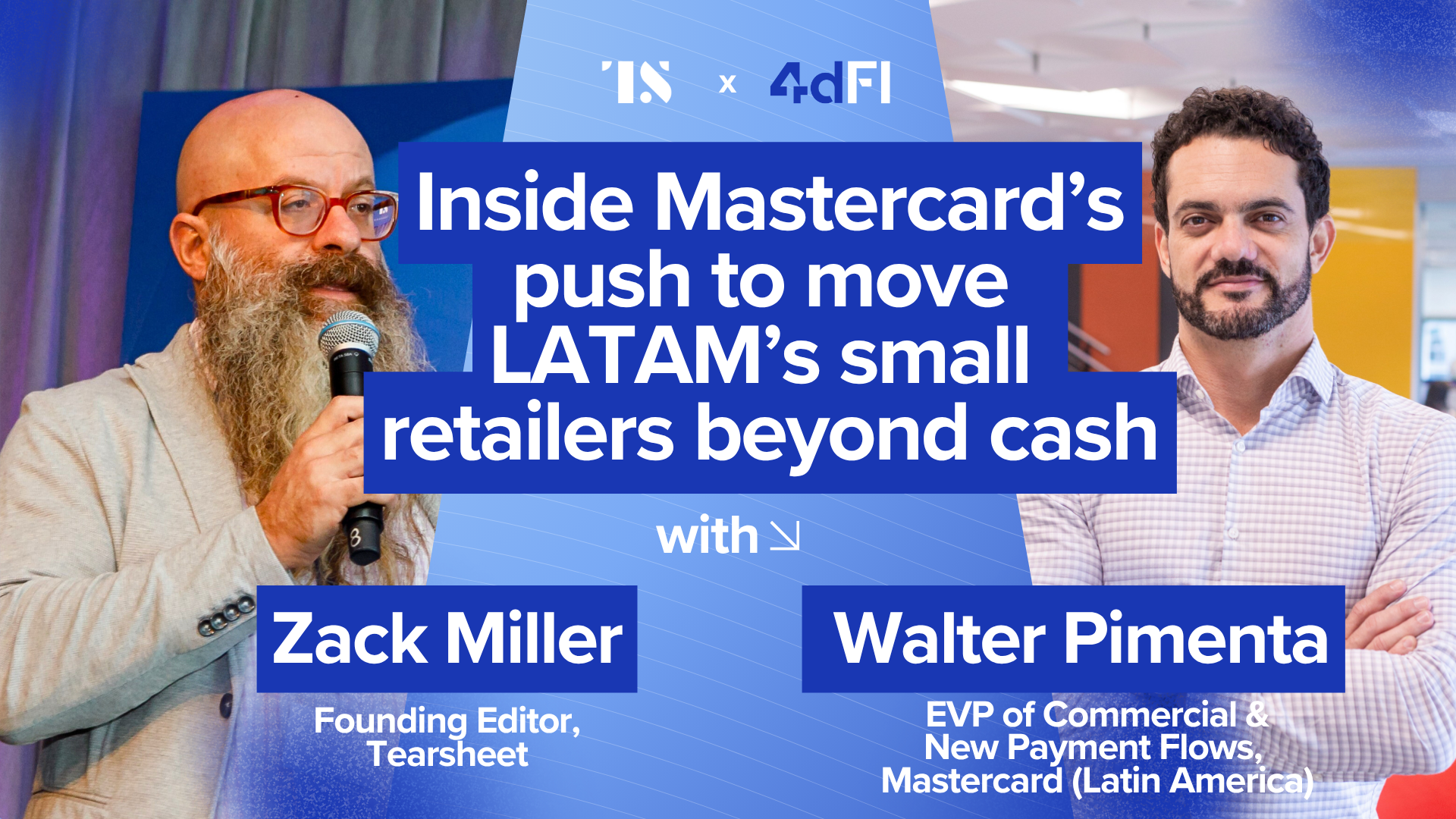
Inside Mastercard’s push to move LATAM’s small retailers beyond cash
- In Latin America, 43% of small retail transactions and 90% of B2B payments still happen in cash.
- Walter Pimenta, Executive Vice President of Commercial and New Payment Flows for Mastercard Latin America, joins us to discuss how his team is driving digital adoption while tackling the cybersecurity challenges that have already hit 46% of small businesses in the region.
Tearsheet is excited to launch 4dFI Capital Partners, an exclusive group of out-of-the-box builders and investors building a community to invest in the next wave of fintech startups around the world. If you are an accredited investor and want to learn more, sign up here
Across Latin America, we’re witnessing a massive shift as regions traditionally dominated by cash transactions begin embracing digital financial tools. This transition represents more than just technological adoption—it’s creating new economic opportunities, enhancing financial inclusion, and building resilience against growing cybersecurity threats.
The numbers tell a compelling story: a $448.4 billion digital payment opportunity exists across Latin America, the Caribbean, and the U.S. With nearly 12 million small retailers processing $362 billion in B2C sales — 43% still in cash —a nd 90% of B2B transactions between small retailers and suppliers handled through traditional methods, we’re looking at a financial transformation that’s just beginning.
Today, I’m joined by someone at the forefront of this transition. Walter Pimenta serves as Executive Vice President of Commercial and New Payment Flows for Mastercard Latin America, where he’s leading initiatives to expand SME acceptance solutions, scale enablement through strategic partnerships, and strengthen cross-border payment capabilities.
Walter’s team is also tackling another critical trend: the growing cybersecurity challenges facing SMEs, with recent research showing 46% of small businesses have experienced cyber-attacks, resulting in bankruptcy for nearly 1 in 5 affected companies.
Listen to the full episode
Subscribe: Apple Podcasts I SoundCloud I Spotify
Watch the full episode
Diverse markets, Diverse needs
The LATAM region is not a single, uniform market. Mastercard operates across 44 different markets in Latin America. Each country brings its challenges and opportunities. “PC and digital penetration vary widely—from high levels in Brazil and Chile to lower levels in places like Mexico,” Pimenta notes.
This means small business digitization cannot take a one-size-fits-all approach. Some SMEs need basic tools to begin accepting digital payments. Others are already looking for ways to optimize global supply chains and expand their e-commerce footprint. Mastercard addresses this spectrum by providing region-specific SME solutions. It also enables local financial institutions to better serve their markets.
Meeting SMEs where they are
Small businesses in LATAM fall into distinct categories. From individual entrepreneurs and micro merchants to more complex middle-market enterprises, each group has unique financial and operational needs.
Micro merchants often struggle with digital literacy and the cost of accepting digital payments. For them, solutions like Tap on Phone, which turns a smartphone into a payment terminal, can be a game changer. “We’ve eliminated the need for expensive hardware,” says Pimenta. “Now, any NFC-enabled phone can become a secure payment device.”
At the other end of the SME spectrum, middle-market businesses often need support for cross-border payments. It also includes ERP integration and advanced cash flow management tools. “These companies behave like large corporations. And they need systems to manage suppliers, inventory, and payments with scale,” he explains.
CPG partnerships as an on-ramp to digital
Consumer Packaged Goods (CPG) companies are becoming a vital entry point to financial inclusion. Pimenta explains how Mastercard is working with major CPG players. The aim here is to digitize their distribution and payment systems, streamlining the value chain.
Many of these CPGs sell directly to mom-and-pop stores that still rely heavily on cash. This creates inefficiencies for both parties. “The inefficiencies of cash fraud, security are costly for everyone involved,” Pimenta says.
Mastercard is digitizing order placement (through platforms like WhatsApp). It also enables digital payments via smartphones. And, it issues prepaid cards through fintech partners like Migo. “We’re digitizing both the sales and the settlement process,” he adds.
Navigating cybersecurity challenges
The move to digital opens LATAM SMEs to new threats, particularly around cybersecurity. Mastercard research shows that 46% of small businesses in the region have experienced cyber attacks. Many of them face devastating consequences.
To address this, the company is rolling out tools like My Cyber. It is a solution designed to help businesses identify and resolve vulnerabilities in their digital storefronts. “Cybersecurity cuts across all SME segments. We have a responsibility to protect them as we digitize them,” says Pimenta.
Education is also a core focus. Mastercard is building tools to help small businesses go digital. These platforms focus on keeping their operations secure.
Cross-Border Payments fueling growth
LATAM businesses are becoming more globally connected. Cross-border payments also play a crucial role. “Small businesses today want to buy from suppliers overseas. Sometimes it’s cheaper, sometimes better quality,” Pimenta says.
However, traditional international payment systems can be slow, opaque, and expensive. Mastercard’s Move platform aims to streamline this process by enabling faster, more transparent cross-border payments — through local rails, supporting transactions to over 200 markets globally. “We can now deliver transactions to almost any endpoint, account or card,” he says.
The Big Ideas
- Small businesses are the economic core of LATAM. “In LAC, 99% of the businesses are small businesses… the economic engine.” Small businesses are not a niche—they are the foundation of the region’s economy.
- Digitization looks different across LATAM. “It’s a very diverse region… from a cultural and financial point of view.” Each market requires tailored SME solutions based on digital readiness.
- CPG companies are natural partners for driving change. “CPGs have a direct relationship with micro merchants… and share the pain of cash.” By digitizing CPG supply chains, Mastercard helps both vendors and retailers benefit.
- Cybersecurity must grow with digital adoption. “We have a responsibility… and we have the technology to help them.” Tools like My Cyber are helping SMEs protect themselves as they move online.
- Cross-border capabilities are essential to SME growth. “Small businesses today want to buy from suppliers overseas.” Solutions like Mastercard Move reduce friction in global transactions.