


Over and Underhyped: The banking trends we’re getting wrong
- In Episode 2 of The Editors’ Room, Sara and Zack each pick one trend they think the financial industry is getting wrong – one overhyped and one underhyped.
- Sara looks at the fight for primary financial relationships, while Zack makes the case for why bank branches still have an important role to play in an increasingly digital banking landscape.
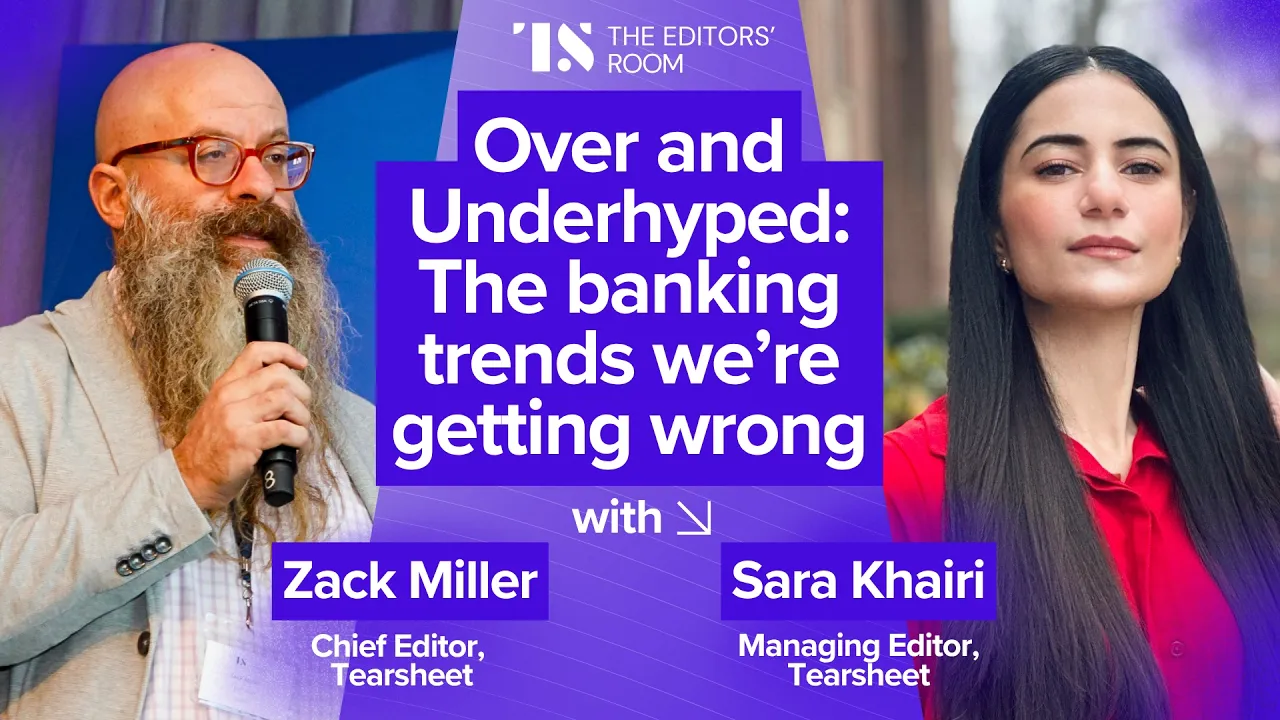
Welcome to The Editors’ Room [TER], a new Tearsheet Podcast series where Editor-in-Chief Zack Miller and Managing Editor Sara Khairi take the conversations that usually happen behind the scenes about our biggest stories and put them on the record.
This isn’t a rehearsed interview or carefully choreographed panel answers. It’s just two editors comparing notes, challenging each other’s takes and trying to make sense of what is actually happening in financial services. Think of it as pulling up a chair after the meeting ends.
It’s the stuff we usually debate after the calls end: what a new product actually means, which industry trends have legs, and where the hype gets ahead of reality. Raw, conversational, and occasionally accompanied by a blooper.
For the second episode, we flipped the format around. One trend we think the industry is overhyping, and one that isn’t getting nearly enough attention.
Sara took the overhyped side: the race to become a customer’s primary financial relationship.
Zack’s underhyped pick was something that gets little attention in the larger scheme of things: the continued importance of bank branches.
Watch the episode
Listen to the full podcast
Subscribe: Apple Podcasts I SoundCloud I Spotify
Customers don’t need one bank for everything
Banks have spent years trying to become the one institution customers use for everything – deposits, cards, lending, investments, and payments.
Sara isn’t convinced that’s where customer relationships are heading.
Customers are increasingly choosing providers by use case. One company handles deposits, another lending, another international money movement, or investing. The unbundling of banking created that behavior, and even as financial services move toward rebundling, customers still have plenty of reasons to pick the best provider for each job.
Zack offered Wise as an example. He uses it for international money transfers, where he thinks it excels. But that doesn’t mean he would choose Wise for investing.
That gets to Sara’s bigger point: adding products doesn’t automatically create loyalty or more ownership of a customer relationship. Expanding into adjacent businesses can make sense when those products complement what a company already does well. But adding products just to capture more of the customer’s wallet can also introduce added complexity, increase costs, dilute what made the company valuable in the first place, and, more importantly, push firms into businesses they aren’t particularly good at.
If primacy is becoming harder to achieve, Sara sees another way to think about differentiation: embeddedness. You don’t necessarily need to be the customer’s only or primary financial services provider. You need to become difficult to replace within something that matters.
The question, then, isn’t how many products a financial institution can put under one roof. It’s what makes its product(s) indispensable to both the customer and the broader ecosystem – through trust, data, security, distribution, familiarity, or simply being exceptionally good at one critical job.
The continued relevance of bank branches
Zack’s underhyped trend sounds almost contradictory to everything happening in digital banking: branches.
The number of U.S. bank branches has increased for the first time in 17 years, with roughly 120 net new branches added over the last three quarters. Zack points out that 64% of banking consumers still rely on branches for conflict resolution when they can’t find a way to resolve an issue online. Think about a complicated mortgage issue, a high-stakes financial problem, or a situation where a customer simply wants to sit across from another human being.
That’s why he sees branches and digital as complementary, not competing channels. It’s digital and branches, rather than digital vs. branches.
Bank of America, for example, has surpassed 50 million active digital users while continuing to expand its branch footprint. Large banks and regionals, including PNC, Truist, and Fifth Third, are also growing their physical presence in high-growth markets.
The role of the branch is changing, too. It’s less about processing routine transactions and more about handling the situations that require trust, reassurance, and human judgment. And that may become even more important as banking gets more automated. As AI takes over more routine interactions, the moments that genuinely need a human being could become more valuable, not less.
That brings the two sides of the conversation together: banking may not be about owning everything anymore. It may be about knowing where you are indispensable and where customers still need you to be there.