
Partner, Podcasts

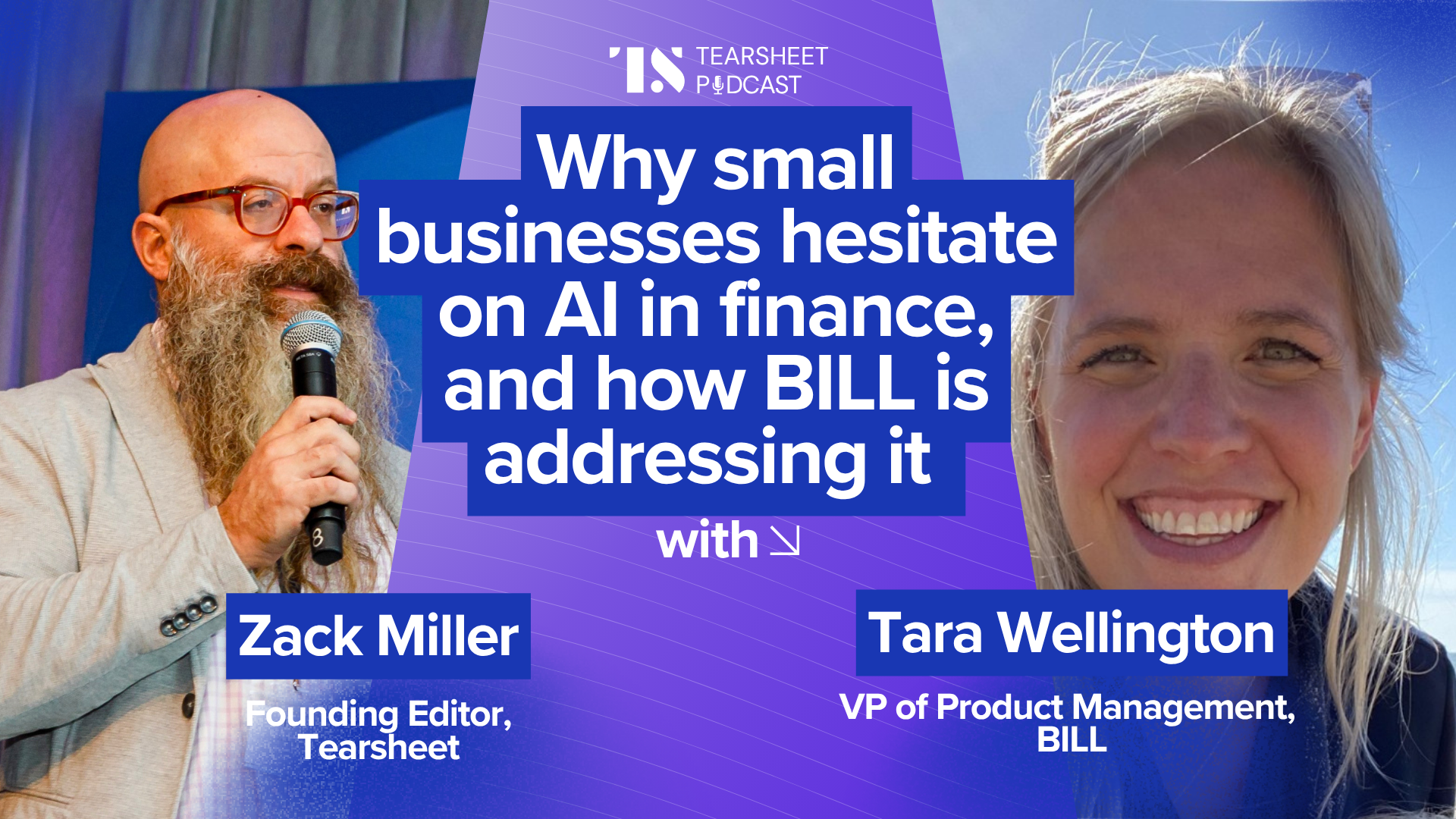
Why small businesses hesitate on AI in finance, and how BILL is addressing it

  • Small and midsize businesses want the time and cost savings AI can offer, but hesitate to hand over their financial operations, so BILL built its new AI suite around three pillars: accuracy, control, and security.
  • According to BILL’s Tara Wellington, the company’s own risk platform saw about $1.5 BILLion in potentially risky or mistaken payments last year. For her, that kind of data is what lets the risk agent flag issues at the moment they matter, helping keep operations moving smoothly.
close

Email a Friend

Why small businesses hesitate on AI in finance, and how BILL is addressing it

At Money 2020, BILL announced it had surpassed $2 trillion in cumulative payment volume and unveiled a suite of AI tools for finance teams. Tara Wellington, the company’s VP of Product Management, says the launch was shaped by a tension she hears constantly from customers. Small and lower mid-market businesses are eager for the time and cost savings AI promises, but their finances are “at the heart of everything” they do, so hesitancy runs high. For these businesses, a single payment error or missed invoice can ripple through cash flow, vendor relationships, and payroll, so there’s little room to experiment. Which is why trust has to be earned before AI automation feels safe

Wellington notes BILL AI is designed to reduce this anxiety, with the suite built around three pillars of accuracy, control, and security.

The need for control, she explains, comes straight from customer conversations, where trust means being able to see what has been done and decide what AI can do. BILL built safeguards into the product, such as a hub with  full audit logs of the actions AI takes, plus the ability to switch AI features on or off. 

On security, Wellington points to BILL’s’s Risk Intelligence, which uses the company’s payment data to spot anomalies, such as a vendor that normally bills $1,000 a month suddenly billing $10,000. The AI flags the unusual charge for review before money goes out the door, catching mistakes before they cost the business—while a human stays in the loop on the decisions that matter.

BILL’s own risk platform saw roughly $1.5 BILLion in potentially risky or mistaken payments last year.  Between August and September 2026, Risk Intelligence has autonomously detected an average of about $138,000 of mistakes or unusual payments per customer.

Key insights

  • Interest in AI is high, but confidence depends on proof that it won’t create costly surprises.
  • Audit logs, on/off toggles, and human-in-the-loop options keep customers in charge.
  • Flagging mistakes pre-payment protects cash and saves time spent unraveling  problems later.
  • Payment history helps the platform recognize unusual activity within each vendor relationship.
  • Businesses should define what trust means to them and look for solutions that prioritize security, control, and accuracy.

0 comments on “Why small businesses hesitate on AI in finance, and how BILL is addressing it”

Partner Content, Podcasts

What Bluevine learned from $2 billion in mobile check deposits and a growing partner stack

  • Bluevine’s SVP and GM of checking and payments explains how the digital bank decides which jobs to take on for small business owners, and what it takes to make a partner's product feel like its own.
  • Cooper also discusses what Bluevine learned from processing more than $2 billion in mobile check deposits without branches, and why he expects most owners to choose the provider they trust over the best tool for every task.
Zack Miller | November 05, 2026
Opinion, Podcasts

If you disappeared tomorrow, would your customers care?

  • In Episode 3 of TER, Sara and Zack discuss what makes a fintech indispensable and which companies could disappear without customers noticing much of a difference.
  • Zack picks PayPal for its role in opening up online commerce. Sara names Wise and Stripe, where value comes from solving recurring problems and becoming embedded in business operations.
Sara Khairi | November 04, 2026
Partner Content, Podcasts

Banks look to close the expectation gap with data, real-time infrastructure, and human judgment

  • Executives from Regions Bank and Temenos explain how a bank’s data, real-time infrastructure, and AI controls, combined with human judgment, can close the gap between what customers expect and what banks deliver, from personalized advice to payments.
  • They discuss how Regions is applying generative AI with people in the loop, why security and convenience anchor its payments strategy, and what it takes to earn a larger share of a customer’s financial life.
Zack Miller | November 03, 2026
Partner, Podcasts

Why B2B payments are a whole-journey problem ft. TreviPay

  • Digital-native buyers are rewriting the rules of B2B payments, demanding consumer-grade convenience, flexible terms, and openness to stablecoins and AI, while sellers race to keep their best customers happy under tight credit conditions
  • TreviPay’s Allen Bonde explains why today’s AI mostly assists rather than replaces human buyers, and what it will take for banks, networks, and fintechs to build the shared infrastructure that could change that.
Rabab Ahsan | October 21, 2026
Banking, Partner, Podcasts

Why Salient bet everything on auto lending and never looked back

  • Salient’s CEO Ari Malik bet everything on auto lending, relocated to sit next to a single customer, and now says the company has never lost a client among the roughly half of the top 20 lenders it serves.
  • Malik breaks down, how AI voice agent grew into a full compliance and loss-recovery stack, why big banks are adopting AI faster than smaller fintechs, and the company got here without a sales team.
Rabab Ahsan | October 13, 2026
More Articles