
Partner, Podcasts

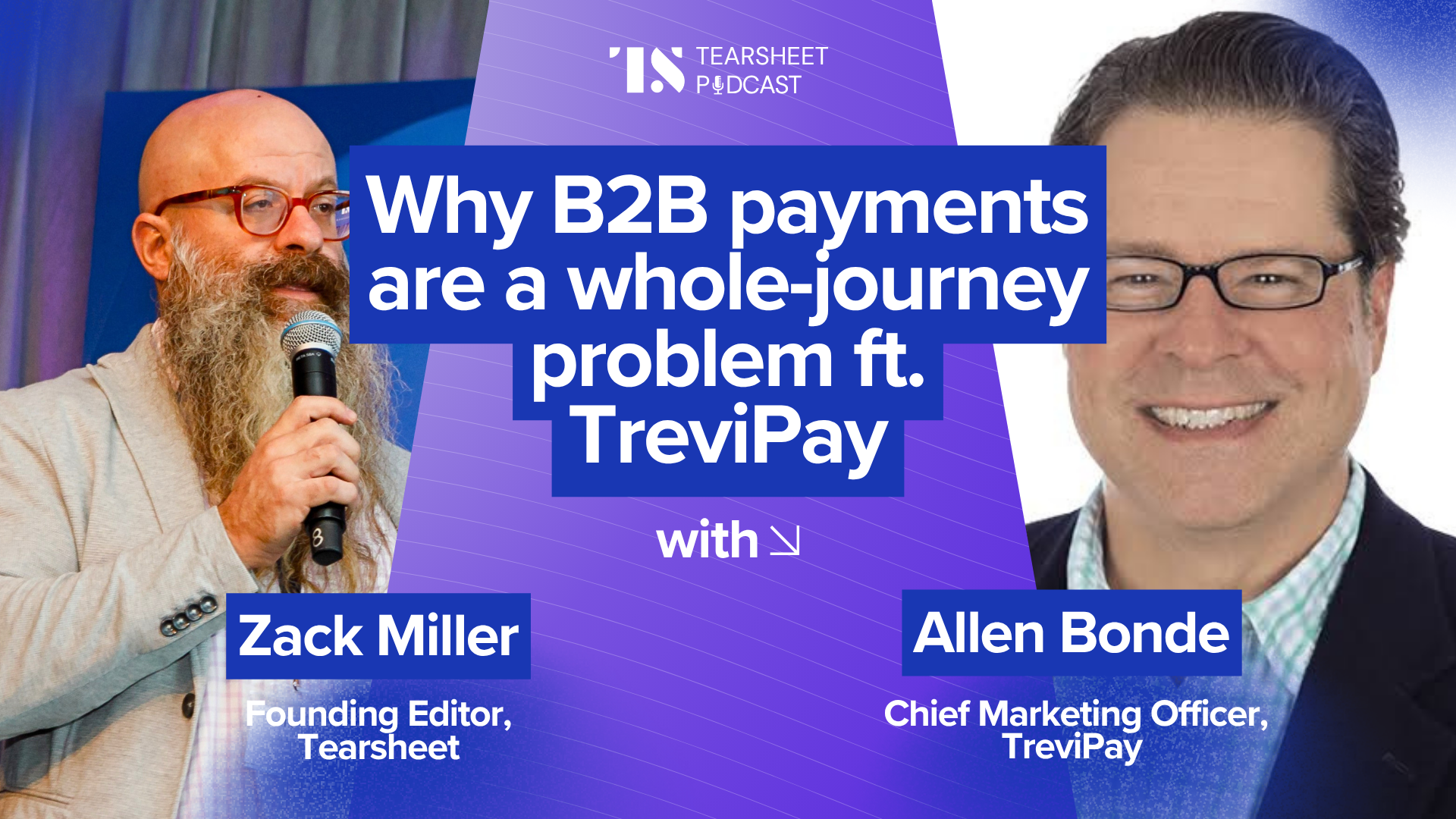
Why B2B payments are a whole-journey problem ft. TreviPay

  • Digital-native buyers are rewriting the rules of B2B payments, demanding consumer-grade convenience, flexible terms, and openness to stablecoins and AI, while sellers race to keep their best customers happy under tight credit conditions
  • TreviPay’s Allen Bonde explains why today’s AI mostly assists rather than replaces human buyers, and what it will take for banks, networks, and fintechs to build the shared infrastructure that could change that.
close

Email a Friend

Why B2B payments are a whole-journey problem ft. TreviPay

Allen Bonde, Chief Marketing Officer at TreviPay, argues that a new generation of digital-native buyers is the biggest force reshaping how businesses buy and pay. Accustomed to frictionless consumer experiences, they expect the same convenience and omnichannel consistency from their suppliers. They are also more open to alternatives like stablecoins, net terms modeled on consumer BNPL, and AI as a co-creator. Sellers, meanwhile, are working to retain and keep their best customers happy in a tight macro environment, where the cost of capital puts pressure on businesses to extend credit and get paid faster.

Most AI in B2B today plays a supporting role, helping with credit decisions, research, and price checks, rather than enabling fully autonomous, agent-to-agent buying, according to Bonde. The challenge is adapting consumer-oriented agentic models to B2B’s complexity, which includes contract pricing, flexible payment terms, and country-specific compliance. That, he says, demands shared infrastructure built through partnerships with payment networks and banks, an approach that also underpins TreviPay’s Crossroads B2B Payments Conference in Kansas City November 8-10th.

Key insights

  • Trevipay’s research with Murphy Research shows that payment choice builds loyalty, but it only lasts if suppliers improve purchasing, invoicing, and collections.
  • Today’s AI agents mainly support humans, with greater autonomy most plausible for routine purchases like replenishment.
  • Loyalty, payment choice, and good experience matter whether or not bots are involved.
  • Marketers need to feed generative AI engines accurate information about their products, values, and differentiators, much as they once optimized content for SEO.
  • Buying groups, varied payment methods, settlement, and VAT collection explain why B2B hasn’t adopted these models yet.
  • Banks, payment networks, and fintechs need to build shared infrastructure together to make these models work at scale.

0 comments on “Why B2B payments are a whole-journey problem ft. TreviPay”

Blockchain and Crypto, Partner, Podcasts

At Stellar’s Meridian conference, Anthony Scaramucci tells banks to “kill the iPod in your business”

  • Anthony Scaramucci wants the 10 largest U.S. stocks on chain first, because equities will draw the attention that pulls the rest of the market along.
  • The SkyBridge founder expects SEC guidance to matter more than legislation and urges bank product leaders to retire their own best-selling products.
Rabab Ahsan | November 10, 2026
Partner Content, Podcasts

What Bluevine learned from $2 billion in mobile check deposits and a growing partner stack

  • Bluevine’s SVP and GM of checking and payments explains how the digital bank decides which jobs to take on for small business owners, and what it takes to make a partner's product feel like its own.
  • Cooper also discusses what Bluevine learned from processing more than $2 billion in mobile check deposits without branches, and why he expects most owners to choose the provider they trust over the best tool for every task.
Zack Miller | November 05, 2026
Opinion, Podcasts

If you disappeared tomorrow, would your customers care?

  • In Episode 3 of TER, Sara and Zack discuss what makes a fintech indispensable and which companies could disappear without customers noticing much of a difference.
  • Zack picks PayPal for its role in opening up online commerce. Sara names Wise and Stripe, where value comes from solving recurring problems and becoming embedded in business operations.
Sara Khairi | November 04, 2026
Partner Content, Podcasts

Banks look to close the expectation gap with data, real-time infrastructure, and human judgment

  • Executives from Regions Bank and Temenos explain how a bank’s data, real-time infrastructure, and AI controls, combined with human judgment, can close the gap between what customers expect and what banks deliver, from personalized advice to payments.
  • They discuss how Regions is applying generative AI with people in the loop, why security and convenience anchor its payments strategy, and what it takes to earn a larger share of a customer’s financial life.
Zack Miller | November 03, 2026
Partner, Podcasts

Why small businesses hesitate on AI in finance, and how BILL is addressing it

  • Small and midsize businesses want the time and cost savings AI can offer, but hesitate to hand over their financial operations, so BILL built its new AI suite around three pillars: accuracy, control, and security.
  • According to BILL’s Tara Wellington, the company’s own risk platform saw about $1.5 BILLion in potentially risky or mistaken payments last year. For her, that kind of data is what lets the risk agent flag issues at the moment they matter, helping keep operations moving smoothly.
Rabab Ahsan | October 22, 2026
More Articles