


Fifth Third Bank’s approach to retooling Jeanie into an intent-driven assistant
- Fifth Third rebuilt its Jeanie chatbot in-house, raising self-service containment from 3% to 42% and intent recognition from about 20% to 87%.
- Fifth Third builds its app and deposit system in-house, buys back-office software, and its CIO predicts Jeanie will handle everyday tasks within 3-5 years.
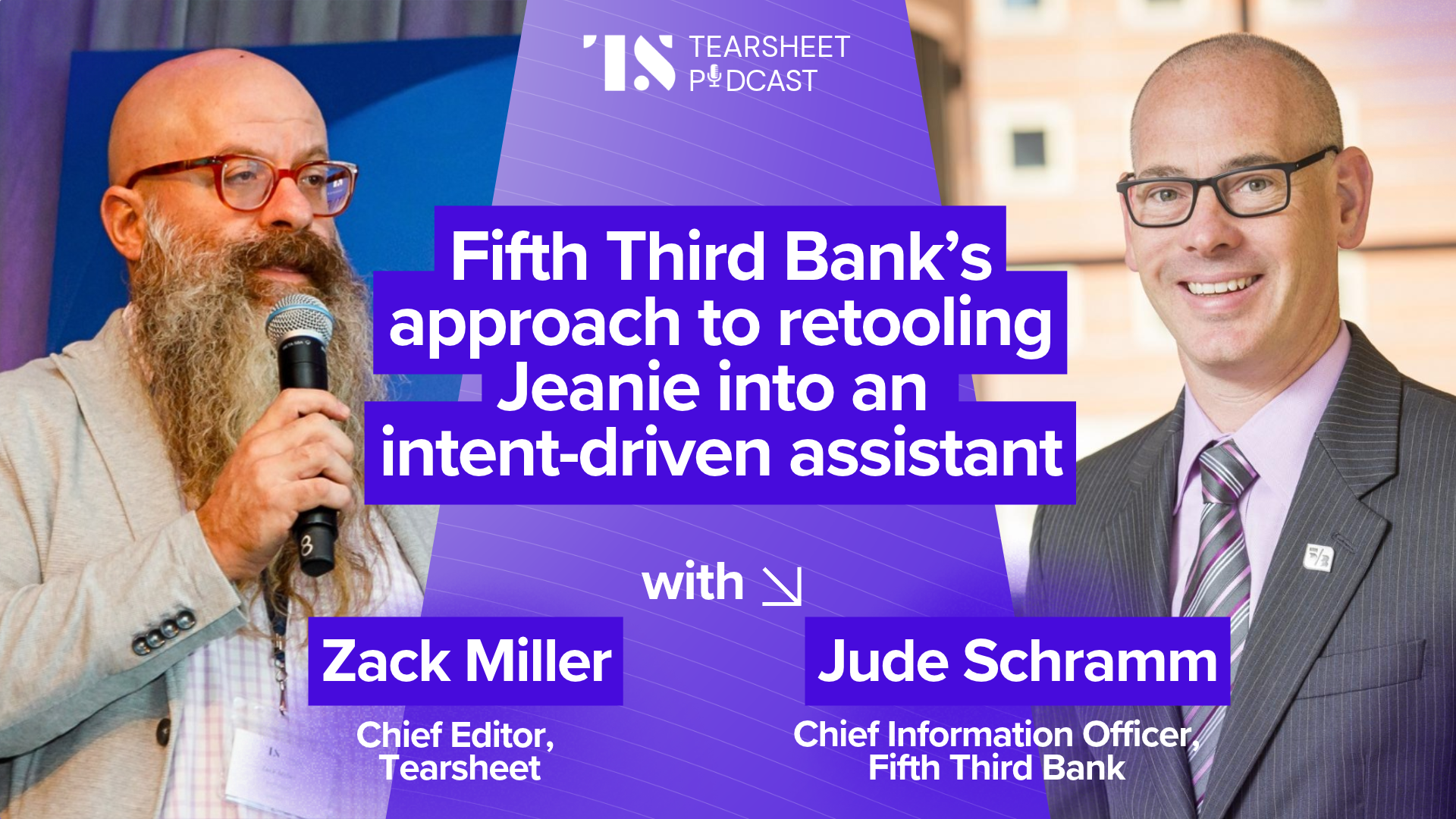
Fifth Third Bank first used the Jeanie name in 1977 for one of the earliest shared ATM networks in the U.S. During the pandemic as call volumes rose, the bank revived itas the name of its chatbot.
That early version ran on a third-party platform and reflected the way the bank was organized internally. Since then, Fifth Third has rebuilt Jeanie in-house. Self-service containment has climbed from 3% to 42%, and intent recognition has risen from roughly 20% to 87%.
Chief information officer Jude Schramm, who leads technology, data, cybersecurity, AI and process optimization at the bank, says the gains came from redesigning the experience around how customers talk.
“We want to think about how customers want to experience and act and interact with our bank,” he says.
Watch the full podcast
Listen to the full podcast
Subscribe: Apple Podcasts I SoundCloud I Spotify
Designing around intent
Banking apps typically ask customers to know where a feature lives. Schramm says traditional chatbots inherit that logic by steering users into a fixed workflow. Fifth Third’s app has over 200 features, and early versions of Jeanie confirmed intent with customers in what he calls a cumbersome way.
The current model interprets plain language and sends customers directly to the right capability. A request like “I want to send Zelle” or “I want to send money to my uncle” lands in the same place. Schramm credits years of customer data and training.
“It’s just hard work,” he says.
Handoffs that keep context
Self-service is the cheapest path, Schramm says, because no human agent is involved. The bank still lets customers ask for one at any point, either a digital agent in the chat or a phone agent. The conversation history goes with them, so there’s no repeat authentication or re-explaining.
Schramm says the bank didn’t set out to cut costs. Cost reduction came as “an additional benefit” of a smoother experience.
Guardrails before agentic features
Fifth Third began adding generative AI to Jeanie in late 2025, after building policies and controls for what AI would be allowed to do. Schramm says the framework had to stay flexible enough to “revisit that decision literally every day if we have to.”
Jeanie cannot move money on its own. “We have to always still have a human in the loop, the human being, the customer,” Schramm says, and the assistant reconfirms even simple requests such as a balance check. The bank also holds patents on what it calls Sentinel technology, which monitors and protects the connection between customer, device, and Jeanie. Schramm adds that Fifth Third took part in Project Glasswing, the cybersecurity effort Anthropic announced with the government.
Selective bets on build and buy
Where customers choose the bank because of an experience, Fifth Third leans toward building. “We want to own and control that experience,” Schramm says. The mobile app and core deposit system are custom built. Back-office tools such as HR and the general ledger run on vendor platforms, left uncustomized.
Generative AI complicates that calculus, since teams can build quickly. Schramm expects the bank to experiment over the next year. On vendors, he is cautious: “My guess is 90% of them won’t exist in five years.” He also sees AI-native products that could speed up call centers and chatbots, if a bank can fit them into its enterprise environment.
As a regional bank, Fifth Third has less room for error than its larger rivals. “I just have to make decisions that I can’t afford to miss,” Schramm says. Leasing infrastructure from AWS lets the bank use its provider’s investment, and a 12-week replanning cycle with the business keeps priorities honest. Its NewLine payments business, built partly through the Rize acquisition, moved roughly $14 trillion last year.
Human relationships where they matter
Schramm expects customers to handle everyday banking through Jeanie by app, voice, or navigation, within three to five years. That leaves loans, financial advice. and complex transactions for people. The bank is betting on its branch network for that work: a customer knows the banker, and the banker knows the customer.
The goal, he says, is “really personalized human interactions where they matter most.” The middle layer between those two points is what the bank is rethinking. He adds that the pace will depend on what the industry and the public are comfortable letting AI do.