


Banks look to close the expectation gap with data, real-time infrastructure, and human judgment
- Executives from Regions Bank and Temenos explain how a bank’s data, real-time infrastructure, and AI controls, combined with human judgment, can close the gap between what customers expect and what banks deliver, from personalized advice to payments.
- They discuss how Regions is applying generative AI with people in the loop, why security and convenience anchor its payments strategy, and what it takes to earn a larger share of a customer’s financial life.
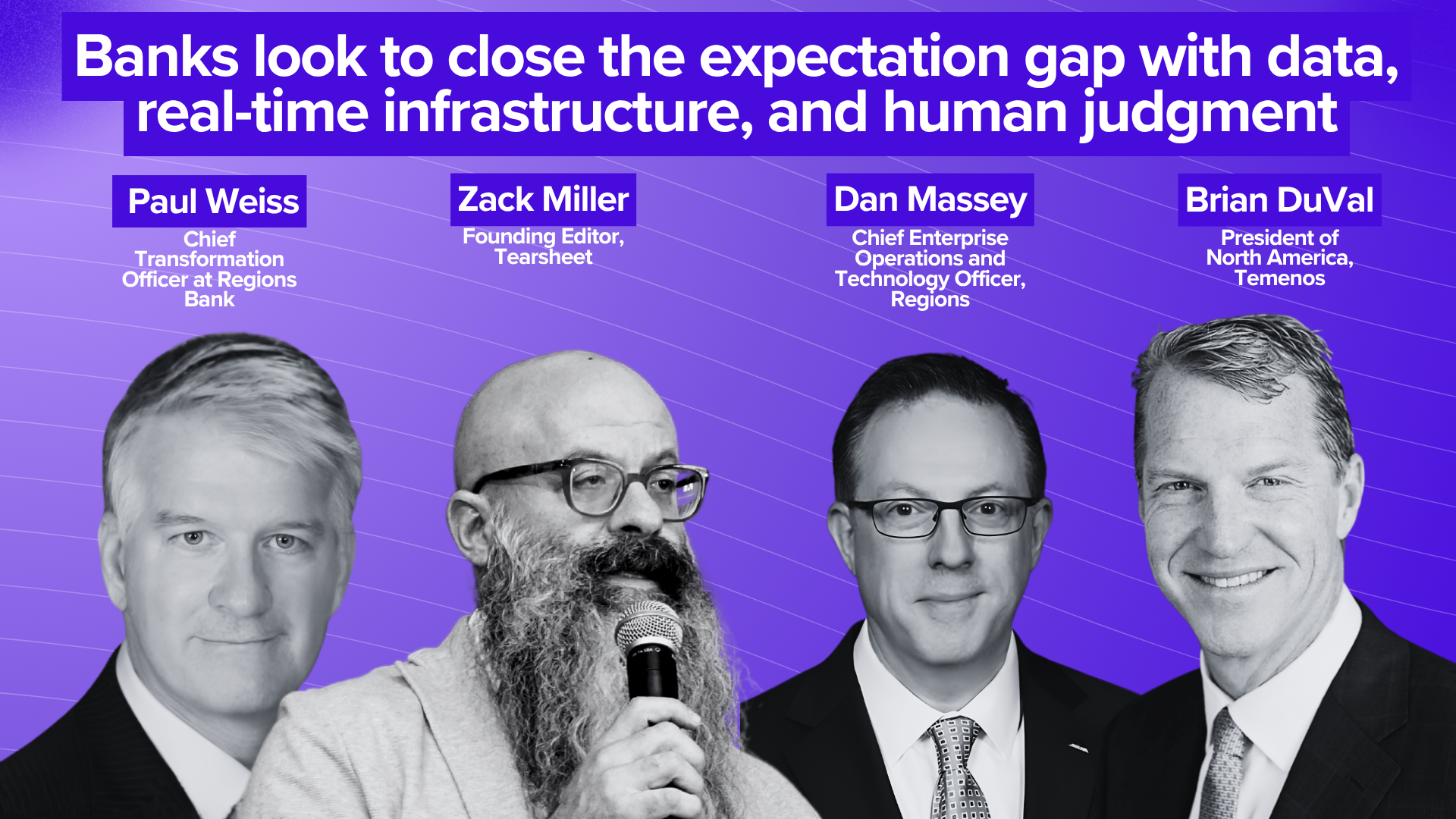
Customers hold their banks to a standard they learned somewhere else. Brian DuVal, President of North America at Temenos, points to the speed and ease of use they have become accustomed to booking a hotel, renting a car or buying with one-click on Amazon. Yet their banking experiences don’t always measure up.
This distance is the subject of “The Banking Expectation Gap: U.S. Consumer Edition,” research commissioned by Temenos. It points to a widening gap between what consumers expect and what many institutions can deliver, particularly in personalization, trust, digital experience, and timely human support. Paul Weiss, Chief Transformation Officer at Regions Bank, doesn’t expect the gap to stop widening on its own. “I don’t see the pace of change that has driven that gap slowing down,” he said.
For Dan Massey, Chief Enterprise Operations and Technology Officer at Regions, the starting point is the information banks already hold. “Data is at the heart of that,” he said, referring to helping clients build financial confidence. Closing the gap depends on whether a bank can put that data to work on a client’s behalf.
In a recent Tearsheet podcast, Massey, Weiss, and DuVal discussed how this plays out in practice, from core platform investment and AI governance to personalization and payments.
Watch the full podcast
Listen to the full podcast
Subscribe: Apple Podcasts I SoundCloud I Spotify
Legacy data becomes useful when the foundation changes
Banks hold a trust advantage over newer fintechs, and that same longevity creates a technical problem. “Sometimes that data can be locked in some legacy systems, some really old technology that’s tough to get it out,” said Massey. Strategic capital allocation toward platforms that can turn data into something clients value, while giving AI engines the inputs they need, can be the answer.
Weiss described the foundation as a set of capabilities: clean data, real-time interactions delivered in a cloud-native and scalable way, and services that can be composed into new client experiences. Building them is slow work. “Those aren’t easy to do as a series of incremental steps off of your business as usual platform,” he said.
Regions’ work with Temenos on its core platforms is part of that effort. A real-time, event-driven architecture with a strong API layer will enable a competitive advantage, and it is the base for the personalization the bank wants to offer.
AI starts in controlled settings with people in the loop
Regions began applying generative AI in the back office, where developers have seen “probably about a 30% efficiency rate,” according to Massey. The bank has also deployed intelligent document processing and knowledge-base agents. It has layered generative AI onto existing analytics, including a commercial tool called RClick that assesses the health of commercial clients, so relationship managers can query it through a conversational interface. The bank has also deployed agentic tools that scan the bank’s environment for vulnerabilities and write code that developers can deploy quickly.
Each use case goes through risk and cybersecurity review in parallel. “We’re very much a human-in-the-loop organization at this point,” Massey said, adding that the goal is to build patterns that can be repeated and scaled.
Weiss laid out the sequence. “You have to start with your risk and your security partners with you out of the gate,” he said, followed by a governance framework, threat modeling of each use case, and an architecture with security and risk protocols built in. He also advised staying focused. “It’s easy to get distracted by shiny objects,” he said, so enterprise-level priorities should determine which use cases get built.
DuVal said customers have accepted the technology but want to understand how it works. “Customers don’t mind if you’re using AI,” he said, but they want transparency about how it uses their data and handles their money. As a response, Temenos has built copilots for bank users and a financial crime mitigation agent, reflecting growing concerns about fraud and synthetic content.
Personalization extends across the whole relationship
Massey said many banks offer a narrow set of insights drawn from transaction activity. Regions wants a wider view. “We want to help people with their larger financial relationship versus individual products,” he said. The resulting insights would be available across digital channels and to contact center agents, frontline bankers, relationship managers, and wealth advisors.
According to Weiss, the industry has done a good job bringing transactional capabilities into digital channels. The next opportunity is to add advice and perspective and move from static processes to intelligent workflows, which depends on real-time capabilities and clean data.
Gen AI advancements also make it possible to serve customers as a segment of one, according to DuVal. He recounted receiving weekly mailers from competing banks offering a few hundred dollars to switch accounts. The offers carry “no longer-term value that makes that sticky,” he said. Banks already know a lot about their customers, including where they live, the ages of their children, and when they might be approaching college or retirement. They could use that information to deliver more relevant financial planning guidance.
DuVal also pointed to a gap in how banks treat clients. Most have premium programs for their top-tier customers, but he asked about “all the ones in the middle that could be their next.” Those clients, he said, are “one of one,” and AI makes it feasible to serve them that way.
Payments combine security and convenience
Moving money in real time also gives bad actors less time to be stopped, so Regions has invested in identity verification, third-party fraud controls, and traditional and generative AI tools for fraud prevention. It is also rolling out passkeys for commercial, small business, and consumer customers.
On the topic of convenience, Massey draws an analogy from the shipping industry. An overnight carrier doesn’t ask whether a package should travel by boat, plane, or truck. It asks, “Where do you want it to go? When do you need it to get there?” Banks, he said, should do the same and choose among ACH, wire, and real-time payment rails on the customer’s behalf.
For commercial clients, integration is a key priority. Regions is working with fintech partners and leveraging its API layer to deliver reporting and money movement “directly into your ERP system,” so clients don’t need to visit a separate banking portal. The same infrastructure also positions the bank to respond to emerging demand for stablecoins and tokenized deposits.
Payments bring many expectations together, and the pace of change makes architecture a long-term commitment. “You’re going to have to architect for flexible, rapid, ongoing change for forever,” Weiss said.
Relevance and trust shape the next three years
Personalized relevance, security, and trust are emerging as the expectations most likely to reshape regional banking over the next three years. Fundamental banking products “can be commoditized pretty easily,” according to Massey. The differentiator, he sees, is the ability to move money securely and conveniently in real time while offering insights tailored to each client, whether it’s a consumer, wealth client, small business, or corporation. Massey’s goal is to “help people live a happy life” and spare them worry about the money side.
DuVal framed the business case in terms of wallet share. Many banks, he said, assume clients are staying because they haven’t switched. In reality, those customers may keep a checking account at one institution while holding retirement accounts, insurance, and investments elsewhere. “They’re going to have assets everywhere,” he said. “If they trust the institution, they would do it there if it was easy.” A bank that serves as a trusted advisor, with digital tools that complement its people, has the chance to capture more of that activity.
“It’s easy to forget if you’re not careful that this is a human business,” said Weiss. As the tools become more capable, the opportunity is to help customers succeed beyond facilitating a transaction on a phone, and getting the foundation and the fundamentals right is the path to that. “Better and easier is a good combination,” he said, “and I think we’re tracking well to that.”