


At Stellar’s Meridian conference, Anthony Scaramucci tells banks to “kill the iPod in your business”
- Anthony Scaramucci wants the 10 largest U.S. stocks on chain first, because equities will draw the attention that pulls the rest of the market along.
- The SkyBridge founder expects SEC guidance to matter more than legislation and urges bank product leaders to retire their own best-selling products.
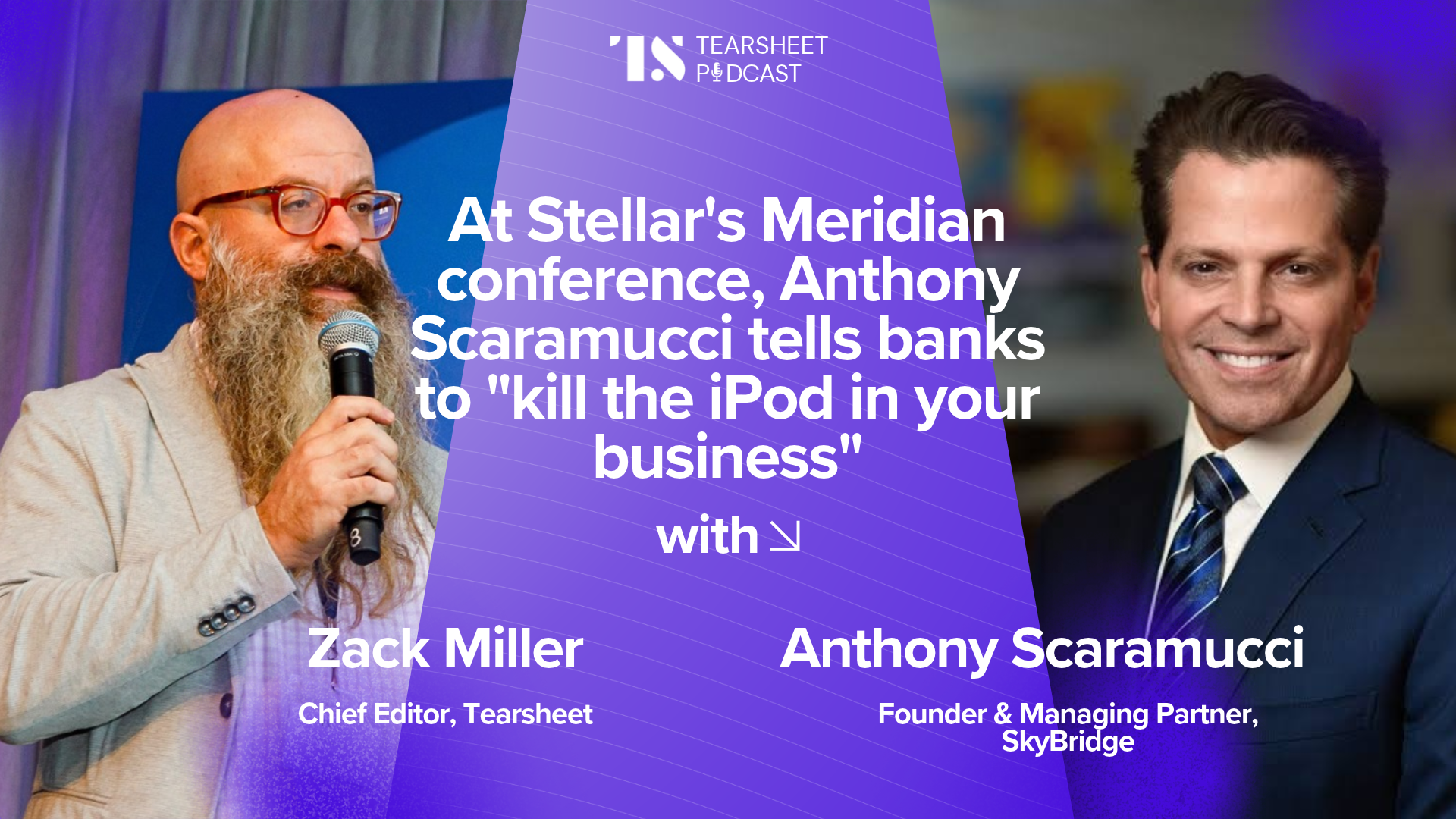
Anthony Scaramucci bought his first bitcoin at about $6,000. In October 2020, he bought nine figures’ worth for himself and his clients, and some of those clients fired him for it. He had been a skeptic, and he had already missed the run from $500 to $2,000. What changed his mind was working out what money is, and he now runs SkyBridge Capital as a crypto and late-stage private equity firm managing a couple of billion dollars. He also runs the SALT conference series, which began in 2009 and has held roughly 30 events worldwide.
His current bet is tokenization. Tokenized assets are growing, and he wants stocks to be the next wave. He argues that putting the 10 largest U.S. stocks on chain would draw the most attention, and that once a few work without glitches, competing CEOs will have to match them. The sequence starts with SEC guidance from Chair Paul Atkins, since the Clarity Act has stalled, and continues with a name like Larry Fink or Jamie Dimon moving first. In his view, the industry has about two years to build that momentum.
His advice to bank product leaders is blunt: kill your own iPod before a competitor does.
Scaramucci spoke with Tearsheet at Stellar’s Meridian conference in Lisbon. He covers what stands in the way of tokenization, why settlement can shrink from days to minutes, how SkyBridge runs tokenized and traditional funds side by side, and what Wolfgang Puck taught him about rebuilding a business that is already working.
Watch the episode
Listen to the full podcast
A meeting with Michael Saylor sealed the decision
He added a lot more bitcoin in the $17,000 to $18,000 range, but the larger commitment followed a September 2020 meeting with Michael Saylor, the MicroStrategy CEO, who he believes had bought his first bitcoin the month before. By then he had concluded that Bitcoin is, technically, the purest form of money, and the nine-figure purchase came the following month.
U.S. regulation is the biggest hurdle
Regulators abroad are waiting on Washington, and the Clarity Act has not passed. Scaramucci expects SEC Chair Paul Atkins to issue administrative guidance that could work as well as the legislation. After that, the industry needs a flywheel: a Larry Fink, a Jamie Dimon, or a Steve Schwarzman tokenizing assets and offering 24/7 trading. As he sees it, once momentum builds, even a regulator in the mold of former SEC Chair Gary Gensler could not put the technology back in the bottle.
Tokenized stocks are the catalyst
Treasuries and mortgages are the deepest markets, but Scaramucci wants equities on chain because stocks are where investors’ attention sits. His logic is competitive: get the 10 largest market-cap stocks tokenized without glitches and rivals will have to follow, because no CEO wants to explain why a competitor offers 24/7 liquidity and his company does not. A recent Wall Street Journal ad warned investors they could lose tokenized stock, which he calls misinformation.
Fewer intermediaries means faster, cheaper settlement
A stock trade today passes through six or seven intermediaries. Scaramucci started in an industry that settled trades five days after execution. Today it is one day, and settlement could drop to minutes, though regulators may not allow it. Moving value from one wallet to another cuts out the third parties that charge for credit card transactions, wires, and cashier’s checks. A house purchase could follow the same path, with a blockchain transfer replacing the lawyers, correspondent banks, and clearing brokers that now stand between buyer and seller.
Adoption follows an S curve
Scaramucci resisted moving his office data to the cloud in 2006, and the cloud later proved cheaper and more secure. He offers penicillin as another example: the first person to take it was probably worried, and now everyone does. In his telling, tokenization is at that stage, and the first assets that run without glitches will settle the question. He held out on contactless payments himself until last year.
SkyBridge tokenized its funds for a younger investor base
SkyBridge runs tokenized and non-tokenized assets side by side. He bet that investors now in their late 30s and 40s are comfortable with blockchain and want to move in and out of positions quickly. Back-office and compliance work is similar for both and much easier with the tokenized assets.
Kill the iPod in your business
Asked what a bank head of product should focus on over the next 90 days, Scaramucci used Apple as the example. The iPod was Apple’s most successful product, and Steve Jobs folded it into the iPhone anyway. His advice: “Shoot first, ask questions later.” He tells banks to “pretend that you’re in 2035” and get there in a hurry, because the first mover gets rewarded.
Wolfgang Puck is the model: he closed Spago after a decade, rebuilt it, and kept repeating the cycle for 50 years, and the restaurant is still hot. Scaramucci wants to break down and rebuild his own business the same way, starting with technology for his conference business. He also plans to grow SkyBridge’s late-stage secondary business, which has held Anthropic, SpaceX, and OpenAI. On the tokenization side, he is betting that Stellar will be one of the big backbones.