


‘Banks use about 35% of their available technology, and we didn’t want to be that bank’: Craft Bank CEO, Ross Mynatt, on evolving tech preferences among community banks
- Hey, I'm Tearsheet's Sara Khairi, kicking off as your new host of the Tearsheet Podcast alongside our editor-in-chief, Zack Miller. Ready to shake things up, I'm excited to bring you some episodes of my own. My very first episode takes you to Atlanta, where we explore the growth and tech preferences of Craft Bank.
- Ross Mynatt, CEO of Craft Bank joins us to discuss his journey as a first-time CEO, the choice of Jack Henry as their core tech partner, and the strategies behind Craft Bank’s $250 million asset growth in just under 4 years.
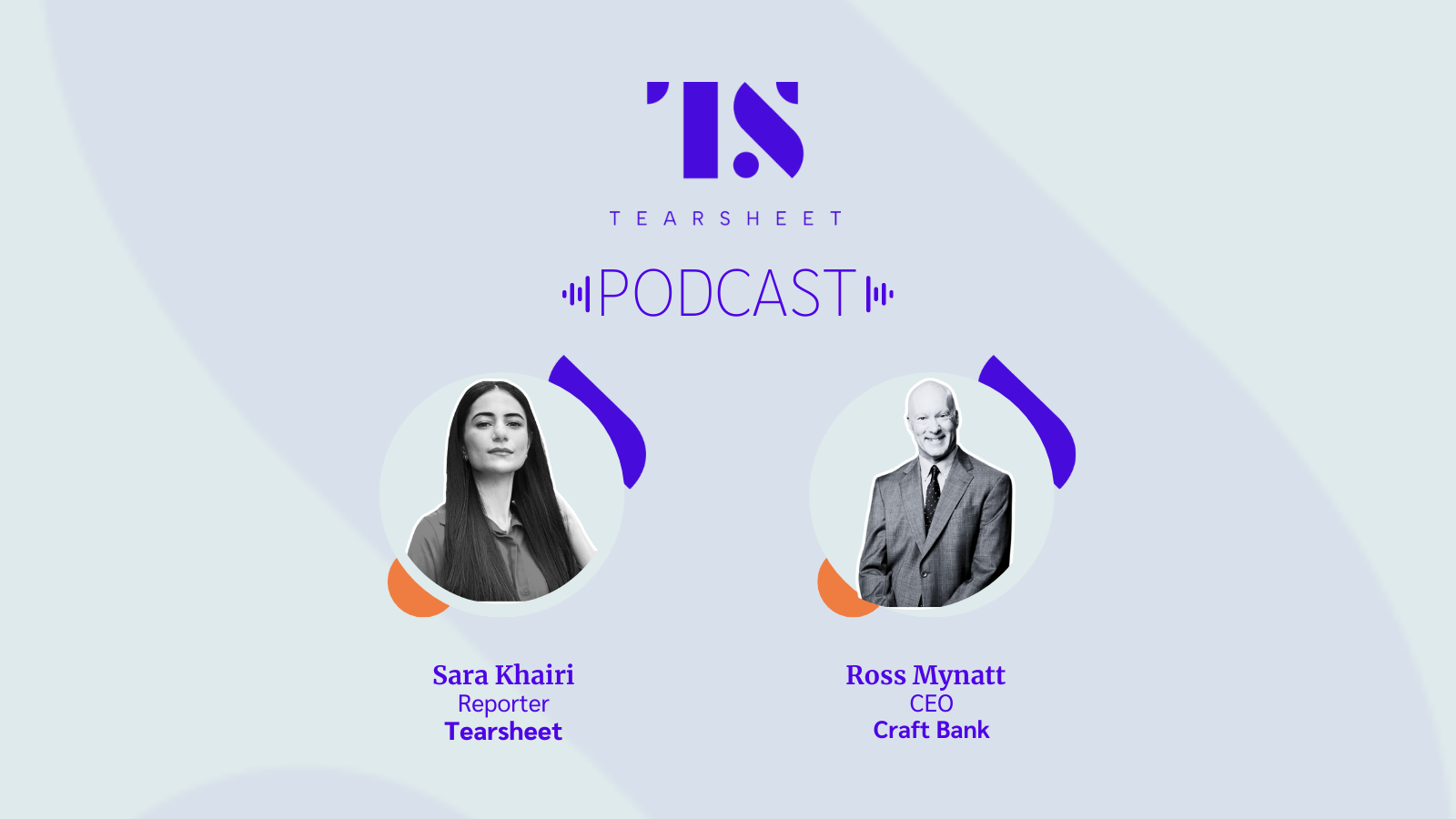
Hey all, I’m Sara Khairi, your host for this episode and a reporter at Tearsheet. If you’ve been tuning into the Tearsheet Podcast, you’ve likely been enjoying the insights brought to you by Zack Miller, our editor-in-chief and the original voice of the show. While Zack remains the heartbeat of the Tearsheet Podcast, I’m excited to jump into the podcasting mix and bring you some episodes of my own. Expect to hear a bit more from me alongside Zack. I hope you find my chats here just as engaging as the stories I write including the weekly 10Q Newsletter for our pro-subscribers. Catch you on the other side!
For my very first episode, I decided to step outside the frenetic pace of the Big Apple and dive into the lesser-known banking scene in other states. Community banks have weathered a storm of challenges in recent years, including macroeconomic pressures and the uncertainty following three regional bank failures in 2023. In particular, young community banks launched during the peak of Covid-19 have had to contend with additional complexities due to their timing.
These community banks may operate on a smaller scale, but their ambitions rival those of Wall Street giants. As the digital wave sweeps across the globe, these banks are not just staying in the game — they’re hustling to keep pace and stay relevant by adopting emerging technologies.
One example is Atlanta’s Craft Bank, which opened its doors in 2020, right when the world was facing a pandemic. Primarily a commercial bank with a business-centric focus, Craft Bank currently operates with a team of 19 employees and manages total assets of $250 million.
Ross Mynatt, CEO of Craft Bank, joins us to discuss his journey as a first-time CEO, the choice of Jack Henry as their core tech partner, and the strategies behind Craft Bank’s $250 million asset growth at a time when most smaller institutions were struggling just to stay afloat.
Throughout our talk, it becomes evident that although 92% of banks aim to maintain or elevate their technology spending in 2024, community banks and large financial institutions take markedly different approaches when it comes to investing, forming partnerships, and selecting technology providers. Ross also discusses whether community banks could potentially leverage technology more effectively than their larger peers.
This first episode kicks off a three-part series exploring the tech and partnership strategies of three emerging community banks. First up: Craft Bank – its origin and its tech evolution. Let’s dive in!
The key takeaways
- Growth drivers for Craft Bank: Ross credits the bank’s growth to a mix of good fortune, a seasoned team with strong connections, and favorable market conditions in Atlanta, where no new bank had opened in 15 years, and the number of community banks had significantly declined. He notes that they raised capital at the pandemic’s peak, which seemed like a daunting endeavor back then but turned out to be well-timed as interest rates were at historic lows.
“We’re right at 250 million in total assets or as our Chief Lending Officer likes to call it, a quarter of a billion dollars, we are 90% a commercial bank,” shares Ross.
- What starting a de novo bank is like, and why not just acquire one? Ross discusses the decision to start a de novo bank rather than acquire an existing one, highlighting the importance of cultural fit and avoiding legacy issues. He also highlights the significance behind the name ‘Craft’ and how it led to the determination to start from the ground up.
“We knew that we could build it from scratch and it would be ours, as opposed to going out and buying an existing bank or an existing charter where there are some legacy issues, perhaps there may be some loans that you might not have booked otherwise, or maybe it’s not a cultural fit – and culture is very important to us,” according to Ross.
- Deciding on tech providers: Craft Bank has invested in technology, choosing Jack Henry as its core software provider. The bank intentionally selected tech solutions it knew would be used well, avoiding the pitfall of investing in tools that go underutilized.
Ross explains that his bank’s approach to investing in software involved everyone agreeing with confidence: “Yes, we will use this”. This consensus was driven by a caution sparked by a data point Ross came across while they were organizing. “On average, banks use about 35% of their available technology, and we didn’t want to be that bank,” notes Ross.
He underscores the value of cultural synergy in tech collaborations, too, sharing lessons learned from both successful and challenging encounters with partners.
- Key qualities of good tech partners: Ross advocates for building personal relationships and a test-run approach to ensure compatibility with tech partners.
“I guess what I would encourage folks to think about is that before you sign up with a dance partner, I may try to do a test run. Let’s do a project together on a very limited, finite basis. Let’s see how it feels, what works, and what doesn’t work.”
- Comparing tech partnerships – community banks and larger FIs: Ross contrasts Craft Bank’s approach with that of larger financial institutions, emphasizing the advantage of personal relationships in smaller banks. He acknowledges that while a community bank may not have the same resources as larger institutions, it can leverage personal relationships more effectively.
“Now I’m not going to tell you I’ve got an advantage over Jamie Dimon, but I will say that we can leverage [personal] relationships probably a lot more effectively than JPMorgan,” says Ross.
Catch the full episode
Subscribe: Apple Podcasts | SoundCloud | Spotify | Google Podcasts
Peruse the transcript (for TS Pro subscribers)