


Banks or Pipes: Where financial institutions go when agents take over
- AI agents are reshaping financial services, forcing banks to choose between building proprietary models, becoming infrastructure providers, or leveraging trust through partnerships.
- With web traffic down 20-30% and Capital One seeing 55% engagement boosts from AI concierges, the transformation is already underway.
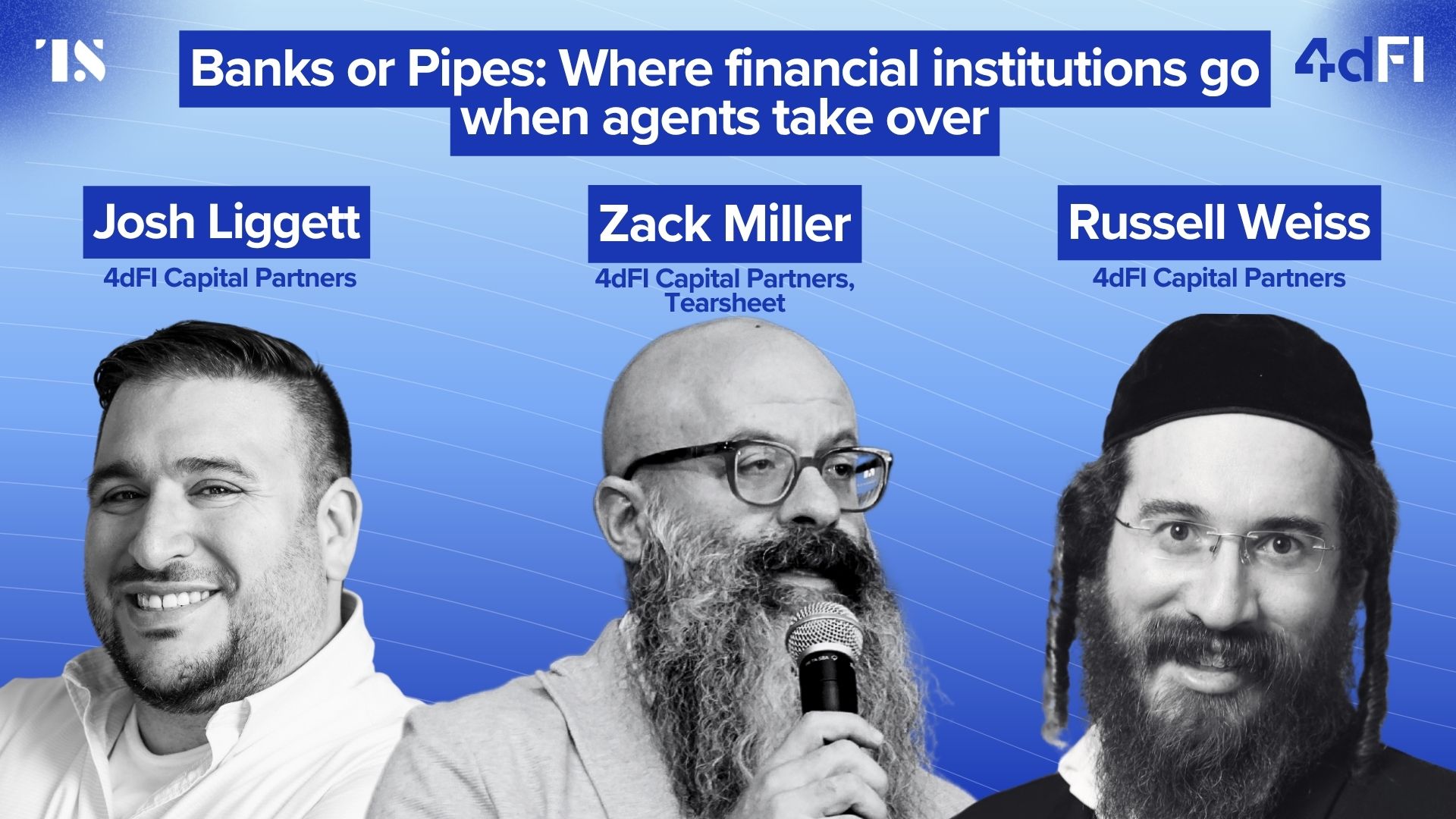
Welcome to a special 4dFi podcast exploring the latest trends and technologies reshaping finance. I’m Zack Miller, Tearsheet’s Editor in Chief.
Today, we’re unpacking the rise of AI agents and their potential to transform how consumers interact with financial services. I’m joined by my partners Russell Weiss, an AI expert and startup builder, and Josh Liggett, a seasoned fintech investor. Together, we’ll bring a multidimensional view to this complex space.
We’ll dive into real-world examples like Capital One’s Chat Concierge, which has driven a 55% boost in customer engagement by automating key tasks across thousands of auto dealer sites.
Looking ahead, we’ll consider the implications for traditional banks. Will they invest billions in proprietary AI models, or cede ground to big tech and infrastructure players increasingly embedding financial services?
We don’t have all the answers but want to open up with good questions and thinking about where things are heading.
We’ll also explore how the evolution of AI agents could intersect with web3, crypto, and asset tokenization to enable digital transactions. Russell and Josh will weigh in on which players are poised to thrive in this new era of AI-powered finance.
There’s a lot to cover, but one thing is clear: AI is no longer a far-off possibility for banks. It’s a present-day reality redefining what’s possible. Stay tuned for a thought-provoking discussion of the opportunities and challenges ahead.
Watch
Listen
Subscribe: Apple Podcasts I SoundCloud I Spotify
The shift is already happening
Customer behavior is changing fast:
- Web traffic down 20-30% as users start with AI chatbots instead of Google or bank websites
- AI agents (ChatGPT, Claude) are becoming the “super apps” the US market has long sought
- Users expect natural conversation, not clicking through 40 steps to get a loan
Real example: Capital One’s Chat Concierge (launched early 2025) connects 12,500 dealer sites, letting customers schedule test drives and arrange financing—all starting from their bank. Result: 55% boost in engagement.
Three strategic paths for banks
- Build proprietary AI – Develop your own LLMs to become the destination for all financial needs (JPMorgan is spending billions on this)
- Become the pipes – Let AI companies handle UI/UX while you provide infrastructure and optimize to be the product AI agents recommend
- Leverage trust – Position as the guardrails and final approval layer in AI-driven transactions through strategic partnerships
The challenge
Banks face a generational divide: older customers will never fully trust AI agents, but younger generations expect AI-first experiences. Missing the 18-25 demographic means losing the critical “first bank” relationship that historically creates lifetime customers.
Bottom line
The shift from “banks vs. fintechs” to “banks vs. AI platforms” is underway. Winners will likely emerge through partnerships: banks bring trust, AI platforms bring technology and experience.
To learn more about Tearsheet’s new investment community participating in the next gen of leading fintech startups, go to tearsheet.co/4dfi