May’s public fintech theme: Operating systems over products


    Weekly 10-Q

    The weekly 10-Q newsletter is part of the Tearsheet Pro subscription, where I unpack the recent moves and strategies of leading banks and fintechs in the public space, coupled with stock market analysis. In your inbox every Friday!

    Message Sara


    May’s public fintech theme: Operating systems over products

    Firms are pushing closer to the decision layer where financial actions are executed.


    May showed that companies are tightening control over the infrastructure that runs financial systems, including coordination, decisioning, workflows, and the underlying data layers.

    Across Coinbase, LendingClub, Green Dot, Citi, and Intuit, the details differ. The direction doesn’t. Each firm is moving one layer down the stack, closer to where financial decisions are actually made and executed.

    1. Coinbase: Still trading-led, increasingly infrastructure-shaped

    Coinbase is building toward an “everything exchange,” but its business is still defined in real time by trading.

    Q4 2025 (reported February 2026) made that clear: revenue of $1.78B, down 22% year over year, and a $666M net loss tied to weaker trading activity. Yet subscription and services revenue held up at $727M, driven by custody, stablecoins, and institutional products.

    Two engines are now visible:

    • Trading: volatility, upside/downside driver
    • Subscriptions and infrastructure: baseline, recurring layer

    CEO Brian Armstrong called Coinbase in “pole position” for 2026. Structurally, it is still a volatility-priced company building a stability engine underneath it.

    2. LendingClub: The business changed first, the name followed


    subscription wall for TS Pro

    How Intuit is turning QuickBooks into an operational coordination layer for SMBs

    SMB software solved workflows but created operational sprawl

    Small businesses digitize workforce management one tool at a time: payroll software, HR systems, scheduling apps, hiring platforms, benefits tools. 

    The result is fragmentation. According to Intuit, SMBs now manage between 7 and 25 business applications, spending roughly $120,000 annually on software. But the larger cost is operational: duplicated data, manual reconciliation, disconnected approvals, and fragmented workflows.

    “The business owner is still the one doing the connecting,” said Olivier Bartholot, VP of Product Management for Workforce Solutions at Intuit.

    That’s the problem Intuit is targeting with its recent launch of QuickBooks Workforce. The firm is trying to remove the business owner from acting as the integration layer between disconnected systems.

    Intuit is merging workforce data with financial context

    QuickBooks Workforce sits directly inside QuickBooks, which means payroll, workforce activity, accounting, cash flow, invoicing, and expenses now exist inside the same system.

    That changes what the software can do. A traditional payroll platform reports staffing costs after the fact. An integrated workforce-financial system can identify margin pressure, overtime risk, or staffing inefficiencies before payroll even closes.

    This also changes how Intuit’s acquisition of GoCo last year should be viewed. What initially looked like an HR expansion was, in fact, a broader infrastructure consolidation play. Bartholot described the acquisition as a way to connect workforce and financial data “without an API sitting between them.”

    Integrations move data between systems, while unified architectures create operational awareness.

    The bigger AI play is orchestration

    Coordination is the most important aspect of QuickBooks Workforce.

    The platform automates payroll prep, validates time tracking, syncs onboarding workflows, and flags inconsistencies before payroll runs. But the larger ambition is to coordinate operational decisions continuously across the business.

    The industry spent years building digital tools for every workflow of SMBs. Now it is trying to reconnect the systems and processes that became fragmented along the way.

    Intuit wants to turn workforce management into a financial operating system

    Small businesses (SMBs) digitize HR the same way they digitize everything else: one tool at a time.

    Every workforce function lives in a different piece of software: payroll, benefits, hiring, time tracking, reviews. The result is not modernization so much as operational sprawl with a patchwork of dashboards, exports, approvals, spreadsheets, and duplicated employee data accumulating beneath the surface of ‘digitization’.

    As a result, workforce management becomes more software-driven while simultaneously becoming harder to manage.

    That fragmentation is the problem Intuit is aiming to solve with the launch of QuickBooks Workforce, its new AI-native, end-to-end human capital management platform embedded directly into QuickBooks.

    “The launch of QuickBooks Workforce marks the most significant evolution of Intuit’s human capital management capabilities since QuickBooks Online debuted 25 years ago,” said David Hahn, EVP, GM, Services Group at Intuit, in the press release.

    The real problem is operational fragmentation

    SMB workforce management software has evolved horizontally. Companies bought specialized tools for recruiting, onboarding, compliance, scheduling, payroll, benefits, time tracking, and performance management. Each solved a narrow workflow well enough. But together, they created a coordination problem.


    The uneven geography of modern finance: AI, branches, and BNPL

      Financial firms are choosing to anchor themselves before, during, or after a transaction.


      This week didn’t offer a single storyline to hang everything on. Instead, it gave us three companies moving in completely different directions, signaling how far financial services has drifted from any shared playbook.

      PayPal is trying to teach small businesses how to use AI. Chase is opening more branches in an era defined by digital banking. And Klarna is turning payments into more of a daily habit loop.

      It all comes down to: how do you stay relevant when the way people interact with money is shifting faster than the institutions themselves?

      PayPal wants AI to stop feeling like AI

      PayPal and Anthropic have partnered to help small businesses adopt AI, including training and workflow integration. 

      PayPal is no longer confined to the checkout flow; through its integration with Anthropic’s Claude, it is moving closer to SMB workflows where transactions are initiated and executed. In effect, it is extending from a payments layer into the operational layer around business activity.


      subscription wall for TS Pro

      The Week in Market Moves | May 14–21, 2026


      Company signals and market response

      This analysis tracks the top 5 company developments and how markets absorbed them through Thursday’s close, focusing on where shifting narratives translate into price action.

      It is part of Tearsheet PRO’s weekly 10-Q Newsletter, where strategy meets market reaction. I track how leading banks and fintechs are evolving in public markets and how investors are pricing those moves.

      Subscribe to PRO and get the full 10-Q story every Friday!


      1. Klarna (KLAR) – Close: $15.93

      • Klarna is embedding itself directly into Worldline’s acquiring and merchant infrastructure, starting with e-commerce and eventually extending into in-store POS systems across Europe.
      • The partnership gives Klarna distribution through one of Europe’s largest payment acceptance networks at a time when BNPL usage is expanding beyond discretionary purchases into everyday cash flow management.
      • Klarna launched a shopping app inside ChatGPT that lets users search products, compare prices and check live inventory without leaving the conversation.
      • The move pushes Klarna upstream from payments into product discovery, where purchase decisions increasingly begin inside AI interfaces rather than search engines or retailer apps.

      Why it matters: This move is less about adding another payment button and more about distribution power. Klarna is moving from being a checkout feature into core payments infrastructure. By integrating deeper into Worldline’s stack, Klarna becomes easier for merchants to activate and harder to ignore. The timing matters too. BNPL is increasingly functioning as a short-term cash flow tool for younger consumers. Klarna understands that the winner in BNPL may not be the firm with the best consumer app, but the one most deeply wired into merchant systems and transaction flows.

      Klarna is positioning itself for a world where commerce starts with conversation instead of browsing. If consumers begin asking AI what to buy, the firms controlling that discovery layer gain influence long before checkout happens. What’s interesting is that Klarna is no longer waiting at the payment stage. It wants to sit at the moment of intent formation, when shoppers compare, evaluate, and narrow choices. That changes Klarna’s role from transaction processor to commerce intermediary. In AI-driven retail, discovery may become as valuable as payments themselves.

      2. Intuit (INTU) – Close: $307.07

      • Intuit is cutting roughly 17% of its workforce while redirecting resources toward generative AI infrastructure and product integration.
      • The company is simultaneously restructuring around AI-powered services rather than standalone software tools, supported by partnerships with Anthropic and OpenAI.

      Why it matters: This is not just a cost-cutting story. It reflects a deeper shift in how software companies think about value creation. Traditional SaaS products were built around menus, workflows, and manual inputs. AI changes that model entirely.

      Intuit envisions that accounting, tax, and SMB operations will increasingly run through AI-led orchestration rather than conventional software navigation. The layoffs signal how aggressively firms are willing to reorganize themselves around that assumption even before the long-term economics are fully proven.

      3. NVIDIA (NVDA) – Close: $219.51

      • NVIDIA reported a record $82 billion in revenue for the first quarter of FY2027, which corresponds to the quarter ending around April 2026, as demand surged for infrastructure powering agentic AI systems capable of executing tasks. 
      • The company introduced a clearer distinction between AI reasoning infrastructure and AI execution infrastructure, positioning new chips like Vera around task completion economics rather than raw compute rental.

      Why it matters: The important shift here is that AI infrastructure is becoming tied to staffing replacement economics. Earlier AI waves mostly enhanced software features. Agentic AI is being sold as operational capacity; systems that can investigate, execute, and complete workflows with minimal human involvement.

      That changes the spending logic. Businesses no longer view AI compute as experimental R&D spending. They increasingly view it as infrastructure directly tied to productivity and cost savings. NVIDIA is effectively becoming the industrial backbone for automated digital staffing.

      4. American Express (AXP) – Close: $309.70

      • American Express and Fanatics are launching a co-branded sports rewards card tied to FanCash, collectibles, tickets, and fan experiences.
      • Fanatics will also become Amex’s first sports-focused Membership Rewards transfer partner, linking payments directly into a broader sports commerce ecosystem.

      Why it matters: This deal shows how rewards programs are evolving from generic cashback structures into identity-driven ecosystems. Sports fandom already produces recurring spending behavior, emotional loyalty, and community participation. Payments firms increasingly want to sit inside those engagement loops.

      For Amex, the card is less about transactions alone and more about relevance. The goal is to turn spending into participation, where rewards are connected to experiences, access and belonging rather than points accumulation. Fanatics, meanwhile, gets another mechanism to keep users circulating inside its ecosystem longer.

      5. J.P. Morgan Chase (JPM) – Close: $303

      • Jamie Dimon said J.P. Morgan could eventually hire more AI specialists than traditional bankers as automation reshapes parts of the bank.
      • The firm is already deploying AI tools across investment banking workflows and cybersecurity operations while relying on natural attrition to gradually rebalance its workforce.

      Why it matters: Banks are moving beyond experimenting with AI and starting to redesign organizational structures around it. What J.P. Morgan is describing is not simply productivity software layered onto existing jobs. It is a gradual reallocation of staff toward technical and AI-operational roles.

      Dimon’s vision is notable because it is more pragmatic than the “AI replaces everyone” rhetoric circulating elsewhere in banking. But the direction is still clear: future financial institutions may compete less on headcount scale and more on how effectively they combine domain expertise with machine-driven execution.

      The Week in Market Moves | May 7–14, 2026


      Company signals and market response

      This analysis tracks the top 5 company developments and how markets absorbed them through Thursday’s close, focusing on where shifting narratives translate into price action.

      It is part of Tearsheet PRO’s weekly 10-Q Newsletter, where strategy meets market reaction. I track how leading banks and fintechs are evolving in public markets and how investors are pricing those moves.

      Subscribe to PRO and get the full 10-Q story every Friday!


      1. SoFi (SOFI) – Close: $15.77

      • SoFi has acquired PrimaryBid’s directed share program assets, ending its independent operations.
      • The deal builds on an existing partnership around equity issuance infrastructure (DSP2.0) for public offerings.

      Why it matters: This is SoFi pushing beyond consumer banking into the plumbing of capital markets. Instead of just letting users invest, it is starting to touch how equity offerings are structured and distributed. The move signals a broader ambition: not just to serve retail investors, but to sit closer to how companies raise capital in the first place. This shifts SoFi into a more complex, institution-facing layer of finance where scale alone is not the advantage; equally important are trust, regulatory depth, and execution quality.

      2. Remitly (RELY) – Close: $23.23

      • Remitly Business is now fully available to SMBs in Canada after earlier US and UK expansion.
      • New features include bulk international payments and ‘send via link’ workflows to simplify recipient onboarding.

      Why it matters: Remitly is trying to turn cross-border payments from a consumer remittance product into a business operating layer. The real opportunity is removing the operational drag of international pay runs, beneficiary errors, and fragmented payout workflows. If it works, Remitly becomes less of a remittance app and more of a back-office utility for global SMB commerce. The challenge will be whether it can stay simple as it moves deeper into business complexity.

      3. Coinbase (COIN) – Close: $220.70

      • Coinbase introduced Solana-backed loans, allowing users to borrow USDC against SOL holdings.
      • Loans are powered by Morpho’s on-chain lending infrastructure with instant access and flexible repayment.

      Why it matters: Coinbase is continuing its shift from exchange to financial infrastructure layer. Crypto-backed lending turns dormant assets into usable cash flow without forcing users to exit positions. That pushes Coinbase closer to being a credit intermediary, not just a trading venue. The bet is clear: if crypto assets are going to sit in long-term portfolios, the real value comes from making them productive. The risk sits in volatility cycles as credit tied to asset prices is only as stable as the market beneath it.

      4. Affirm (AFRM) – Close: $66.16

      • Transaction frequency per user has risen 50%, reaching 6.7 transactions annually.
      • Affirm is expanding into cards, wallets, banking integrations, and an industrial bank structure.

      Why it matters: Affirm is moving away from being a point-of-sale financing tool and toward a broader payments network. The emphasis is no longer just lending at checkout, but increasing how often users interact with the ecosystem. That creates a feedback loop: more transactions generate more data, which strengthens underwriting and improves targeting. The ambition is to become embedded in consumer spend flows.

      5. Chase (JPM) – Close: $300.33

      • J.P. Morgan is preparing to launch its retail banking push in Germany, starting with a savings account.
      • The strategy mirrors an entry-first model used by digital banks: land deposits, then expand products.

      Why it matters: This is a conservative but deliberate entry into European retail banking. Instead of trying to compete head-on with incumbents, J.P. Morgan is using savings as a low-friction entry point to build customer relationships. It reflects a broader truth in retail banking: distribution often starts simple, then deepens over time. The harder question is whether a US banking giant can translate brand strength into everyday consumer relevance in a market where local incumbents already dominate trust and habit.

      BNPL moves into the conversation layer of commerce

        Affirm and Klarna embed BNPL directly into Google’s Gemini as shopping shifts from search bars to conversations.


        The checkout button is starting to lose its original place in the buying process as payments move upstream into AI interfaces.

        That shift is now surfacing inside Google’s ecosystem, where BNPL firms Affirm and Klarna are embedding installment payments into Google Search and the Gemini app through Google Pay. The integrations move BNPL directly into AI-driven shopping experiences, where discovery, comparison, and purchasing happen within a single conversational interaction rather than across separate search funnels and checkout pages.

        Affirm is designing BNPL for machine-readable commerce

        Affirm’s move into Gemini reflects how the company sees shopping and lending evolving together inside AI platforms.


        subscription wall for TS Pro

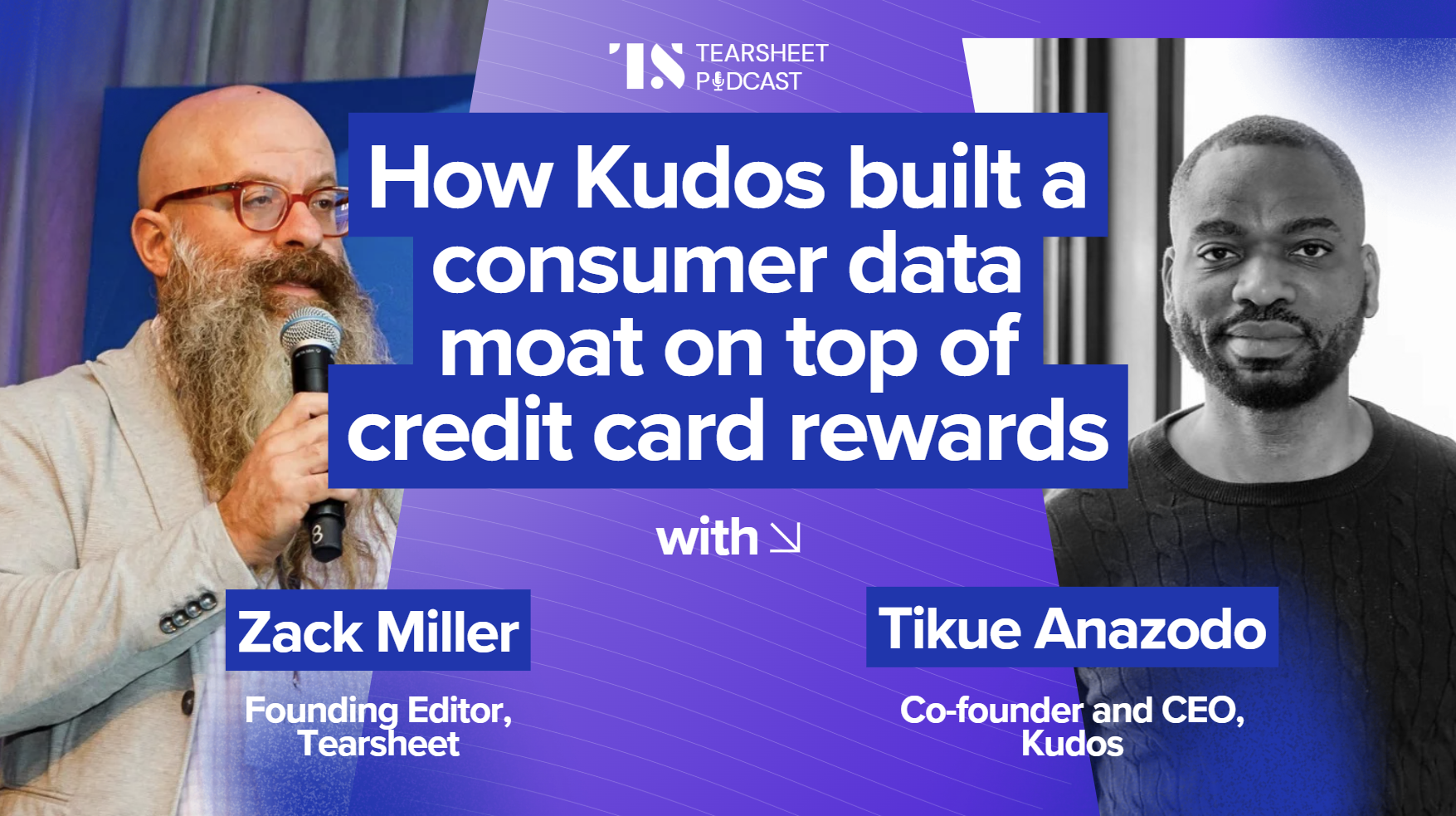
        How Kudos built a consumer data moat on top of credit card rewards

        Most people leave money on the table every time they swipe — not because they’re careless, but because the credit card rewards ecosystem is genuinely complicated. Thousands of cards, millions of merchants, shifting bonus categories, buried benefits. AI promises that it can do that optimization work invisibly, in the background. Today I’m joined by Tikue Anazodo, co-founder and CEO of Kudos — an AI-powered smart wallet that tells you which card to use at checkout, recommends cards based on your spending habits, and layers on additional rewards on top of what your cards already earn. Kudos has raised over $17 million, is backed by QED Investors, and was named to Forbes’ Fintech 50. Tikue, welcome to Tearsheet.

        Watch the episode

        Listen to the full podcast

        Subscribe: Apple Podcasts I SoundCloud I Spotify

        Read the whole transcript (for TS Pro subscribers)

        The founding story: building for consumers, not merchants


        The Week in Market Moves


        Company signals and market response

        This analysis tracks notable company developments and how markets absorbed them through Thursday’s close, focusing on where shifting narratives translate into price action.

        It is part of Tearsheet PRO’s weekly 10-Q Newsletter, where strategy meets market reaction. I track how leading banks and fintechs are evolving in public markets and how investors are pricing those moves.

        Subscribe to PRO and get the full 10-Q story every Friday!


        1. Chime (CHYM) – Close: $19.28

        • Chime posted its first GAAP-profitable quarter, Q1 2026, as a public company, while active members climbed to 10.2 million.
        • The company is leaning harder into higher-margin products like earned wage access, instant loans, and premium banking tiers.

        Why it matters: This feels like a transition point for consumer fintech. Chime is no longer operating like a challenger bank trying to acquire users at all costs; it is starting to behave like a full-stack financial institution optimized for monetization and retention. The tension is that scale changes expectations. Once fintechs move upmarket and deepen product exposure, they inherit the same scrutiny around trust, cybersecurity, and responsible growth that traditional banks have spent decades managing.

        2. Robinhood (HOOD) – Close: $76.31

        • Robinhood’s private markets fund has attracted 150,000 retail investors as of May 2026.
        • The company is pushing to give everyday investors access to high-growth private firms long before IPOs.

        Why it matters: Robinhood is trying to break one of the clearest structural divides in finance: private market access. For years, the biggest gains from companies like OpenAI or Stripe accrued largely before public investors could participate. Robinhood sees an opening in turning venture-style exposure into a retail product. That could reshape expectations around who gets access to wealth creation, though it also introduces a more complicated conversation around risk, liquidity, and whether retail investors fully understand what they are buying into.

        3. Intuit (INTU) – Close: $407.97

        • Intuit launched an AI-powered human capital management platform aimed at SMBs.
        • The company is combining agentic AI with human advisers to automate payroll, hiring, compliance, and workforce operations.

        Why it matters: This is part of a larger race to become the operating system for small businesses. Intuit already owns critical financial workflows through QuickBooks; now it is moving deeper into labor and workforce management, where SMBs still juggle fragmented software stacks. The broader outlook is that AI will collapse multiple operational layers into a single system. If that works, software vendors stop selling tools and start managing decisions.

        4. American Express (AXP) – Close: $317.40

        • American Express launched AI training and scholarship programs for small businesses and workers.
        • The initiative focuses on practical day-to-day AI adoption.

        Why it matters: A lot of companies are talking about AI as a technology shift. Amex is treating it more like a workforce shift. Small businesses are increasingly less worried about whether AI exists and more concerned with whether their teams know how to use it productively. By positioning itself around education and enablement, Amex is trying to stay embedded in the operational layer of small business growth rather than remaining just a payments and credit provider.

        5. Chase (JPM) – Close: $307.50

        • Chase rolled out revamped banking and credit products aimed at Gen Z and first-time banking customers.
        • The bank paired app redesigns with branch expansion and financial education initiatives.

        Why it matters: Traditional banks spent years assuming digital convenience alone would win younger customers. Chase is leaning on the fact that Gen Z wants a more hybrid arrangement: strong digital tools backed by physical access and guidance when financial decisions become more complicated. The deeper competitive shift here is that banks and fintechs are converging toward the same middle ground – modern UX, embedded education, and relationship-driven engagement – rather than competing on ‘digital versus physical’ alone.

        Green Dot and the case to make financial experiences feel calmer

          Green Dot is looking inward, toward the overlooked moments in product conversations.


          Money doesn’t usually create confusion at the point of action. It creates confusion in the pause that follows: when something has technically been done, but not yet fully understood. A transfer completes, a balance updates, a transaction clears, and still there’s a moment of recalibration, as if the system and the user are briefly out of sync.

          Most of fintech’s progress has been built around removing that first layer of effort by introducing fewer steps, faster rails, and cleaner interfaces. And it has worked – money today moves with a speed that would have felt improbable a decade ago. But what hasn’t kept pace is the emotional side of that experience: the need to feel certain about what those movements actually mean in real time.

          That’s the layer Green Dot is now trying to address more directly. Chief Product Officer Melissa Douros calls it “Cortisol UX” – a way of thinking about financial design that starts from the simple premise that users are often already stressed when they arrive. The product, then, is not just an interface for action, but a system that either amplifies or absorbs that stress.

          That’s the conversation with Green Dot’s CPO, Melissa Douros, and what it reveals about how financial products are evolving when clarity becomes the real measure of design.

          Melissa Douros, Chief Product Officer at Green Dot


          subscription wall for TS Pro