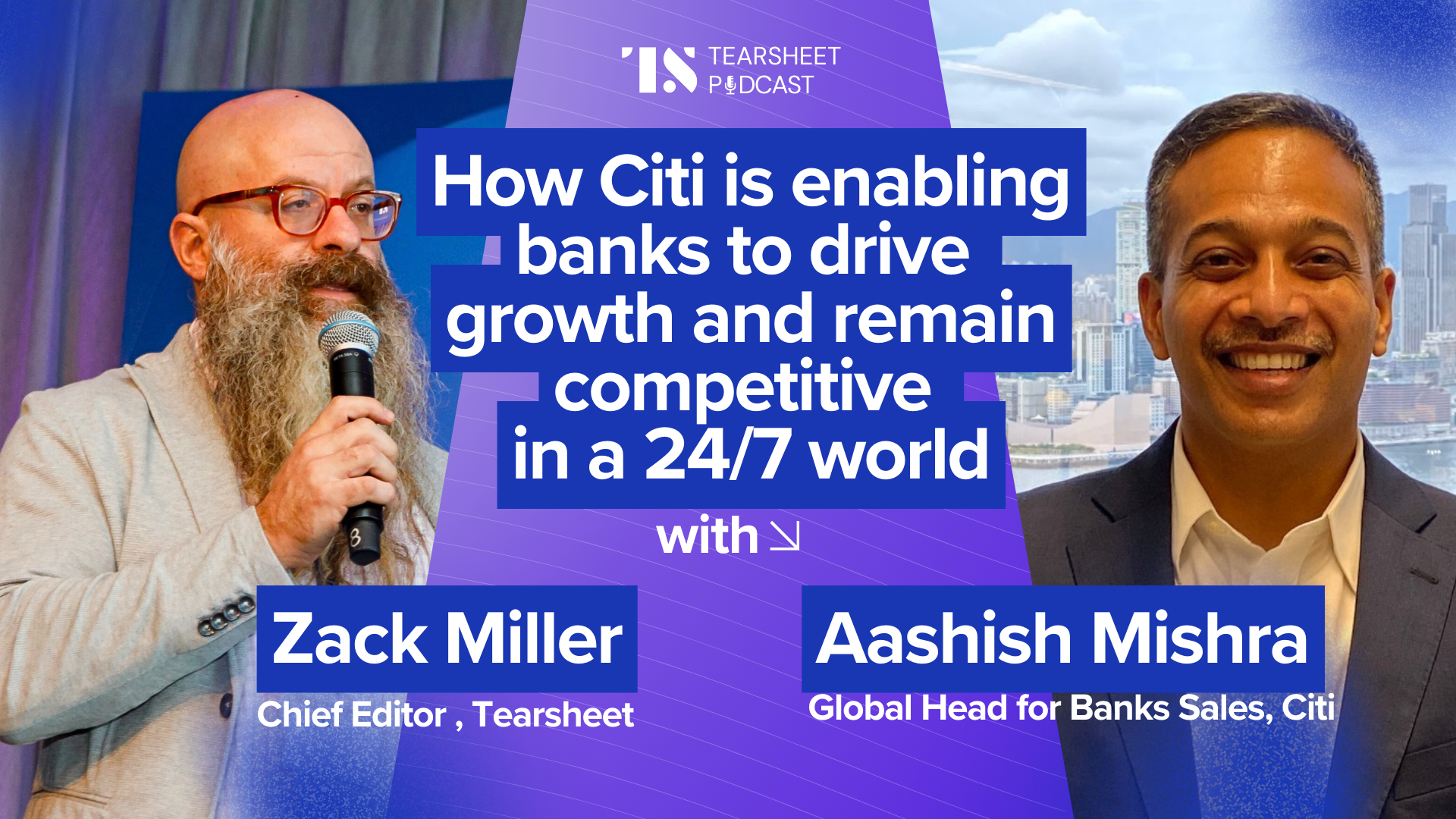
Fintechs have pushed the industry to focus on client experiences, and our show today digs into how traditional banks can collaborate with global banks like Citi to improve experiences like cross border payments for their clients.
In our conversation today, Aashish Mishra, Citi’s Global Head for Banks sales and North Asia head for Financial Institutions and Fintech Sales, Treasury & Trade Solutions (TTS), dives into how the bank’s 24/7 US dollar clearing business, as well as solutions like Worldlink ® Payment Services, are helping the firm’s bank clients deliver modern and intuitive experiences to its customers.
Aashish Mishra is part of Citi’s Services’ business based in Hong Kong, and he performs two roles: he’s responsible for TTS sales and strategy for all FI client segments in North America, which spans banks, fintechs, insurance, asset managers, and broker dealers. And for the bank segment globally, his focus is on delivering the entire TTS solution set to his clients, including cash clearing, global payments and receivables, Banking as a Service, liquidity solutions and trade solutions. Prior to this role, he spent extensive time in Citi’s Security Services business, including as the Head of Custody Product and Head of Direct Custody and Clearing business for Asia.
Aashish has extensive experience in the financial institution space, and has worked closely with senior clients, regulators, and financial market infrastructure during his career. Today, he brings that insight from multiple arms of the vast Citi footprint to the show to explore how banks can push their products further without burdening their teams with technical lift, as well as where he expects client expectations to go in the future.
Listen to the full episode
Subscribe: Apple Podcasts | SoundCloud | Spotify
The big ideas
The Shift Towards 24/7 Real-Time Banking: The banking industry is rapidly moving towards a 24/7 real-time model, driven by several factors including Changing Customer Demands, Fintech Competition, Growth of eCommerce and Disruptive Technologies.
These factors are pushing the industry towards 24/7 payments, 24/7 liquidity management, and 24/7 customer service. Citi is at the forefront of this transformation, offering solutions that enable banks to meet these evolving demands and create differentiation via 24/7 USD Clearing, Support for Alternate Payment Methods, 24/7 Liquidity Solutions and Enhanced Customer Experience tools.
How Citi’s 24/7 US dollar clearing services are helping banks catch up with fintechs: “Once banks are live on this feature, they’re obviously looking to give the benefit to the end customers [to help them] send and receive US dollars, by enabling payments and commerce in real time. This is something that the end clients can often get from fintechs. This is one of the reasons why customers move to fintechs and leave traditional bank platforms. And therefore, by being enabled on this capability, our bank clients are able to win back market share, grow market share, and this also becomes a very strong differentiation for them as they compete in the home market.”
How Citi is leveraging blockchain technology without increasing the technical lift for its bank clients: “If you look at Citi® Token Services: while there is a blockchain platform which is internal to Citi – from a customer perspective, they’re completely transparent. They just send us a regular funds transparent instruction and we do everything else, which is the complexity behind the scene, keeping the client completely transparent.”
How Citi’s payment services are bringing fintech-like experiences to incumbents’ clients: “(a) by using our Worldlink solution and using APIs, we have the ability to completely end-to-end power the mobile banking app or the internet banking platforms of our customers and of our bank clients, for the purpose of cross border payments. (b) The future industry growth will be driven by, what we call, alternate payment methods. So think wallets, credit cards, and debit cards. One of the areas where we’ve spent a lot of investment and focus over the last few years is, how do we make sure that our Worldlink platform is able to cater to some of these new alternate payment methods as they develop. (c) Payment tracking services – The moment a payment is sent out, we have the ability to keep automatically updating the beneficiary of the payment on where the payment is and the status of the payment. It’s great from a client experience point of view because, instead of the beneficiary of the revenue having to call up the bank and figure out where the payment is and keep making phone calls, they can now get an SMS and email, which is almost like a courier tracking service, and they can see real time where the payment is.”
Asia as the hotbed of financial innovation and adoption: “Asia is really leading … the charge on some of that new technology deployment and innovation. What all of that does is drive disruption, drive innovation, and lead to things like new forms of commerce, new forms of business models like open banking, banking as a service, embedded finance, and digital banks.”
How digital assets are changing the way banks move and manage money: “…digital assets, taking a long term view, have very exciting prospects in terms of what they can do for cross border payments, in terms of efficiency, cost, and transparency.”
The full transcript
The major shifts that are influencing how banks provide services to their retail and corporate customers
Let me just step back a bit and talk you through a little bit about our operating environment and how our customers are evolving and changing, because that’s really driving a lot of the changes in our business. One of the key things that we do is enable both the real economy and the financial economy through cross border movement of liquidity and payment. If we look at a classic client today [and that would be a client who is based, for example,] in China, which is selling their goods and services on an ecommerce site in the US. They’re buying goods in turn from suppliers who could be based in Latin America or they could be based in the Middle East, and they could have subsidiaries all over the world, whom they need to inject with working capital, as the needs may be.
In our world, this client will need to enable all of the payments and the money involved in real time, 24/7 and 365 days, so that’s what our customers need to do. And that is the world in which we, as transaction banks, operate. We need to, therefore, service and enable our end customers. So, that’s the big shift in the business that we do these days. Now, what’s in turn driving this new operating environment? I would point back to four fundamental shifts in the last few years.
Number one, the nature of the end consumers of banks has changed dramatically. So be it a retail client or an institutional corporate client – all our clients today want instant fulfillment. They want a digital experience. They want the ability to click a few buttons and get the transaction completed. That’s what our consumers demand and expect of traditional banks.
Secondly, the emergence of fintech as competition. Today, when we speak to our senior bank clients, and if you ask them, who do you think is the biggest competition? Fintech comes up invariably, and what that really forces banks to do is focus much more on the product capability or the client-to-client experience they’re able to deliver.
The third shift is commerce to ecommerce. There was a Citi research report which came out recently which estimated that nearly 23% of total retail sales globally are done via ecommerce. If you look at ecommerce, [for example] if you look at [some of the biggest retail brands], these are all 24/7 365, so commerce has moved to 24/7 365, and therefore payments, liquidity, and the banking system need to [too].
The fourth shift has been the growth of disruptive new technology ranging from APIs, cloud, Gen AI, digital assets, etc. So if you put all of those four things together, these are all driving a significant disruption and a significant shift in how our business is carried out, and pushing it all towards an environment which is 24/7, real time, and instant payment based.
How banks are using Citi’s 24/7 USD clearing to meet the demands of their customers
What 24/7 clearing does is it allows our bank clients to send and receive US dollars, 24/7, 365, so it does away with any concept of cut offs, down times, and US holidays. This was something we launched about two years ago, and today, we have about 200 clients live and taking advantage of this feature with us, and that network is growing as we speak.
There are a couple of key and different use cases that we see emerging. Firstly, once banks are live on this feature, they’re obviously looking to give the benefit to the end customers, and giving their end customers across retail, institutional, Small and Medium-sized Business (SMBs) (and corporate, to transact, send and receive US dollars, and enable payments and commerce in real time. This is something that the clients can often get from fintechs. This is one of the reasons why customers move to fintechs and leave the traditional bank platform. And therefore, by being enabled on this capability, our bank clients are able to win back market share, grow market share, and this also becomes a very strong differentiation for them as they compete in the home market. So the ability to go as a marketing campaign, or to go to the end customer base, and make this claim, it’s a very powerful proposition.
Secondly, for banks which have multiple international branches – all of the branches are enabled on this 24/7 capability. Once they do that, they can then go to their clients – retail or corporate doesn’t make a difference – but they can go to the clients and give them the ability that within this closed loop ecosystem of their branch network, their customers can send and receive US dollars in real time. A really powerful proposition from a customer perspective, in the cross border space.
For the third use case, think of a bank with multiple branches. Often these branches have independent treasuries. They need to incur overdraft, set up credit lines, borrow from the market, even if another branch might have surplus liquidity. What 24/7 clearing can result in is a centralized Treasury concept, the full cost for maintaining different branches’ liquidity can be optimized and can be made much more efficient.
When we rolled out this feature, we were very clear that we wanted something which our banks could adopt at scale without having to put in any amount of complex dollars on technology investments, implementation, etc. So we designed the solution in a way that our clients could almost switch on and switch off this feature at their will, without having to do any form of implementation or tech enhancements. There’s absolutely no need for them to invest in blockchain digital assets to take advantage of this. They operate using standards. So it’s really a very easy way for our clients to take advantage of this feature.
How Citi is leading in cross border payments
I think the future industry growth will be driven by, what we call, alternate payment methods. So think wallets, credit cards, and debit cards. A few years back, money used to move from one account to another. But today, money moves from an account, but the destination could be either a bank account or a wallet or a credit card or a debit card. That’s the way the cross border payments business is moving. This is what, in our view, will drive future growth. So if you take wallets as an example, 15 years ago, they were practically non-existent, at least as far as the cross border payments business was concerned. It was just not an important end destination.
Wallets are the leading payment methods in ecommerce. Wallets account for nearly 49% of ecommerce and nearly 32% of point of sale commerce happens through wallets. Citi report estimates that by 2026, 60% of the world’s population will be enabled in wallets. What we have done at Citi is our cross border remittance platform called Worldlink. One of the areas where we’ve spent a lot of investment and focus over the last few years is, how do we make sure that our Worldlink platform is able to cater to some of these new alternate payment methods as they develop? For example, we are one of the first global bank’s to enable cross border payments into MasterCard debit cards.
We were one of the first global bank’s to enable a specific type of financial institution… crossborder payment flows into [digital wallets] in 100 plus markets. We are one of the first global banks to enable cross border payments into China, which are two of the predominant usage methods in China. How do we help our bank clients and arm them with some of these capabilities? Because that’s really what the end customers are increasingly looking for.
What we call this is the increasing convergence and intersection of 24/7, real time payments and real time liquidity. And look for anyone who knows the banking industry payments and liquidity. They’re two sides of the same fund, one can’t exist without the other. So if banks need to enable 24/7 payments, we also need to enable the liquidity to support those payments. We have really focused on a couple of things to enable this real time, cross border liquidity.
Firstly, [we have] what we call internally at Citi as real time liquidity sharing. Essentially what this does is that it allows the automated usage of a centralized liquidity pool. So for example, if you have a bank client with a head office branch, which is really the mothership which keeps the central liquidity pool, this real time liquidity sharing capability allows all the multiple branches on a cross border basis to use this liquidity on a 24/7 365 basis, and this is really what becomes a key tool to support things like 24/7 dollar clearing.
Secondly, we are focusing on what we call Citi Token Services. Today we are live with this in Singapore, New York, and very recently, London. And in a nutshell, what this does is, let’s assume if a client of ours has an account with us in Citi Singapore and they want to move that liquidity to Citi in New York. They’re able to do this real time by taking advantage of the Citi token feature, which is really what helps move that liquidity from Singapore to New York. Just similar to our thought process, we want clients to be able to use all of the features with minimal tech enhancements. If you look at Citi Token Services, while there is a blockchain platform which is internal to Citi, from a customer perspective, they’re completely transparent. They just send us a regular funds transparent instruction and we do everything else, which is the complexity behind the scene, keeping the client completely transparent. So those are two of the main things that we are focusing on with banks to enable the liquidity movement as well.
Readying banks for fintech competition
One of the things fintechs do extremely well is just a shared customer experience. They’ve really set the bar very, very high. In many cases, banks lose market share simply because the customer experience that they offer cannot match fintechs. That’s one of the main areas for cross border payments to act where we have really upgraded our capabilities, and in turn, we are allowing our banks to take advantage of those, so that they are able to offer their end customers a much better level of customer experience.
What I loosely call digitization of the cross border payments experience essentially means that by using our Worldlink solution and using APIs, we have the ability to completely end-to-end power the mobile banking app or the internet banking platforms of our customers and of our bank clients, for the purpose of cross border payments. So right from payment initiation, payment completion, fulfillment, payment tracking and the foreign exchange involved, everything is digital. Everything is seamless.
So if you are the end customer of the bank, you would get pretty much the same experience as you would expect to see from fintech providers. That’s been a key part of a strategy and a key part of our success with our bank clients in this space.
From a customer experience point of view, especially for cross border payments or for retail payments, for example, or SMB payments, for example, payment methods are an important destination that the end customers want. If the banks are not able to support that, the end customer will just move to a fintech platform. Through our investments in supporting these alternate payment methods, we are now able to help our bank clients plug that gap and be able to offer a streamlined process to their end customers.
Also what we call our Payment Tracking services or Global Beneficiary services: essentially, the moment a payment is sent out, we have the ability to keep updating automatically the beneficiary of the payment on where the payment is, the status of the payment. It’s great from a client experience point of view, because, instead of the beneficiary of the revenue having to call up the bank and figure out where the payment is, and keep making phone calls, they can now get an SMS and email, which is almost like a courier tracking service, and they can see real time where the payment is like.
How Citi’s Services’ business come together to build better client experiences
The clients include, for example, broker dealers, global custodians, asset managers, insurance. And all of these clients, they have needs, and they buy solutions from both parts of Citi services business, i.e. the TTS business and the Security Services business, because they need the span of both of these.
From a client perspective, it’s basically the same cash which moves from their operational side, which is where the TTS business gets involved and moves to the investment side, which is where the Security Services business gets involved. Eventually it’s really the same cash moving through the whole system. So clearly there is a value proposition for a certain set of clients in bringing a joint solution to them, which combines both TTS and the Security Services.
[For clients, the advantages of packaging this together are] number one, there are clear economic efficiencies from consolidating providers, versus having too many fragmented providers for different requirements, and having one consistent provider. So there are economies of scale there. There is a much more consistent and a much more end to end solution set in having both pieces put together much more cohesively. There are operational efficiencies in terms of our liquidity that can be seen, consolidated, and deployed. There are far more operational and therefore liquidity-related alpha that our clients can generate. And then finally, it does result in a much more superior client experience because of single touch points, end to end view, consolidated infrastructure.
Those are some of the benefits that our clients get. And if you put that on top growing emerging needs around client needs, around common APIs, common data feeds, common onboarding and KYC processes, all of those benefits add up for our clients.
Clearly, this is an important area for us. We absolutely see the needs of our clients converging. From a client perspective, how much value they get also depends on the customer itself. How are they structured? What is the complexity of their operations and the geographical footprint? So the value for the client varies depending on how they are structured.
In terms of how we bring both businesses together and give our clients the right value and the right efficiency – if you look at Citi, given our global network, and the strength we have in each of those individual businesses, we are fairly unique in the industry in terms of our ability to cobble solutions together, which spans both, and deliver both to clients on a truly globally consistent basis.
How Asia is pushing the envelope in adoption and innovation
North Asia, particularly, is an extremely exciting region for banks to operate in. There are two opportunities as well as challenges. There is a real chance for smart players to step up and really drive growth and market share. One of these things that are unique to North Asia is just the pace of infrastructure changes. If I look at the regulator, the financial market infrastructure, they are driving absolutely world class payment technology, payment systems, fostering innovation, laying down the right policies to allow new, innovative practices to evolve. So that, to me, is fairly unique to this region.
Number two, the consumer demographics, the size, scale, the wealth growth that we’re seeing in this region – all of that is driving very different consumer demographics, which again, lays out significant opportunities for this industry. Then the availability and the adoption of new age technology – it could be something as simple as just the mobile pervasiveness and the ability and the ubiquity of mobile devices to something much more evolved, like Gen AI.
Asia is really leading, and within that, North Asia is very active in leading the charge on some of that new technology deployment, and innovation. What all of that does is drive disruption, drive innovation, and lead to things like new forms of commerce, new forms of business models like open banking, Banking as a Service, embedded finance, and digital banks. Malaysia is probably one of the most active regions for digital banks. To me, over the next few years, I think all of us in the financial services industry will really have to up our game to make sure we’re able to navigate and take advantage of some of these ongoing disruptive changes.
The next major innovation in cross border payments
[In terms of future innovation,]I will really point at two things, and these are both based on what we are doing at Citi and equally, what we hear from clients – purely senior client feedback. Number one, digital assets, taking a long term view, have very exciting prospects in terms of what they can do for cross border payments, in terms of efficiency, cost, transparency. I think there is significant potential, from a Citi perspective, in digital assets. For cross border payments, we are really focusing on two things, one is Citi Token Services, and how we continue furthering the use cases of Citi Token Services. That’s a big thrust for us.
The second one is the regulated liability network, the RLN. In simple terms, it’s an open architecture industry effort to make tokens across the industry competitive. It has very powerful potential deployment in terms of both within a US dollar currency, for example, the dollar clearing business, and even more so as bank regulators across the world start looking at this and start seeing how different currencies link up as well.
As far as cross border payments go, the second major innovation that a client will see is Gen AI.
Our clients are at different stages of deploying and adopting it. We did a recent survey on the adoption of AI with our different client sets and independent FI segments, a lot of the banks still seem to be behind, say, NBFI, traditional insurance asset managers, in terms of how they’re looking at this space.
They’re starting off – rightfully so – they’re taking a very measured approach in some of the risk of these deployments as they go through it, and obviously some of the regulatory approval processes. From a Citi perspective, Citi has a form of strategy on how we approach this space and the use cases that we are evaluating across the bank and as we scale and deploy this across the firm, we are staying vigilant in how we manage the associated risks with it.
Effective risk management
Risk management is central to everything that we do, both within the bank and in terms of the work that we do with our clients. It’s just central to all of that. Risk management has multiple aspects in our business: it ranges from operational resilience, regulatory risk management, to cyber fraud mitigation. It ranges the whole spectrum. If you look at the changing nature of payments and the volume of payments and transactions increasing exponentially, these are fairly unique challenges in terms of managing risk.
From a Citi perspective, we continue to invest significantly in infrastructure, technology, and people to strengthen our risk management standards, and are able to safeguard not just Citi, but equally, our clients in terms of all the business that they entrust with us.
I think one of the things that helps Citi, we have very, very talented people in each of the countries that we operate in. We have feet on the ground, who understand the local regulatory landscape, who understand the local requirements, and in turn, are able to feed that both into the Citi system and to our clients. That helps us be more effective in some of these efforts, but clearly it’s one of our most important priorities.
Disclaimer: The views and opinions expressed by the individual, unless reflected in Citi’s Research Reports, are those of the speaker and may not necessarily reflect the views of Citi or any of its affiliates. All opinions are made at the time of the recording and are subject to change without notice. The expressions of opinion are not intended to be a forecast of future events or a guarantee of future results.