


How Citizens Bank is building GenAI with a five-year vision, not just quick fixes
- Krish Swamy, Citizens' Chief Data and Analytics Officer, joins the show to discuss data driven Gen AI implementation, cultural management, risk, and governance.
- Swamy shares how the bank thinks about choosing its partners, measures ROI on AI implementations, and how a strong data infrastructure serves as the foundation for Citizens' Gen AI strategy across call centers, software development, and cloud migration.
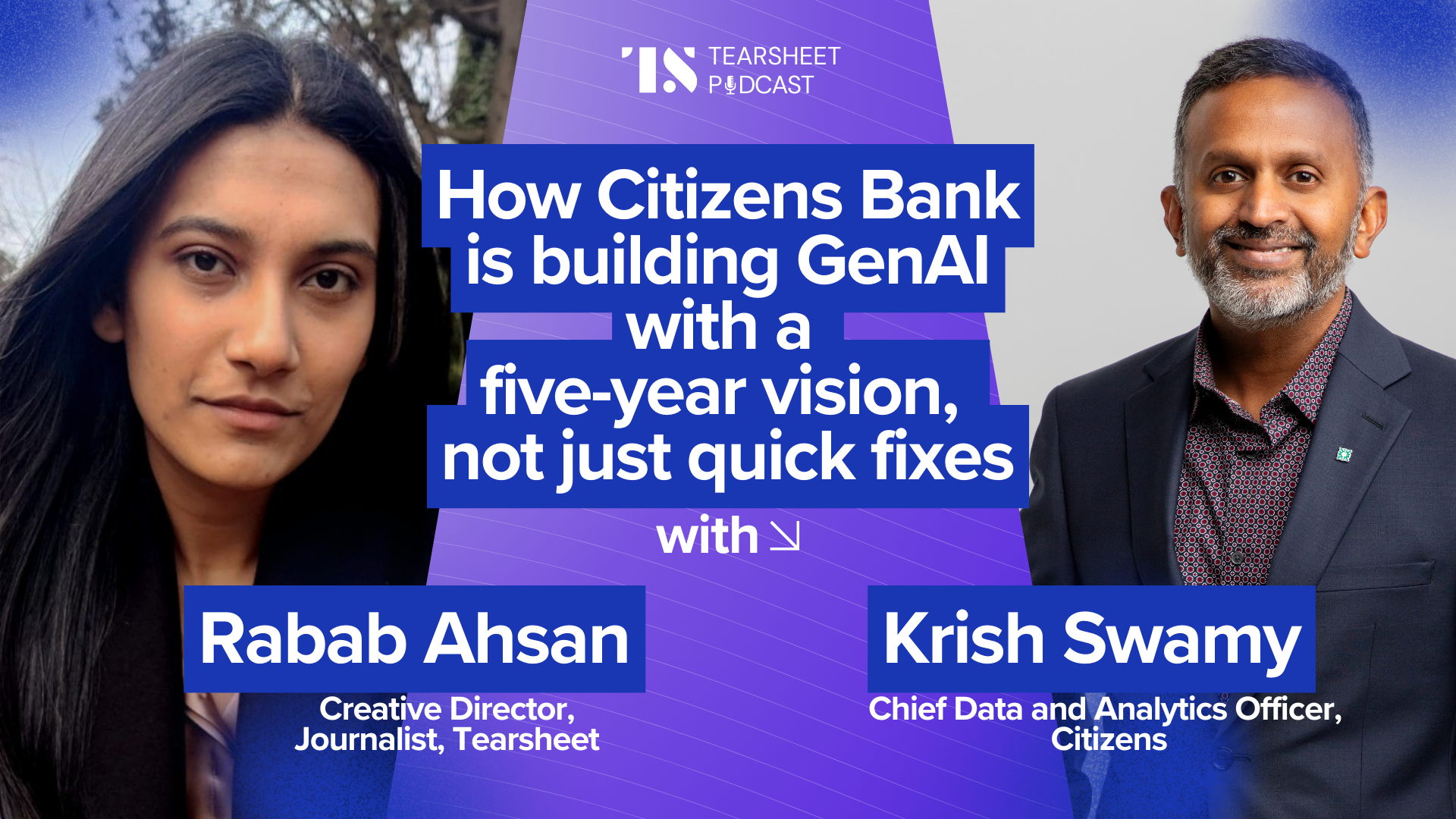
Investment in data is the hallmark of successful Gen AI implementations, according to Citizens’ Chief Data and Analytics Officer, Krish Swamy.
Giving us a system wide view of how Citizens is leveraging Gen AI, Swamy joins the podcast to talk about harnessing the power of data to drive decision-making, enhance customer experiences, and navigate the complexities of digital transformation in the banking sector.
Our conversation delves into the challenges and opportunities of building a data-driven culture within a traditional banking environment, and how Citizens is positioning itself at the forefront of financial innovation through strategic analytics initiatives.
Swamy, who also heads the firm’s Generative AI Council, shares his vision for the future of data in banking and the tangible ways Citizens is turning data insights into meaningful actions that benefit both the institution and its customers.
Watch the full episode
Listen to the full episode
Subscribe: Apple Podcasts | SoundCloud | Spotify
Long term view of Gen AI implementations
Citizens’ approach to Gen AI is best described as cautious and optimistic. While the firm is not rushing into any use case and is instead taking a methodical approach to evaluating every time a process or task can be improved by Gen AI, it is also sketching out what role the technology could play in the future for its employees and customer experience.
“We’re not just taking a process, or a component within a process, and applying Generative AI there. While that might be the starting point, the end game is always going to be: How does this function three or five years from now? How do we work towards that end game?” said Swamy.
Strong data based foundation as a differentiator
Swamy is a firm believer in using a comprehensive data infrastructure as the scaffolding for new technological implementations. “When we invest in data, when we make data easily available, and when we teach people how to use data, I think they become a lot more effective at being able to self-serve. So creating that foundation is an area of differentiation,” he shared.
One area where this focus helps the bank drive powerful results is fraud, which has seen a significant uptick since the pandemic, according to Swamy. “We’ve spent a lot of time overhauling the fraud infrastructure and the fraud platform itself. There are multiple sub components around fraud detection, claims processing, case management, which all are parts of the overall fraud value chain. And we made investments to improve the quality of those platforms,” he said.
Helping the fraud team stay ahead of bad actors, is the firm’s move to the cloud, which should be completed by the end of this year. “We are almost 80% migrated to AWS, and it makes it easier to get access to data and we are able to bring better data when it comes to our fraud defenses,” he said.
Having a centralized source for the data also ensures that fraud teams that include analysts and contact center employees are working from the same source of information. This allows these teams to be more effective and coordinated when trying to spot trends and undertake fraud mitigation strategies, he shared.
Another area where the firm is applying data-led Gen AI strategies is the call center. “A lot of the customers’ questions tend to be fairly narrow, almost esoteric and [call enter employees] have to reference procedure documents to be able to give that answer,” he said.
In the past, call center employees have used keyword search to access this information, but now the firm is using Gen AI and helping call center agents learn how to prompt more effectively to reach information,” he said.
Similarly, the firm is also using the tech to help its developers take care of some of the most frustrating parts of coding: documentation and testing. “Those are areas where we’ve been able to find a lot of leverage from giving software development engineers the right tools to be able to do the testing, documentation, sometimes even writing code, and become more efficient at that,” he shared.
Citizens’ partnership strategy
When it comes to assembling the right technology partners, Swamy believes building consistency across the organization is the golden rule. “For instance, there are multiple teams that need the ability to have machine learning platforms, and it is conceivable that everybody then goes out and figures out their own thing. That would be a really bad outcome, because I think that would lead to proliferation of costs and would lead to loss of control,” he said.
“What you do need to do is make sure these solutions are all integrated with all of the other solutions, which is a lot of work for sure. The place where we have spent a lot of time on homegrown solutions is on managing our data. Those are critical assets which are unique to us, which we would not be comfortable leaving completely in the hands of a commercial solution or a bought out solution,” he said.