The weekly 10-Q newsletter is part of the Tearsheet Pro subscription, where I unpack the recent moves and strategies of leading banks and fintechs in the public space, coupled with stock market analysis. In your inbox every Friday!
Goldman Sachs built its talent pipeline around apprenticeship. AI is now testing what that means
How do you develop talent when AI does the work they once learned from?
Goldman Sachs approaches the first months of a young employee’s career as a formative period. The company puts new hires close enough to experienced bankers and traders to learn what no classroom could teach: how a client conversation actually works, why a senior colleague makes a particular call, and what to notice before anyone explains it.
AI is changing the economics of that first pass and potentially the learning that came with it. The pressure is now showing up in a new place. Goldman’s internal research says entry-level workers are already facing stronger AI-related hiring headwinds than more senior employees. Entry-level work has traditionally served two purposes: getting the work done and training the person doing it. If AI eliminates enough of the former, companies have to deliberately recreate the latter.
At the same time, Chris Churchman, who heads Marquee, Goldman’s digital platform for institutional clients, warns that the bank could automate away some of the very experiences through which junior employees learn to become senior ones.
So, what happens to the apprenticeship model when AI starts doing the work apprentices used to learn from?
Goldman’s early-career programs were always deliberately hands-on
When I spoke with Omer Tanvir, Goldman Sachs’ former global head of campus and diversity recruiting, for Tearsheet’s coverage of the bank’s 2024 summer internship program, the word “apprenticeship” described how the firm expected young people to learn.
This analysis tracks the top company developments and how markets absorbed them through Thursday’s close, focusing on where shifting narratives translate into price action.
It is part of Tearsheet PRO’s weekly 10-Q Newsletter, where strategy meets market reaction. I track how leading banks and fintechs are evolving in public markets and how investors are pricing those moves.
Subscribe to PRO and get the full 10-Q story in your inbox every Friday!
1. Wells Fargo (WFC) – Close: $84.97
Wells Fargo is stepping up its recruitment of independent advisers, who can use the bank’s infrastructure without becoming full-time employees; those advisers have already brought in $17 billion this year.
The strategy is also helping offset adviser departures across the industry, with Wells Fargo attracting teams such as James Taylor’s from Morgan Stanley, along with nearly $6 billion in client assets.
Why it matters: The wealth-management model is changing as technology makes it easier for advisers to operate independently. Rather than fight that shift, Wells Fargo is trying to become the infrastructure layer that independent advisers can build on. That gives the bank a way to keep the economics and relationships of wealth management without insisting every adviser fit the traditional employee model. The bigger bet is that flexibility, rather than employment status, becomes the new battleground for adviser talent.
2. Visa (V) – Close: $379.66
Visa has expanded its Visa Vulnerability Agentic Harness (VVAH) from finding and assessing vulnerabilities to actually remediating and validating them.
It is pairing the technology with an expanded cybersecurity advisory practice, helping clients assess risk, prioritize vulnerabilities, and build remediation roadmaps.
Why it matters: The interesting shift here is that AI is moving further down the operational chain. Finding a vulnerability is useful, but the real value comes from shortening the distance between discovery and fixing it. That’s becoming more important as attackers can exploit newly discovered weaknesses in hours rather than weeks. Visa is treating cybersecurity as an ongoing response loop, not a periodic assessment exercise.
3. TD Bank (TD) – Close: $121.09
TD generated C$195 million ($141 million) in AI value during the first three quarters of fiscal 2026, putting it within distance of its full-year C$200 million target months early.
The bank is deploying AI across credit, software development, and contact centers, while expanding into areas such as insurance claims, employee knowledge management, and income verification.
Why it matters: TD’s significance is that AI is being measured as a business outcome rather than an innovation program. The bank is pushing AI into processes where the payoff can show up in lower unit costs, faster decisions, and less manual work. It also gives TD a concrete baseline against which future AI spending can be judged. The next question is whether these early gains can compound to achieve the bank’s C$1 billion medium-term AI value ambition.
4. Affirm (AFRM) – Close: $77.49
Affirm’s transactions grew 41%, faster than its 36% GMV growth, while average order value fell 4% – a sign that consumers are using BNPL for more frequent, smaller purchases.
Affirm Card is accelerating that shift: active cardholders more than doubled to 5.2 million, while card GMV jumped 124% to $2.8 billion.
Why it matters: Smaller baskets and higher transaction frequency suggest Affirm is expanding from a financing product into a broader payment habit. That creates more opportunities for usage, but also puts more pressure on underwriting discipline as frequency rises. The usual test is whether Affirm can increase everyday engagement without turning that broader reach into a credit-quality problem.
5. NVIDIA (NVDA) – Close: $227.98
Nvidia is reportedly nearing a roughly $13 billion acquisition of Hugging Face, the platform where developers share, discover, and build AI models.
The deal would give Nvidia a much deeper position in open-source AI at a time when developers are looking for alternatives to models controlled by OpenAI, Anthropic, and other closed-model providers.
Why it matters: This is a strategic move beyond chips. Nvidia’s hardware dominance ultimately depends on there being a large and growing ecosystem of models that need to run on that hardware, and open-source models can help expand that market. Bringing Hugging Face closer could give Nvidia influence over both the developer and compute layers. It also highlights how the AI infrastructure battle is broadening: firms are now eyeing controlling the ecosystem around how models are built, deployed, and run.
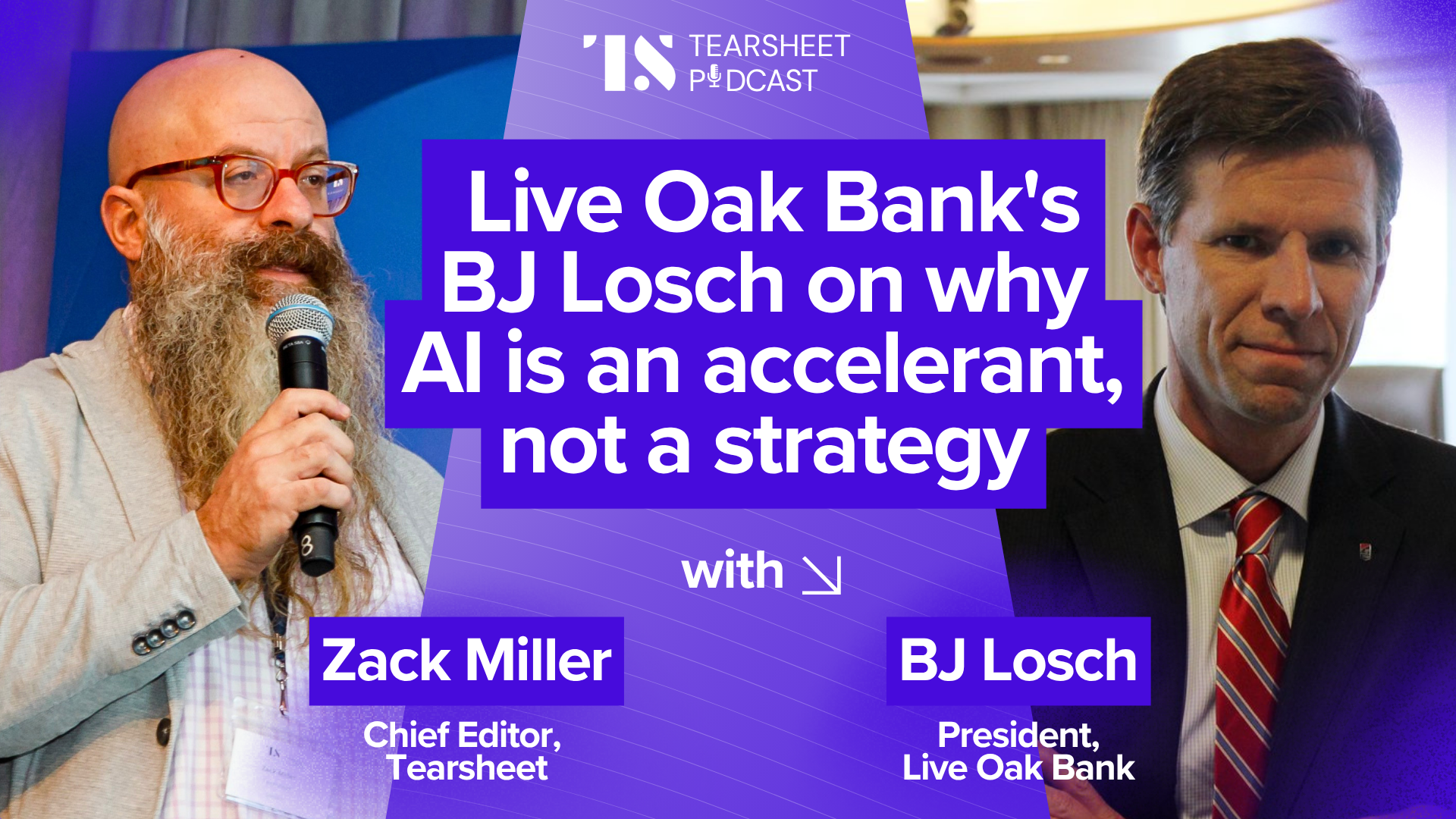
Most banks seem to chase small business customers as one segment among many. Live Oak Bank was built around a bet that specializing beats generalizing — and it started about as narrow as a bank can start, lending only to veterinarians. Today, Live Oak has grown that thesis into 40 verticals, holds the top spot among all SBA 7(a) lenders by dollar volume, and has done it all without a single branch.
My guest is BJ Losch, president of Live Oak Bank. Live Oak has never had a physical location, yet its people travel the country to sit across the table from customers a branch down the street never would. Now the bank is layering AI onto that model, cutting loan approval-to-close timelines from over 100 days toward a two-week target, and thinking hard about what it means to stay high-touch while going high-tech.
We talk about the theory of verticality, where automation should and shouldn’t touch the credit decision, and why BJ sees AI as an accelerant of Live Oak’s strategy rather than the strategy itself.
Top-line Takeaway: In his conversation with Tearsheet founding editor Zack Miller, BJ Losch, President of Live Oak Bank, underscores that AI works best as an accelerant to a strong strategy, not a strategy in itself. For Live Oak, the branchless, nationwide bank, that strategy is vertical specialization: deeply understanding small businesses in specific industries and pairing that expertise with high-touch service. AI can take on more of the manual work behind lending, helping the bank move toward two-week loan closings and making personalized service more scalable. But Losch draws a clear line around human judgment in credit decisions, where trust, accountability, and borrower context still matter. The bigger opportunity, he says, is using AI to rethink workflows, productivity, and distributionwhile preserving the customer intimacy that has differentiated Live Oak from traditional banks.
Read the whole transcript (for TS Pro subscribers)
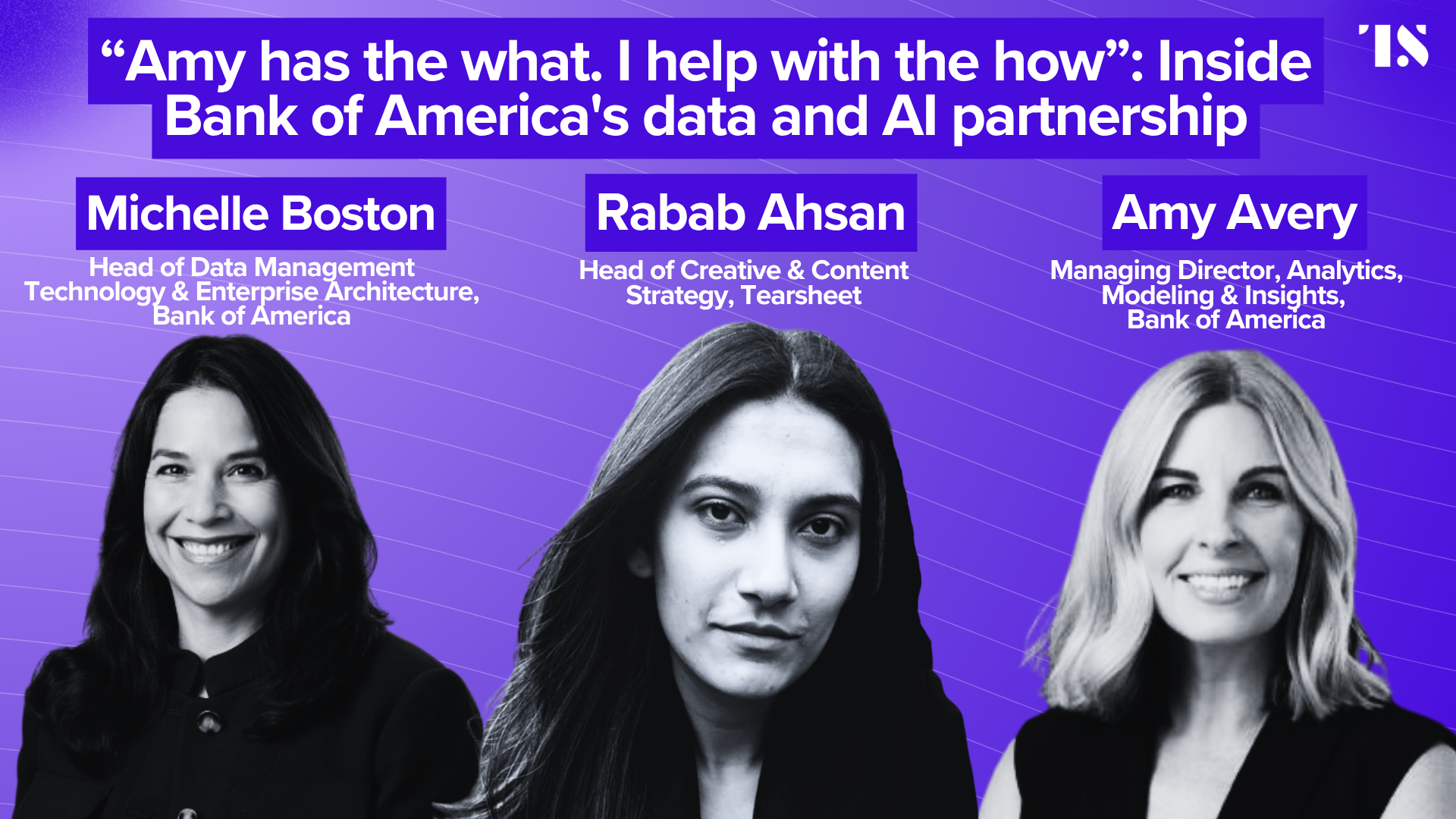
Amy Avery, Managing Director, Analytics, Modeling and Insights, took her job at Bank of America because of a number. When she interviewed at Bank of America, she was told that the bank interfaced with, at the time, 67 million clients. “Gosh, that’s so much information,” she remembers thinking. “Think about what you could do with that.” She started in January 2020. Two months later, the pandemic made that abstraction very literal: the bank suddenly needed to know, in real time, how its customers were doing, thinking, and coping. Avery’s job was to figure out how to answer that.
Michelle Boston, Head of Data Management Technology & Enterprise Architecture, arrived by a different route entirely. She built her career in enterprise technology, rose to CIO of a startup that was eventually built and sold, and came to Bank of America first as a contractor to lead an information architecture practice. “Data has always kind of been in my blood,” she said. At Bank of America, she works at a scale few other organizations have and builds the platforms that serve as the enabling force for Avery’s work.
Despite a very different set of starting points, the two describe a partnership that has essentially erased the line between their jobs. “We probably know each other’s jobs better now than before generative AI showed up”, Avery said, because the pace of the last two years has forced her strategy team and Boston’s engineering team to make decisions in near lockstep.
Listen to the full episode to hear how Avery and Boston have built a shared language across the two functions, and how they’re stress-testing it against a technology cycle that seems to wait for no one.
The weekly 10-Q newsletter is part of the Tearsheet Pro subscription, where I unpack the recent moves and strategies of leading banks and fintechs in the public space, coupled with stock market analysis. In your inbox every Friday!
Citi is done getting smaller. Now it has to get better.
After years of restructuring, Citi is putting its rebuilt infrastructure to work.
Citi delivered its best quarterly revenue in a decade. Revenue reached $24.8 billion, up 14% year over year, while net income jumped 45% to $5.8 billion and investment banking revenue rose 44%. Yet the stock fell 4.2% after earnings.
Investors are moving past whether the bank can generate earnings and toward what management does with them. Citi’s 13% Q2 Return on Tangible Common Equity (RoTCE) was already above its 10%-11% 2026 target, but management has kept that target intact while leaving room to pull forward investment spending. Its next test is proving the rebuilt bank can become a more effective growth machine.
The $1 trillion franchise hiding in plain sight
Citi’s Services business – Treasury and Trade Solutions and Securities Services – is where the bank’s growth strategy is becoming most tangible.
Services revenue rose 18% in Q2 to a record $5.5 billion, while average deposits grew 19% to about $1.1 trillion. Cross-border transaction value rose 13%, assets under custody and administration increased 22%, and the business generated a 30.9% RoTCE, more than twice Citi’s 13% firmwide return.
The bigger opportunity lies in what happens when Citi can connect those capabilities within the same institutional relationship. A bank sitting inside a company’s daily cash flows can see when balances build, receivables shift, currency exposure emerges, or financing needs appear.
Payments can be the entry point, but a wider opportunity is owning more of what happens around the money.
This analysis tracks the top company developments and how markets absorbed them through Thursday’s close, focusing on where shifting narratives translate into price action.
It is part of Tearsheet PRO’s weekly 10-Q Newsletter, where strategy meets market reaction. I track how leading banks and fintechs are evolving in public markets and how investors are pricing those moves.
Subscribe to PRO and get the full 10-Q story in your inbox every Friday!
1. Klarna (KLAR) – Close: $14
Klarna Card reached 6.5 million active users across 16 countries, up from 1.3 million a year ago, while paying subscribers reached 2 million, eight times the year-earlier level.
But Klarna cut its full-year GMV outlook to $149-$151 billion from more than $155 billion as discretionary spending weakened in Germany. The stock fell more than 20% after the results.
Why it matters: Klarna Card, pay-in-full transactions, subscriptions, and larger-ticket financing are giving it more ways to monetize the same customer relationship. But the lowered outlook is a reminder that expanding the product set doesn’t remove Klarna’s exposure to consumer spending. The question now is whether these newer businesses can make Klarna’s revenue less dependent on the broader shopping cycle.
Visa and Mastercard joined Rain’s newly launched Agentic Payments Alliance, alongside Fiserv, Circle, Solana, and Remitly, to work on standards for how AI agents will transact.
The coalition will focus on agent identity, authorization, fraud, loyalty, and regulation – the infrastructure questions that have to be solved before agents can transact at meaningful scale.
Why it matters: The agentic commerce debate is moving beyond “can an AI agent buy something?” to who gives the agent permission to pay, what limits apply, and who is responsible when something goes wrong. Visa and Mastercard’s involvement matters because those decisions will shape how the existing payments system adapts to software acting on behalf of consumers. The rails are starting to help define how agentic commerce works.
3. Citi (C) – Close: $129.67
Citi launched Custody+, a suite of near- and real-time custody capabilities designed for compressed settlement cycles, continuous markets, and increasingly automated investment decisions.
The bank is also building digital-asset custody on the same architecture, with bitcoin expected to be the first asset supported later this year.
Why it matters: Custody has historically been built around batches, cutoffs, and end-of-day processes. Citi is effectively acknowledging that the underlying financial system is moving toward continuous activity and custody has to move with it. There will be a common architecture for traditional and digital assets: rather than treating crypto as a separate infrastructure layer, Citi is trying to make it another asset type within the same custody system.
4. PayPal (PYPL) – Close: $62.30
PayPal and Venmo are expanding into tuition payments through integrations with Illumia, Nelnet Campus Commerce, and TouchNet, giving students and families the option to pay schools directly through their platforms.
The integrations are already live at schools including Bellarmine, Butler, Kansas State, and Michigan State, with more institutions expected to join.
Why it matters: Tuition is a large, recurring payment that still runs through fragmented systems at many schools. PayPal is trying to insert itself into an existing institutional workflow rather than simply compete for another checkout transaction. If its wallets can handle more of the payments people already make, the network becomes more embedded in everyday financial activity rather than relying on individual transactions.
5. Robinhood (HOOD) – Close: $95.10
CEO Vlad Tenev is pushing U.S. policymakers to update securities rules to allow tokenized stocks, arguing that American investors shouldn’t be excluded from infrastructure being built around American assets.
Robinhood says its Robinhood Chain has already processed 100 million transactions, while its Stock Tokens provide exposure to more than 190 U.S. stocks across 120-plus countries.
Why it matters: Robinhood is now lobbying for the regulatory framework that would let tokenized assets become a mainstream part of U.S. markets. That makes this a bigger strategic bet on how ownership itself could work, including 24/7 trading and faster settlement. But the regulatory push also highlights the unresolved question: tokenizing an asset doesn’t automatically mean you’ve preserved all the protections and market infrastructure surrounding the underlying security.
The weekly 10-Q newsletter is part of the Tearsheet Pro subscription, where I unpack the recent moves and strategies of leading banks and fintechs in the public space, coupled with stock market analysis. In your inbox every Friday!
Is it time for AI to enter the payback period and show its ROI?
AI’s contribution remains buried in the broader earnings numbers.
Block’s latest quarter is an early test of what happens when a financial company doesn’t simply add AI to its products but, in fact, restructures the company around it. Six months after cutting more than 40% of its workforce, Block reported 25% year-over-year gross profit growth, a record 27% adjusted operating margin, and 65% growth in adjusted diluted EPS. It also raised its full-year outlook.
That doesn’t prove AI is responsible for the improvement from head to toe. But it gives investors a real operating experiment to watch, which is relatively more useful than another AI product announcement at the moment.
Last week, I looked at Block’s Q2’26 results and how AI is increasingly shaping the way the company operates. That got me thinking about the next question. If AI is changing the operating model, how do we know when AI itself is actually paying off?
A little context: Block’s bet started in February 2026, when CEO Jack Dorsey cut more than 4,000 jobs and argued that AI had changed the economics of how the company could operate. That meant smaller teams equipped with increasingly capable intelligence tools could do more work, faster.
Six months later, there are signs that the operating model is changing. Block said it shipped 130 features in the first half of 2026, more than three times the 40 it shipped during the same period a year earlier. AI tools are now involved in nearly every production code change and review.
CFO Amrita Ahuja said the company was able to achieve “record profitability” while continuing to invest in growth, with AI helping increase product velocity.
The numbers are significant because they show up alongside – not instead of – business growth. Square gross profit and gross payment volume each increased 13%. Cash App gross profit grew 31%. Consumer lending originations rose 59%. Block raised its full-year gross profit forecast to $12.51 billion and adjusted EPS growth forecast to 70%.
That makes Block a pretty clean case study for the emerging question of AI ROI.
But there is an important catch: the company still can’t isolate how much of that performance came from AI alone.
This analysis tracks the top company developments and how markets absorbed them through Thursday’s close, focusing on where shifting narratives translate into price action.
It is part of Tearsheet PRO’s weekly 10-Q Newsletter, where strategy meets market reaction. I track how leading banks and fintechs are evolving in public markets and how investors are pricing those moves.
Subscribe to PRO and get the full 10-Q story in your inbox every Friday!
1. Wells Fargo (WFC) – Close: $88.11
Wells Fargo plans to launch tokenized deposits for select corporate and commercial clients this fall, initially enabling 24/7 movement and settlement between U.S. dollars and British pounds.
The move puts Wells Fargo into a more direct contest with J.P. Morgan and Citi over the future of bank-based digital money for corporate payments, with expansion to more clients, currencies, and countries planned for 2027.
Why it matters: The move gives corporate treasurers some of the speed and programmability of stablecoins without asking them to move money into a separate digital asset. If payments can eventually be tied to invoices, delivery milestones, or other business conditions, the bigger opportunity is automating the workflow around the payment itself. The catch is interoperability: a tokenized deposit is only as useful as its ability to move beyond one bank’s network.
2. Block (XYZ) – Close: $83.09
Square is expanding Bill Pay so sellers can use their Square Credit Card to pay vendors even when those vendors don’t accept cards, with funds delivered via ACH or check.
The refreshed card offers 3% cash back on Square Bill Pay transactions and 1.5% on other purchases, adding another reason for sellers to keep more of their spending inside Square.
Why it matters: Block’s Square is pushing its credit product deeper into the day-to-day cash-flow management of a small business. The important move is removing the card-acceptance constraint that normally limits where business credit can be used. Combined with Square’s deposits, lending, and payments products, the company is making the case for managing more of the business’s financial life in one place, while giving itself more opportunities to monetize that relationship.
3. Coinbase (COIN) – Close: $153.90
Coinbase Business can now accept payments from AI agents through the x402 open standard, with transactions settling instantly in USDC.
The update comes alongside broader payment tools, while Coinbase says its Business platform now serves more than 5,000 companies and has powered more than 100,000 payments.
Why it matters: This is one of the clearer signs that agentic commerce is starting to require its own payment infrastructure. An AI agent doesn’t have a traditional checkout experience or necessarily want to navigate cards, invoices, and banking portals the way a human does. USDC and x402 give machines a way to transact directly, but the bigger question is whether businesses will actually want autonomous agents making payments and what controls they’ll eventually require when they do.
4. Intuit (INTU) – Close: $358.29
Intuit is adding Intuit Intelligence Chat to QuickBooks Online Advanced and Intuit Enterprise Suite, allowing finance teams to query business data and trigger workflows using natural language.
QuickBooks Online Advanced is also bringing bill pay, payments, and AI-driven bookkeeping into the core subscription, including “Books Upkeep” for continuous transaction reconciliation.
Why it matters: Intuit is moving beyond the familiar “AI assistant” pitch and putting AI directly into the financial workflows where decisions and transactions happen. That’s a meaningful shift for the middle market: the value isn’t just getting an answer faster, but having the system resolve transactions, reconcile books, and initiate workflows. It also raises the bar for measuring AI’s value: less about how often users chat with an AI tool and more about how much manual finance work disappears.
5. Klarna (KLAR) – Close: $20.68
Klarna is rolling out four new membership tiers across 11 European markets, ranging from €4.99 to €44.99 [roughly $5.75-$51.80] per month, with higher tiers offering more cashback, subscriptions, travel benefits, and protections.
The company is simultaneously removing service fees and increasing rewards, positioning the membership model as a broader financial relationship rather than simply a BNPL add-on.
Why it matters: Klarna is trying to make the membership itself a gateway to more of the customer’s financial life. The higher tiers are bundling payments, rewards, subscriptions, travel, and card usage into one recurring relationship. That matters because the economics of a financial platform can look very different when it earns from a customer’s broader engagement rather than from individual transactions alone.
The fintech bargain with banks is getting harder to maintain. Companies that built the customer experience while leaving deposits, lending, and regulatory oversight to a partner bank increasingly want the charter themselves.
Bunq just ran into the reality of what that requires. The Dutch neobank, which has 20 million users across more than 30 European markets, had already secured a U.S. broker-dealer license and was positioning its U.S. bank around consumers who live and work between America and Europe. But on August 7, the Office of the Comptroller of the Currency (OCC) rejected its application for a national bank charter, saying Bunq needed a U.S.-specific plan, more demonstrated experience with the products it planned to offer, and greater clarity around its financial structure.
Bunq CEO Ali Niknam explained the reason behind the rejection: “The OCC wants to see a plan more specifically built for the US market, with greater demonstrated experience in the products we want to offer, and detail on our financial structure,” he told Bloomberg. “So we’ll do what we always do: listen, adapt, and keep moving forwards.”
Bunq wasn’t the only fintech to hear no from the OCC this summer. In July, the agency rejected Wise’s proposed national trust bank, citing shortcomings around AML/CFT controls and management experience. Wise’s existing U.S. operation had been under a multistate consent order since 2025 over suspicious-activity monitoring, reporting and other compliance deficiencies. The OCC questioned whether those problems had been sufficiently addressed before being carried into a new bank.
The two rejections offer a useful picture of what the OCC is looking for as a growing number of fintechs pursue bank charters.
In this edition we will spotlight Jeff Pomeroy, Payment Services & Crypto.
Executive Summary
Six months after setting an ambitious agenda that included unifying PayPal’s global platform, expanding in-store, and scaling value-added services, Jeff Pomeroy is back on The Quarterly Review with progress to show on all three.
He also plants a flag on a newly broadened mandate: one platform for every business, every channel, and every payment modality — future-proofed with crypto and agentic commerce. And he shares his read on trends worth watching, including where he thinks the next durable moat in payments will be built, and what he’s doing to build it.
“When we last spoke, I framed our work around one idea: intense focus,” Pomeroy said. “Now I’m coming up for air to tell you about it.”
Here is what Pomeroy and his team have accomplished since our last conversation:
Made value-added services like network tokenization self-serve, converting nearly all merchants in a recent free-trial.
Closed a string of omni-channel deals via Verifone, including PayPal’s first omnichannel government contract.
Brought Australia and Europe fully onto PayPal’s unified platform and began moving processing in-house.
Broadened his remit into a new org, Payment Services & Crypto, unifying enterprise, small-business, crypto, and agentic commerce.
The Full Review
A few quarters ago, Pomeroy set three priorities for PayPal’s enterprise payments business: a unified global platform, in-store expansion via Verifone, and scaled value-added services. Six months later, he’s back with what he calls a clean sweep.
“The short version is that we stayed the course,” Pomeroy said. “This is an industry that produces a new shiny object every week, and most of the discipline is in not chasing it.”
That discipline came from guardrails he’d put in place, measuring every initiative against merchant demand, ROI, and contractual obligations.
“That discipline is showing up exactly where it should,” he said, “in the deals we’re closing, the services merchants are turning on, and how we’re executing in the public market.”
Objective 01: Scaling value-added services
Six months ago, the goal was to scale value-added services — network tokenization, smart retries, debit routing, and payouts. Pomeroy says that work has moved from launch to self-serve: merchants can now go into their portal, look at their own reporting, and switch on some of PayPal’s most meaningful services themselves.
“That’s a different business than the one we had a year ago,” he said.
The bigger challenge, he says, was getting merchants to understand what they’re worth. So his team built a proof mechanism that turns on network tokens for free and lets merchants watch what it does to their own numbers.
“We did exactly that with hundreds of merchants recently, and all but one kept the tokens on at the end of the trial,” he said, “because once they could see the value it returned to their payments experience, the decision made itself.”
His team built tooling that surfaces a merchant’s own performance data such as auth rates and costs. “That lets us walk in with the merchant’s own performance in front of us and have a real conversation instead of a sales pitch,” he said.
The team’s speed comes from process restructuring and optimization. PayPal has leaned into AI internally to reduce time-to-live for products, freeing teams to focus their judgment on the parts of a payments problem that actually need a human who understands how the rails behave.
“AI doesn’t replace that,” he said. “It clears the runway so we get to it faster.”
Objective 02: Winning in-store and omni-channel
The Verifone partnership remains, in Pomeroy’s words, the spine of PayPal’s move into physical retail, and he says the deals are coming through. His team has closed an array of omnichannel deals with real net-new volume, despite a deliberately small team in market and a pipeline several times larger than its previously closed business. Among the wins is PayPal’s first government deal in omnichannel.
“Which is not the kind of logo you expect to win in payments this early,” he said, “and exactly the kind of proof point that tells you the model works.”
But Pomeroy is clear that in-store is only part of the ambition. The bigger goal is making PayPal’s and Venmo’s own wallets feel as natural in a physical store as they already do online. He reaches for a nautical analogy to describe why offline is where the growth now lives.
“When we first docked twenty years ago, it was a quiet marina, and it was all ours,” he said. “Now it’s become pretty crowded. So, what do you do when the marina is full? You go find new water to sail. Offline is clear, open water.”
Pomeroy wants a PayPal or Venmo transaction to flow as seamlessly in person as tapping a card, and he wants merchants to offer those wallets first, every time. However, this ambition is additive rather than exclusive.
“We will always take a payment,” he said. “Our obligation is to bring merchants and consumers into these new environments so that every part of the business rises with them.”
Objective 03: One unified platform, globally
Of the three original priorities, Pomeroy says platform unification has been the most satisfying to watch land. Australia is now fully live on PayPal’s global stack, and so is Europe, for both new business coming in and the existing book of merchants. By the end of the year, he expects the migration to be complete, putting every market on one unified payment stack.
“And we’re not stopping at routing transactions through partners,” he said. “The next step is bringing more of the processing in-house, which is already live in its first market.”
The point, Pomeroy stressed, is that the merchant experience stays constant even as the infrastructure underneath it changes. “The merchant keeps one connection the entire time,” he said. “The plumbing behind it changes; their experience doesn’t.”
The bigger mandate: Payment Services, Crypto, and Agentic
Pomeroy’s remit has broadened into a new organization, Payment Services & Crypto, sharpening what he once described as PayPal’s North Star.
“We want to become a flexible platform for all businesses, operating in every channel, with every payment modality,” he said.
Practically, that means merging enterprise and small-business processing into one center of payment excellence. “The question was when, not if,” he said. “The levers we built on the enterprise side and the levers that have lived in small business no longer have to live in separate boxes.”
Crypto belongs on that same platform, he argues. With more than 600 million crypto wallets globally, he sees efficiency gains across settlement, cross-border payments, and payouts.
“It’s becoming part of the global financial infrastructure, and at that point it can’t be a separate business anymore,” he said. “Putting payments and crypto under one roof is how you bring scale and speed to both.”
He also flagged a distribution gap: much of PayPal’s volume now arrives through platforms like BigCommerce, Wix, WooCommerce, and Shopware, where its value-added services have historically been unavailable. “The next leg of the journey is getting our services onto all of those surfaces, so it stops mattering how a merchant reaches us,” he said.
Pomeroy also names agentic commerce as an area he’s watching closely. “In thirty years in payments, you almost never see a genuinely new channel appear,” he said, “and this is one.” With AI agents projected to drive trillions in commerce by decade’s end, he sees the infrastructure for that shift as still unbuilt at scale. “You earn the right to answer those questions by building the foundation and putting up the volume,” he said. “Then you’ve won.”
A word for other leaders
Last time, Pomeroy talked about the leadership habits he tries to model, building a culture that sticks, empowering people rather than making them ask for permission, and carving out time to think. This time, his advice for other leaders is more compact.
“It is too easy to be distracted by the news cycle,” he said. “Focus in on what you can deliver, what drives value for your customers, and where your teams actually take pride in delivering things in a very focused and measurable way. That’s the whole game.”
This may be the final entry in this particular check-in series, but Pomeroy isn’t ready to close the book entirely.
“I know this series is over,” he said, “but I’d love to check in again next year to talk about how our North Star is coming into clearer focus.”