


‘Value is going to accrue down to the application layer’: VanEck’s Juan Lopez on crypto’s infrastructure shift
- anEck Ventures' Juan Lopez discusses how crypto infrastructure has matured from experimental technology to regulated financial products, with stablecoins growing from under $1 billion to over $60 billion in circulation during his time at Circle.
- He explains why investment value is shifting from the commoditized issuance layer to the application layer, where companies can build user-friendly products on top of crypto rails.
The infrastructure for crypto-native finance is maturing beyond proof-of-concepts into real financial products. Tokenized securities are moving from experimental pilots to regulated offerings, stablecoin infrastructure is becoming the backbone for 24/7 payment systems, and traditional fintech companies are quietly integrating crypto rails to improve settlement and unlock new capabilities.
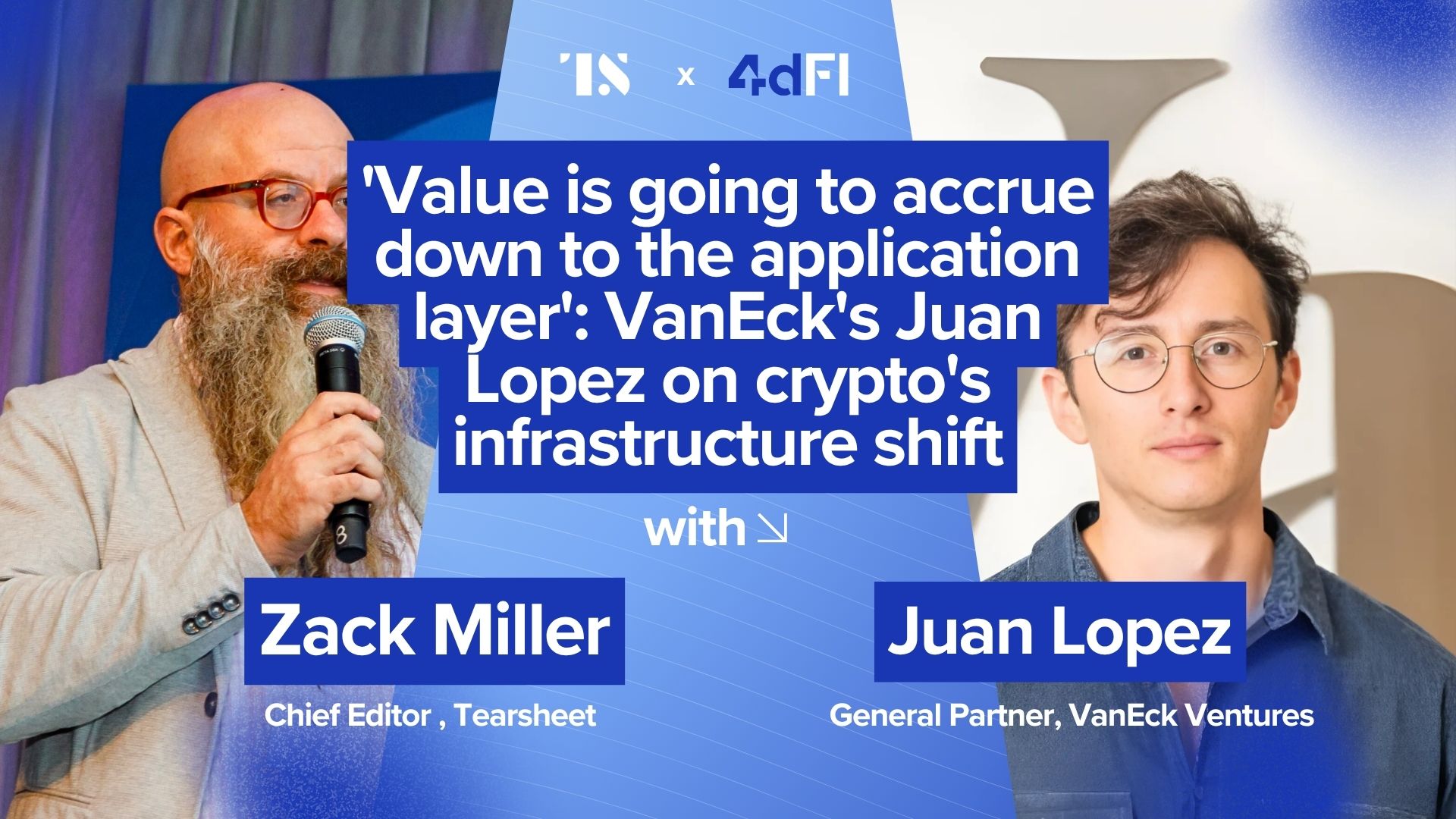
I’m joined by Juan Lopez, General Partner at VanEck Ventures, where he focuses on investments at the intersection of traditional finance and blockchain technology. Before joining VanEck, Juan was at Circle Ventures, giving him a front-row seat to how institutional-grade crypto infrastructure has developed. His portfolio includes companies building the regulated infrastructure enabling this shift from experimental to operational.
Juan’s perspective on where real value is being created—from tokenized equity platforms achieving regulatory approval to stablecoin routing systems—offers insight into how crypto infrastructure is becoming essential plumbing for modern financial services. We’ll discuss what’s driving adoption, where the next wave of exits will come from, and how fintech companies are integrating blockchain technology to improve their core business models.
Watch the podcast
Listen to the podcast
Subscribe: Apple Podcasts I SoundCloud I Spotify
The pendulum swings toward applications
“At the very beginning, we were trying to partner with any great entrepreneur who we thought could help extend the USDC network,” Lopez explains. But as stablecoin issuance became increasingly competitive, his focus shifted. “We started to strongly take the view that the issuance layer will eventually become commoditized. We think value is actually going to accrue down more towards the application layer.”
Every boardroom needs a stablecoin strategy
The recent passage of the GENIUS Act creates new opportunities for financial institutions to integrate stablecoin infrastructure. Lopez believes every company now needs to ask: “What is my stablecoin strategy?” His firm has invested in companies like Ubix, which helps banks accept stablecoins without issuing their own, and Dinari, the first tokenized equity platform to receive FINRA broker-dealer approval.
Stripe validates the vertical integration thesis
Stripe’s recent acquisitions of Bridge and Privy validate Lopez’s thesis about owning the full stack in crypto financial services. “It will matter whether you own the wallet or not, because you’ll get to influence which products you distribute and the types of moats that you can build,” he says. The biggest opportunities ahead lie in companies that can abstract away crypto complexity and make these powerful capabilities accessible to mainstream users.
Key takeaways:
- The value in crypto infrastructure is shifting from issuance (which is becoming commoditized) to the application layer where companies can productize capabilities for end users
- Every financial institution now needs a stablecoin strategy following regulatory clarity from the GENIUS Act, but most don’t actually have one yet
- Wallet ownership matters significantly for crypto financial services economics and product distribution control
- Tokenized securities represent the next frontier for exporting US capital markets globally through programmable infrastructure
- The most successful crypto infrastructure companies combine strong business models with compelling narratives that align investors around long-term growth
Read the transcript (for TS Pro subscribers)