
Podcasts

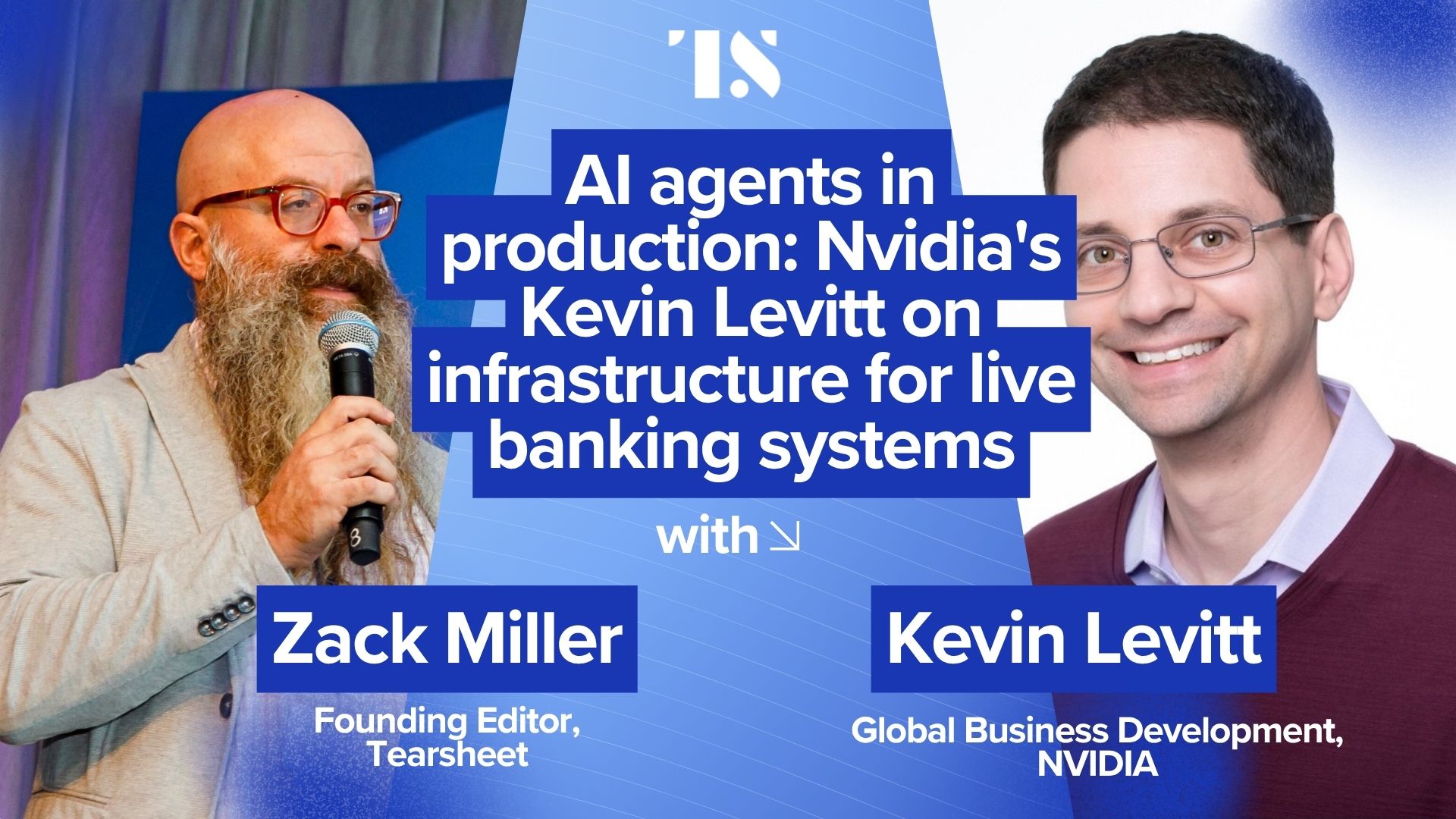
AI agents are making real financial decisions: Nvidia’s Kevin Levitt on the infrastructure behind Capital One, Visa, and RBC’s live deployments

  • Agentic AI has moved into live production at Capital One, Visa, and RBC, with multi-agent systems autonomously executing trades and managing customer interactions.
  • Nvidia's Kevin Levitt explains the infrastructure demands and build-versus-buy decisions as banks deploy AI agents handling real transactions.
close

Email a Friend

AI agents are making real financial decisions: Nvidia’s Kevin Levitt on the infrastructure behind Capital One, Visa, and RBC’s live deployments

We’ve been covering AI in financial services for a while now—chatbots, generative AI, fraud detection models. But something fundamental is shifting. We’re moving beyond AI as a tool that assists humans to AI as an actor that takes action on our behalf.

Agentic AI is no longer a research project. It’s live. Capital One has AI agents helping consumers buy cars. Visa is letting AI agents spend your money. RBC has agents executing trades, learning and adapting in real-time to market conditions.

It’s already here. The question is: what does it take to make this work at scale? What infrastructure do you need when an AI agent is handling real financial transactions at 2 AM? How do you architect for reliability when there’s no human in the loop?

My guest today is Kevin Levitt, who leads global business development for financial services at Nvidia. Before Nvidia, Kevin spent years inside fintechs like Credit Karma and Roostify. At Nvidia, he’s working with firms like Capital One, Visa, and RBC as they deploy agentic AI in production—not pilot programs, actual live systems processing real transactions.

We’re digging into the case studies, the computational demands of multi-agentic systems, the security challenges when agents control money, and what financial institutions need to be thinking about now.

Nvidia’s Kevin Levitt is my guest today on the podcast.

Watch the episode

Listen to the episode

Subscribe: Apple Podcasts I SoundCloud I Spotify

The shift from assistive AI to agentic AI

“We’re moving beyond AI as a tool that assists humans to AI as an actor that takes action on our behalf,” said Zack Miller. Capital One has AI agents helping consumers buy cars. Visa is letting AI agents spend your money. RBC has agents executing trades, learning and adapting in real-time to market conditions. The infrastructure question has become critical: what do you need when an AI agent is handling real financial transactions at 2 AM? How do you architect for reliability when there’s no human in the loop?

Understanding AI factories

“An AI factory powered by Nvidia’s full stack platform is everything from the underlying infrastructure—GPUs, the networking that allows servers to be interconnected at high speeds—to the platform software that helps maximize utilization of that infrastructure,” Levitt explained. “It’s really those three layers: the infrastructure, the platform software, and then the application frameworks and SDKs that sit on top to help developers build and deploy AI-enabled applications at scale.” These AI factories are essentially powering the next industrial revolution, where enterprises take data in and manufacture intelligence out.

Capital One’s multi-agent auto buying assistant

Capital One’s chat concierge represents a breakthrough in multi-agent conversational AI designed to enhance the automotive buying experience. “It’ll help consumers research vehicles that are of interest. It’ll actually reach out to the dealerships on behalf of the consumer to schedule test drives and dealership visits. It’ll help the consumer understand auto loans more deeply, and what the prices and rates are associated with those loans,” Levitt said. The platform is delivering an improved customer experience within a very complex consumer financial journey—shopping for a car and procuring the right loan.

The computational explosion of agentic AI

The migration from generative AI to agentic AI has created unprecedented computational demands. “These agentic AIs first focus on understanding the problem at hand, then they think or reason through that problem, and then they act. All of that requires compute, and it’s no longer just a one-shot outcome like we’re used to experiencing with generative AI,” Levitt explained. “The agentic AI is actually thinking in the background, experiencing what prior frameworks and tools it’s used to answer similar questions. All of that thinking is generating 100x, 200x more compute than we anticipated, if not more.”

RBC’s AI-powered research platform

Royal Bank of Canada is leveraging their Aiden Research Program, a suite of specialized AI agents helping employees focus on more high-value work while AI agents handle tasks such as generating earnings-related content, summarizing calls, and producing updated research reports. “It’s actually improving the cycle time to report generation by over 60%, and they’re able to encapsulate or analyze 10 times more data than a human can,” Levitt noted. Investment bankers need to generate updates as new information becomes available across hundreds or thousands of data streams tied to publicly traded companies—a perfect use case for agentic AI.

The build versus buy decision for banks

Financial institutions are increasingly moving from managed services to building their own bank-specific models. “You take an open source foundation model, which might be about 50% accurate to your bank-specific needs and questions, then you layer in your bank proprietary data, and that’s going to improve accuracy by another 10 to 20 points,” Levitt explained. “Then you do some supervised fine tuning—enabling it to do specific functions like assist with wealth management or anti-money laundering and KYC requirements. Once that accuracy improves, utilization skyrockets, which is why the largest banks are building and training their own bank-specific GPTs to lower their costs and improve their ROI.”

The AI-powered fraud detection arms race

Protecting the financial ecosystem remains job number one, and AI is transforming fraud detection capabilities. “You can leverage deep learning techniques such as graph neural networks to create feature embeddings—multi-dimensional vectors that can help get more accurate detection of fraudulent activities—and integrate those embeddings into machine learning models so that you have the explainability and the pathway to getting into production more quickly,” Levitt said. Beyond transaction fraud, AI agents are processing suspicious activity reports as part of anti-money laundering efforts, freeing human agents to focus on more sophisticated work. Financial services firms facing consent decrees and billions in fines for AML and KYC non-compliance are seeing this as one of the biggest use cases for agentic AI.

0 comments on “AI agents are making real financial decisions: Nvidia’s Kevin Levitt on the infrastructure behind Capital One, Visa, and RBC’s live deployments”

Podcasts

Why venture capital infrastructure is finally getting automated

  • The manual processes that used to require lawyers, fund administrators, and accountants to set up private investment vehicles can now be handled by software in days instead of months.
  • Sydecar's founder explains how standardizing legal documents unlocked automation across the entire investment lifecycle, and why major banks are now acquiring platforms to bring private market access to retail investors.
Zachary Miller | December 03, 2025
Podcasts

Why every bank now needs a stablecoin strategy (whether they like it or not)

  • The GENIUS Act brings regulatory clarity to stablecoins, but Conduit CEO Kirill Gertman argues that clarity alone won't guarantee success.
  • Banks face a choice between building their own infrastructure or becoming the pipes for others.
Zachary Miller | November 19, 2025
4dFI global fintech podcast, Podcasts

Banks or Pipes: Where financial institutions go when agents take over

  • AI agents are reshaping financial services, forcing banks to choose between building proprietary models, becoming infrastructure providers, or leveraging trust through partnerships.
  • With web traffic down 20-30% and Capital One seeing 55% engagement boosts from AI concierges, the transformation is already underway.
Zachary Miller | November 13, 2025
Podcasts

FIS’s Shane McWilliams on SMBs, data sharing, and the strategy that wins in a competitive environment

  • Banks dramatically underestimate how many customers share financial data with third parties, and most of it happens through insecure screen scraping.
  • Shane McWilliams of FIS explains why SMBs now expect their banks to serve as central financial hubs and how relationship-first thinking beats product-centric approaches.
Zachary Miller | November 07, 2025
Payments, Podcasts

How Wix built payments, checking, and capital for 293 million users 

  • Wix transformed its internal payment infrastructure into a $3 billion-per-quarter fintech platform by focusing on universal access and merchant-specific pain points rather than building a walled garden for premium users.
  • Dive into how Wix reimagined checking accounts to eliminate the "where is my money?" problem with instant fund access, and leveraged proprietary website data to expand capital access for small businesses that traditional lenders overlook.
Rabab Ahsan | November 05, 2025
More Articles