
Podcasts

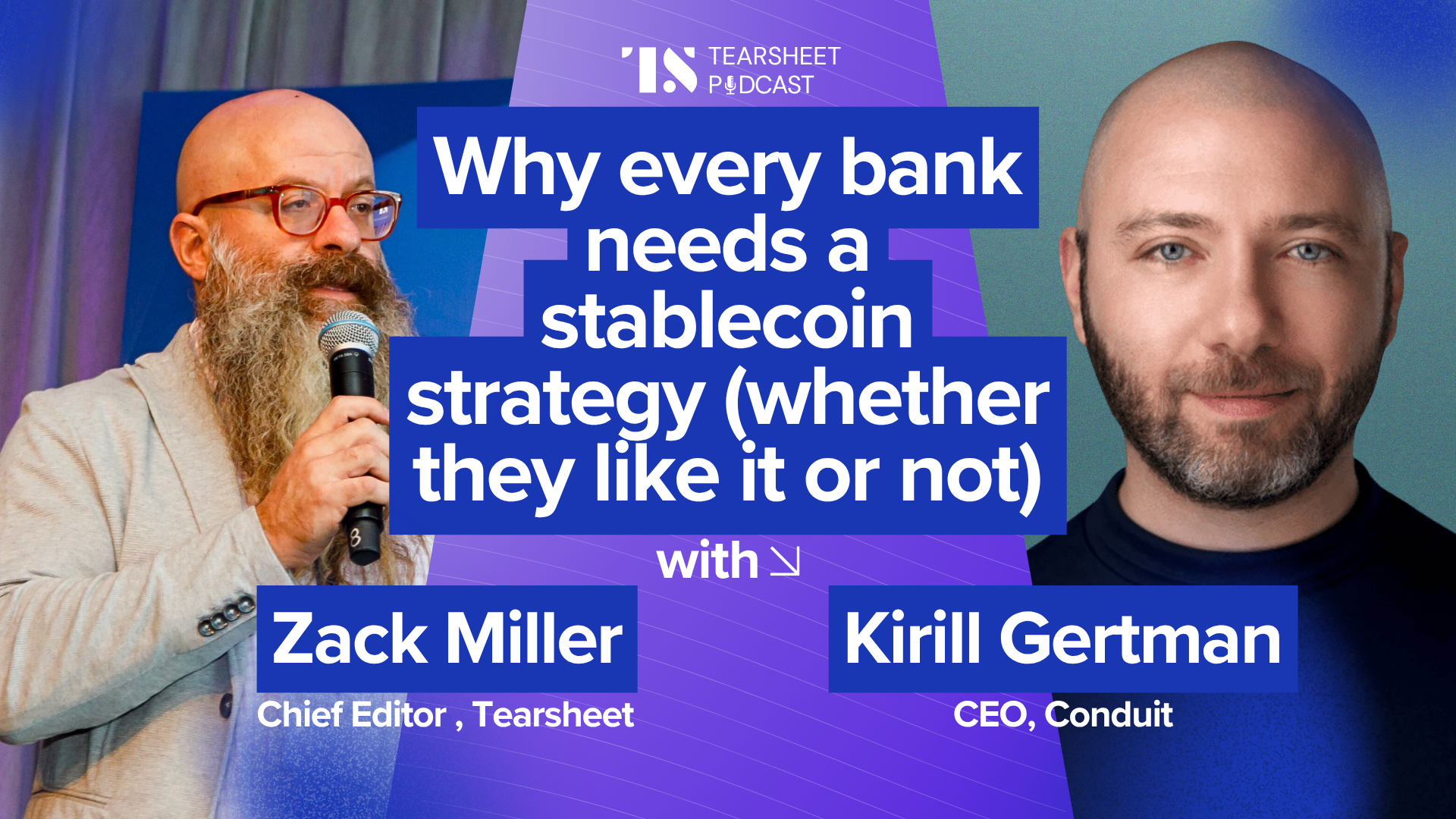
Why every bank now needs a stablecoin strategy (whether they like it or not)

  • The GENIUS Act brings regulatory clarity to stablecoins, but Conduit CEO Kirill Gertman argues that clarity alone won't guarantee success.
  • Banks face a choice between building their own infrastructure or becoming the pipes for others.
close

Email a Friend

Why every bank now needs a stablecoin strategy (whether they like it or not)

The GENIUS Act brings regulatory clarity to stablecoins, but Conduit CEO Kirill Gertman argues that clarity alone won’t guarantee success. Banks face a choice between building their own infrastructure or becoming the pipes for others.

Gertman has watched the stablecoin industry evolve from multiple angles. He spent nearly two decades in financial services before founding Conduit in 2021, including six years in crypto and a stint as VP of product at BRD, which became Coinbase Wallet. His company grew 16x in 2024 by solving a practical problem: businesses in emerging markets were accumulating stablecoins to hedge against local currency volatility but couldn’t use those balances in their day-to-day operations. Conduit now works with tier-one banks and multinational corporations, processing billions in cross-border payments. And with the GENIUS Act bringing the first comprehensive regulatory framework for stablecoins in the United States, Gertman argues the legislation’s passage raises as many strategic questions as it answers—particularly for banks that have been sitting on the sidelines.

Today, we’ll explore why the GENIUS Act matters, the critical difference between stablecoins and deposit tokens, what strategy banks should actually pursue, and where Gertman sees the industry heading as major players race to build vertically integrated stacks.

Watch the episode

Listen to the episode

Subscribe: Apple Podcasts I SoundCloud I Spotify

The big ideas

  1. Regulatory clarity finally exists, but creates new competitive pressures

“Finally, there is a regulation in the US that governs this thing. Finally, there’s actually something that says, well, you can and cannot do and it’s official, and legitimate.”

The GENIUS Act’s mere existence matters more than its specific provisions. For the first time, companies and banks understand the rules around stablecoin issuance, reserve requirements, and what’s legally possible. This clarity is already spurring regulatory efforts in other countries attempting to create similar frameworks. But clarity also exposes who’s ahead and who’s behind. Circle and Coinbase emerge as clear winners with established infrastructure and distribution. Banks, meanwhile, are playing catch-up and lobbying against provisions that allow issuers to pass yield to customers—something banks could do themselves but historically haven’t.

  1. Stablecoins versus deposit tokens: fractional reserves change everything

“If you have $10 of a deposit token, and you have $10 in cash, you can lend out $9 and make money on that, and it’s still valid, because you’re a bank and you can do that.”

The distinction between stablecoins and deposit tokens isn’t semantic. Stablecoins must be backed one-to-one by reserves—typically short-term treasuries—with issuers making money on the yield. Tether generates roughly $4 billion in profit quarterly this way. Deposit tokens can only be issued by banks and are backed by actual customer deposits. The critical difference: banks can fractionalize these reserves just like traditional deposits, giving them a structural advantage no non-bank issuer can match. But that advantage only matters if banks figure out what to actually do with it. The challenge, as Gertman points out, is that issuing a deposit token without a clear use case is just “jumping off a bridge because everyone else is doing it.”

  1. Most US domestic use cases will be invisible to consumers

“I’m here in Boston, I’m probably not going to have a stablecoin wallet for the sake of buying my Starbucks. What I think will happen in the US is Starbucks themselves may issue a stablecoin because it makes economic sense for them.”

Americans already have dollars, so consumer-facing stablecoin wallets for daily purchases don’t make sense domestically. Instead, stablecoins will operate in the background, abstracted from users. Starbucks might issue a stablecoin to earn yield on customer balances and save on interchange, but customers won’t necessarily know they’re using one. The clearer domestic opportunities are in stock settlement, loyalty programs, marketplace payments, and other infrastructure plays. The exception is cross-border payments, where stablecoins offer genuine speed and cost advantages over SWIFT. Banks with customers making international transfers—whether remittances, supplier payments, or revenue repatriation—have the strongest immediate use case for stablecoin strategy.

  1. Vertical integration will create fragmentation that needs horizontal solutions

“If you’re a merchant, and you’re getting paid in a PayPal stablecoin, and then you have your Shopify store, and you need to keep your balance in a Stripe stablecoin, and then you need to pay a supplier in China, and that’s going to be the digital yuan—it’s a mess.”

Major players are building full-stack solutions. Stripe launched Tempo, Circle is developing Arc, and tier-one banks have similar projects in stealth mode. Everyone claims their stack will be interoperable, but the economic incentives push toward walled gardens. This creates complexity for merchants who might receive payments in one stablecoin, maintain balances in another, and need to pay suppliers in a third. Gertman positions Conduit as “the next generation clearing house on chain,” focusing on horizontal interoperability rather than building another vertical silo. The question is whether the market consolidates around a few dominant stacks or whether interchange layers become necessary infrastructure.

From emerging markets to mainstream

Conduit’s growth story mirrors the industry’s maturation. In 2024, the company focused on businesses in Latin America, Africa, and Asia that had accumulated stablecoin balances to hedge against local currency volatility. These importers faced a frustrating workflow: convert stablecoins back to local currency, send SWIFT transfers that took four days and hit them with fixed fees and unfavorable FX rates. Conduit solved this by letting them use their stablecoin balances directly, executing payments locally in minutes.

“You’re an importer in Brazil bringing in TVs, you need to pay net 60, net 90, it’s $10 million,” Gertman explains. “You have the amount of Brazilian real to cover this invoice today, but in three months, that amount is going to need to be a little bit bigger. So you want to lock it in. You buy USDC and just sit on that balance for three months.”

Previously, they’d convert back to reals, send a SWIFT transfer, and wait. “We showed up and we said, don’t worry about that. We’re going to execute that payment locally, using local payment methods on the other side. It’s going to happen in minutes, it’s going to be cheaper, there’s no fixed fees.”

This year, the company’s client profile shifted dramatically. “We’re working with banks, with large multinational corporates. The size of client, the maturity of the client has grown tremendously,” Gertman notes. He’s tight-lipped about specific names but hints at partnerships with tier-one institutions and recognizable public companies launching in the coming months.

The maturation isn’t just about client size. “The story of last year was just explosive growth. The story of this year — now we’re a lot more mature, a lot more legitimate. We’re working with much larger players, and it becomes a lot more mainstream.”

The fragility of regulatory wins

Gertman’s most cautionary observation concerns the GENIUS Act’s permanence. While regulatory clarity is positive, he warns against taking it for granted as political winds shift. The best defense against future rollback is about more than lobbying — it’s making stablecoins so widely adopted that reversal becomes politically impossible.

For banks, this suggests a different kind of urgency. It’s about moving fast enough that you’re helping establish the standard, rather than adapting to whatever your competitors build. In financial services, technology might move fast, but regulatory permanence requires something slower and more fundamental: ubiquity.

0 comments on “Why every bank now needs a stablecoin strategy (whether they like it or not)”

Partner, Podcasts

How Huntington modernized without touching the core ft. Qolo

  • Commercial banks are modernizing by augmenting their core systems, layering virtual account infrastructure and unified platforms on top to handle rising complexity.
  • In this episode, Deepak Kapoor of Huntington National Bank and Rouzbeh Rotabi of Qolo discuss how connected deposits and virtual account structures enable banks to innovate faster, simplify reconciliation, and deliver more flexible, API-driven financial services without overhauling their core systems.
Zack Miller | April 09, 2026
Payments, Podcasts

Squarespace’s Corey Zettler on building a financial services suite for small businesses

  • Squarespace has expanded beyond website building to offer a growing suite of financial tools for small businesses, including payments, capital, and a new integrated balance account with a Visa debit card.
  • On the Tearsheet Podcast, director of product Corey Zettler explains the company's build-vs-partner approach, what it's learned from three product launches, and how it plans to deepen its financial services offering for service.
Zack Miller | April 08, 2026
Payments, Podcasts

How Paze is betting bank trust can crack the digital wallet market

  • The digital wallet space is crowded, but Paze is betting that consumer trust in banks — not tech giants — is the unlock.
  • In this episode, Serge Elkiner, General Manager of Paze at Early Warning Services, breaks down how the bank-backed wallet is building toward critical mass through merchant expansion, issuer growth, and a deliberate focus on the consumers other wallets haven't won yet.
Zack Miller | April 01, 2026
Innovation, Partner, Podcasts

How KeyBank and Qolo are modernizing corporate treasury without ripping out the core

  • Legacy treasury systems force companies to manage dozens of accounts manually. Virtual account management offers a modern fix without replacing core infrastructure.
  • KeyBank's Bennie Pennington and Qolo's Patricia Montesi discuss building a real-time VAM platform together, processing $40B+ in transactions.
Zack Miller | March 26, 2026
Partner, Payments, Podcasts

How Modern Treasury is building a payments platform for a hybrid money world

  • Modern Treasury recently launched an integrated payments platform blending fiat & stablecoins.
  • Tune in to find out how stablecoins complement fiat rails, why working capital is the biggest opportunity, and what instant payments means for enterprises.
Zack Miller | March 10, 2026
More Articles