


How enterprise AI is moving up the stack in 3 layers
- For the first episode of The Editors' Room, Tearsheet editors debate what they'd hand over to AI and what they wouldn't, before digging into how enterprise AI is taking shape.
- The enterprise AI stack is increasingly built around 3 things: shared context, specialized agents, and orchestration.
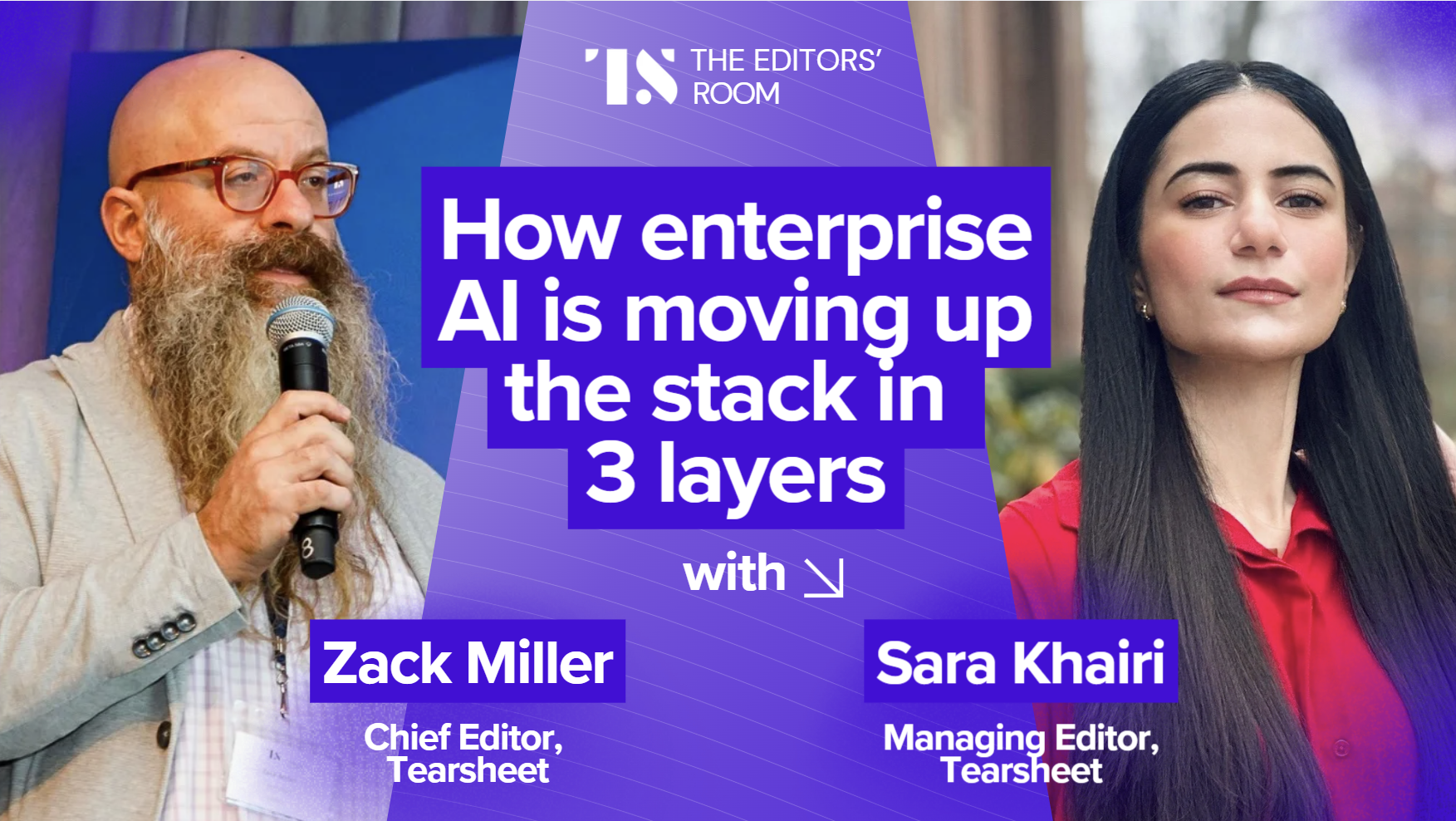
Welcome to The Editors’ Room, a new Tearsheet Podcast series where Editor-in-Chief Zack Miller and Managing Editor Sara Khairi take the conversations that usually happen behind the scenes about our biggest stories and put them on the record.
This isn’t a rehearsed interview or carefully choreographed panel answers. It’s just two editors comparing notes, challenging each other’s takes and trying to make sense of what is actually happening in financial services. Think of it as pulling up a chair after the meeting ends.
It’s the stuff we usually debate after the calls end: what a new product actually means, which industry trends have legs, and where the hype gets ahead of reality. Raw, conversational, and occasionally accompanied by a blooper.
For our inaugural conversation, the topic was AI and, more specifically, what would you happily delegate to AI and what would you never hand over? From there, we got into the bigger question of how enterprise AI is taking shape.
On that first question, Zack’s line is creativity. AI can handle planning and logistics, and he uses it as an editorial sparring partner, asking questions, challenging ideas, and pushing him to dig deeper. But the creative judgment stays human.
Sara draws the line at decision-making. Take an expensive laptop: she’ll happily let AI compare the options, but she wants to be the person who clicks buy.
It turns out that tiny distinction – AI can help make the decision, but shouldn’t necessarily make it – is becoming a much bigger question in financial services.
Watch episode #1
Listen to the full podcast
Subscribe: Apple Podcasts I SoundCloud I Spotify
Credit Karma’s answer to AI’s role: Let the math decide first
Intuit’s latest Credit Karma assistants offer a good example.
The company has launched assistants for paychecks, refunds, and debt, but the more interesting part is what happens beneath the surface. The assistants share a common financial context, giving them a broader view of a customer’s financial life rather than forcing each one to operate in a silo. But their workflow deliberately separates calculation from conversation.
Credit Karma’s optimization engine first analyzes the customer’s income, loans, interest rates, and goals, runs scenarios, and determines an appropriate strategy. Only then does generative AI step in. Its job isn’t to invent the answer but to explain the answer, turning the optimization engine’s structured output into a personalized, understandable recommendation. Then it hands the decision back to the customer.
For both editors, that human-in-the-loop approach is the point. AI can do the homework and can surface the options. But when it comes to your money, someone still needs to take the test.
The chatbot era may be running out of steam
That architecture also points to where financial AI may be headed next.
Zack sees the traditional chatbot interface becoming less compelling. Instead of making customers sit down for a conversation with a bot, AI could increasingly appear inside workflows, surfacing a recommendation, asking for approval, or prompting the next action when it matters.
Sara’s view is similar, with one caveat: chatbots are fine when the problem is simple. When a customer has a complicated, highly specific issue, generic answers can quickly turn the experience into chatbot ping-pong.
That raises another problem: the metrics. Banks love reporting interaction volumes. But a million chatbot conversations don’t necessarily mean a million successful outcomes. Customers might simply be talking to the bot because they can’t reach a human.
The better question is whether AI is actually improving outcomes, whether customers are solving problems faster, making better decisions, or becoming more engaged.
In other words, headline numbers aren’t the same as meaningful numbers.
Agentic AI is moving faster than expected
And then there’s the agentic wave. Only months ago, agentic AI was still largely a conversation. Now banks and fintechs are launching agents left, right, and center.
Zack admits he initially underestimated how quickly the technology would move. Having watched other tech trends take years to mature, he expected a longer runway. AI has been a different beast.
The next phase could see banks build libraries of specialized agents across functions, eventually pushing more toward agentic banking and agentic commerce.
But there’s a catch. The more autonomous these systems become, the bigger the governance question gets. If an agent makes a bad decision, who is accountable? What data did it use? Who approved the action? Can the decision be explained?
The technology may be moving quickly, sure, but the rulebook has some catching up to do.
The 3 layers that now matter the most
That is why Zack is particularly interested in companies building what he calls the decision-making layer. Taktile, for example, is developing a library of agents alongside a layer that coordinates them. The idea is that building individual agents isn’t enough. They need to work across the messy reality of a customer’s financial life.
Banks still operate across product and data silos; customers don’t. A decision-making layer becomes the air traffic control, seeing across those systems, understanding the customer, and determining which agent, product, or action should come next.
If there’s a pattern emerging across enterprise AI, it’s this: give the agents shared context, give each one a job, and have an orchestration layer keep everything moving in sync.
This is how the bigger enterprise architecture is taking shape.
That’s ultimately what we kept coming back to in our first Editors’ Room: AI is forcing the industry to decide what machines should do, how they should do it, and what humans should never stop deciding for themselves.