


Banks reclaim commercial lending through technology and strategic partnerships
- Banks are fighting back against private credit's $3.5 trillion expansion through aggressive technology investments and strategic partnerships with the very firms challenging their dominance.
- FIS's Héctor Pagés reveals how commercial lenders are deploying AI-powered platforms and cloud infrastructure to reclaim competitive advantage in a rapidly evolving market.
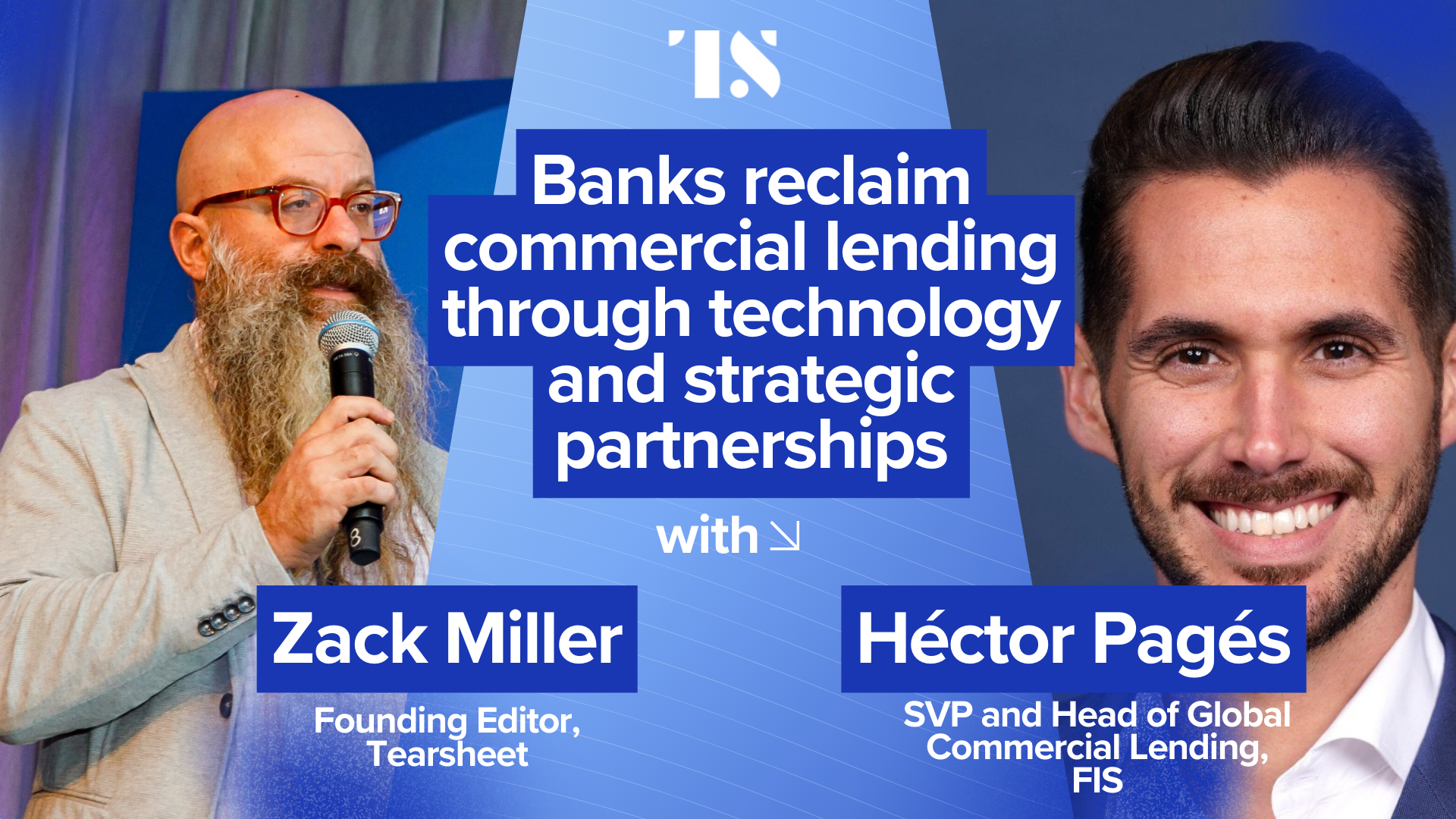
Commercial banks are confronting a rapidly shifting landscape as private credit markets grow toward $3.5 trillion and fintech competitors accelerate their offerings with AI-powered tools. Rather than retreating, traditional institutions are doubling down on technology investments and reimagining their commercial lending strategies to compete in this new environment.
“Banks are not short-term thinkers,” says Héctor Pagés, SVP and Head of Global Commercial Lending at FIS. “We’re not seeing a slowdown in terms of interest or investment from our institutions, in terms of advancing and changing the ways that they’re working.”
The response from banks has been multifaceted, according to Pagés. Some retail-focused institutions are shifting resources toward commercial lending, while smaller commercial banks are expanding into more complex lending products. Others are adopting an “originate to distribute” model, partnering with private credit firms to spread risk while generating fee income.
This strategic evolution is happening against a backdrop of regulatory uncertainty, tariff fluctuations, and the continued expansion of non-bank lenders into territory traditionally dominated by banks.
Listen to the podcast to learn about how banks are transforming their commercial lending operations through unified technology platforms, the role of AI in automating credit decisions and underwriting processes, and why cloud infrastructure is becoming essential for global scalability.
Watch
Listen
Subscribe: Apple Podcasts | SoundCloud | Spotify
Private credit: Competition and collaboration
The private credit market has emerged as both a competitive threat and a partnership opportunity for traditional banks. Pagés notes the sector currently stands at approximately $1.5 trillion and expects it to reach $3 trillion to $3.5 trillion by 2028-2029. This capital isn’t materializing from thin air – much of it represents a shift from traditional lending channels.
Banks are responding through multiple strategies. Some are leveraging fund finance capabilities to invest directly in private credit funds. Larger institutions are forming partnerships with private equity firms, essentially serving as origination engines while distributing loans through these partnerships. “That’s been a very, very fast growing space,” Pagés observes.
The question of regulation looms over this expansion. “You can’t have this system where trillions of dollars are flowing to a side that is going unchecked,” Pagés explains. He anticipates either increased regulation of private credit or easing of restrictions on banks to level the competitive landscape.
End-to-end solutions over point products
In commercial lending, banks need ecosystem and lifecycle solutions from their technology providers. FIS, for example, has assembled 15 different products spanning front, middle, and back office operations across retail, commercial, asset and auto, and supply chain finance.
“Banks don’t really think about it that way,” Pagés says, referring to point solutions. “Banks think about it as an end to end. I need to attract customers. I’ve got to book a loan. I’ve got to originate a loan, I’ve got to price it, I’ve got to book it. I’ve got to move it into servicing, and then I may want to distribute it or syndicate that loan.”
This integrated approach allows banks to compete on automation and efficiency. The strategy includes three technology focus areas: creating good front-end experiences for borrowers, integrating enterprise lending capabilities like customer 360 views and collateral management, and building internal integrations between systems to eliminate manual data entry.
AI deployment with measured risk management
Artificial intelligence is being deployed across the lending lifecycle, but with careful attention to risk controls and record keeping. FIS is working with partners like Microsoft to develop use cases that range from automated credit decisioning up to predetermined limits to automated financial statement spreading and credit memo generation.
One particularly innovative application is Lenders Copilot, an agentic chat experience built on top of commercial loan servicing platforms. “It allows a banker to pull up data from multiple different data sources and make real time informed decisions on a loan book or a borrower, versus having to dig down into all these different data sources,” Pagés explains.
The deployment philosophy balances automation with human oversight. Some AI applications operate in closed loops for specific tasks, while others facilitate free-flowing interactions between bankers and data systems. Critical to the approach is building in traceability and auditability, ensuring that actions taken based on AI recommendations can be tracked and verified.
Since institutions don’t love risk, Pagés said the company is helping its clients determine where AI capabilities can add significant value without compromising their risk tolerance.
Cloud infrastructure for global scalability
Cloud partnerships, particularly with Microsoft Azure, are enabling FIS to serve international markets more efficiently. Rather than building physical data centers in every country, the company can leverage cloud infrastructure to meet data privacy requirements and local regulations.
Pagés cites Malaysia as an example: “For us to go open a data center in Malaysia doesn’t make a lot of sense, but if we have a partnership with Azure and Microsoft, and we have a large bank in Malaysia who wants to run commercial lending, we need to be able to have those options and the flexibility to stand them up and operate their system.”
This approach provides clients with greater flexibility and latitude from an infrastructure standpoint, particularly important as data privacy regulations evolve globally. While regulatory changes typically unfold over years, the cloud architecture enables faster responses when requirements shift.
Strategic partnerships are powering FIS’ excellence globally
FIS’s partnership strategy operates across multiple dimensions. Growth includes acquisitions like Demica, which provides multi-tenant supply chain finance solutions that allow institutions to offer lines of credit against cash flows to commercial customers.
The company also partners with leading fintechs including Amount, Lendio, and Llama for SMB origination, and Nammu21 for document verification and workflow generation. Additionally, FIS works with systems integrators and large consulting firms for “last mile deliveries” in markets where the company is still building an operational footprint.
“We’re being very intentional about those last mile deliveries,” Pagés notes, describing work in Malaysia and parts of Europe where consulting partners help implement FIS products with clients they’re already serving.
This cohesive strategy, combining organic and inorganic approaches, positions FIS to help banks unlock value from their loan portfolios while maintaining the flexibility to adapt to continued market evolution. As commercial lending changes through technology and new competitive dynamics, the institutions investing now in end-to-end capabilities and strategic partnerships are positioning themselves for the next credit cycle.