


How FIS is helping financial institutions evolve loyalty beyond rewards
- Mladen Vladic, FIS's Head of Product, Payment Networks, discusses why capturing share of mind matters more than share of wallet, and how partnerships with Apple and Built are extending loyalty beyond traditional banking touchpoints.
- The $124 trillion generational wealth transfer represents both opportunity and threat for banks, and AI will transform loyalty programs faster than most realize, with autonomous decision-making tools reshaping how institutions segment portfolios and personalize offers.
Financial institutions are rethinking loyalty at a critical moment. Credit card spending sits at record highs, but economic uncertainty looms. For banks aiming to stay relevant, loyalty can no longer be an afterthought – it needs to be embedded into every customer experience from the start.
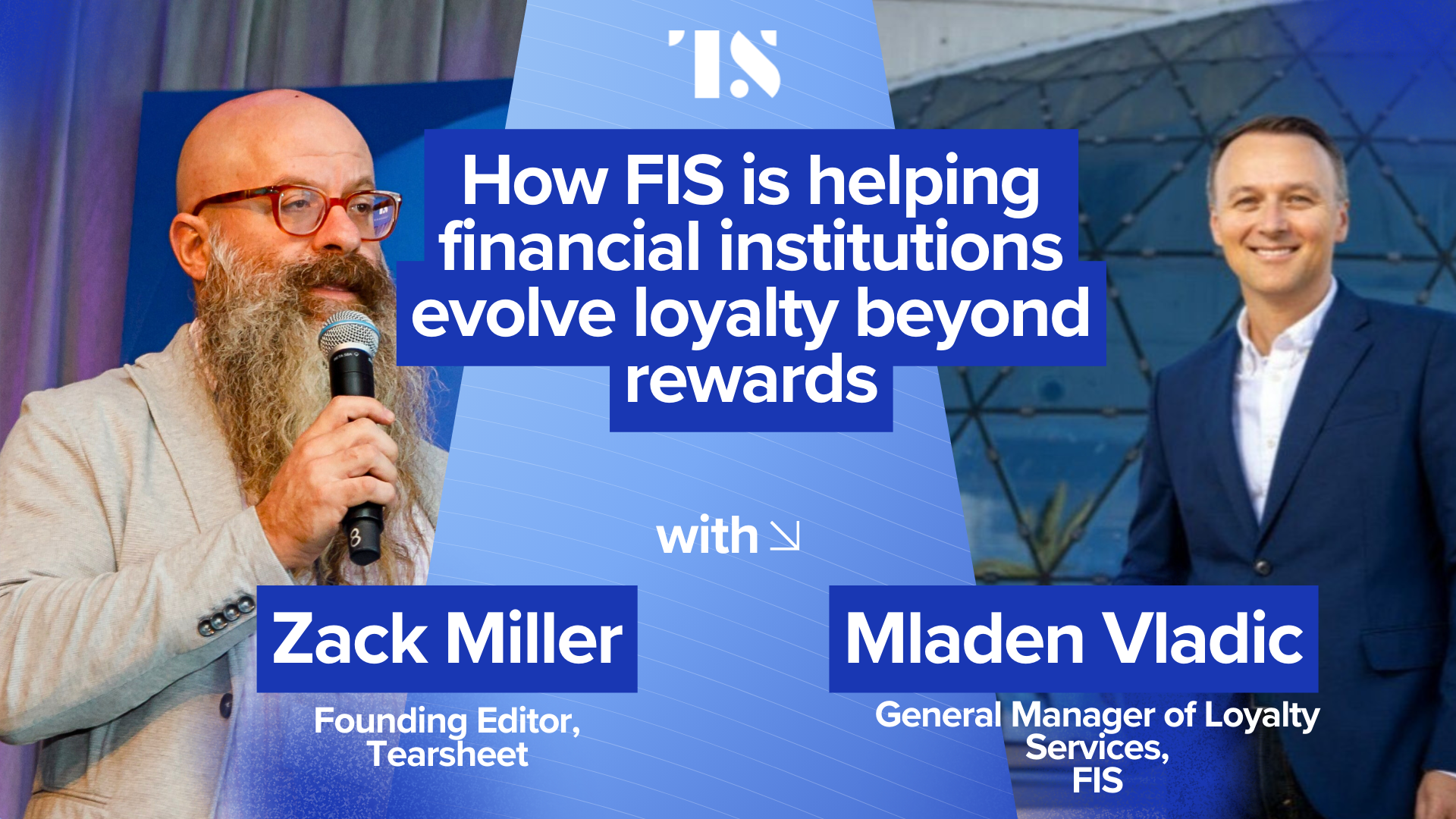
At FIS’s Emerald 2025 conference in Orlando, Mladen Vladic, general manager of loyalty services at FIS, sat down to discuss how the loyalty industry is evolving beyond traditional card-based rewards. His central argument: Financial institutions need to shift from chasing share of wallet to capturing share of mind first.
Beyond card transactions
The industry has overindexed on card transactional loyalty for years. That model worked when credit card spending drove engagement, but today’s environment demands a different approach. “We are truly at a transitional time when it comes to consumer rewards and consumer loyalty,” Vladic explained. “The big concept that I strongly believe in is start with share of mind, even before share of wallet. Once you capture share of mind in this attention-grabbing economy, then share of wallet is going to come as a natural consequence.”
This shift reflects a broader challenge for financial institutions: They’re no longer competing just with other banks. Customer expectations are shaped by experiences at Amazon, Netflix, and other digital-first platforms. “For the longest time, banks were looking at how to match or compete with another bank,” Vladic noted. “In this era of digital experiences, the experience that the financial institution is offering is being measured against other experiences with other brands.”
Watch
Listen
Subscribe: Apple Podcasts | SoundCloud | Spotify
The embedded loyalty imperative
What does effective loyalty look like in this new environment? Vladic advocates for “embedded loyalty”—building rewards and engagement into the core customer experience rather than treating them as add-ons. “Loyalty and rewards and engagement, it’s not an afterthought. As you’re developing the vision for the roadmap of how to stay relevant to the customer, you’re embedding loyalty as an integral part of that experience.”
This requires financial institutions to shift from product-centric to solution-centric thinking. Customers don’t care that multiple teams within a bank are coordinating to deliver an experience – they want good, frictionless solutions. The challenge is delivering constant engagement and value reminders in a digitally-native way.
FIS is pursuing this through strategic partnerships that extend loyalty beyond traditional banking touchpoints. The company recently partnered with Apple to bring pay-with-points functionality to Apple Pay, which is accepted at 85% of merchants nationwide. They’ve also partnered with Built, allowing customers who earn points for paying rent and mortgage on time to redeem those points as payment at point of sale.
“There are very few brands in the industry today that can innovate as fast as consumer preferences are changing,” Vladic said. “The better approach is to partner.”
The generational wealth transfer challenge
Behind FIS’s loyalty strategy lies a big demographic shift. Multiple reports reference $124 trillion in generational wealth transfer by 2048, representing both opportunity and threat for financial institutions.
“Just because three generations of the family banked with the same financial institution is certainly not a guarantee that the next generation is going to do the same, unless you solidify the relationship, unless you bring the experience that they expect,” Vladic explained. This puts pressure on banks to tie their products, services, and experiences together in a more unified way.
The stakes are clear: Financial institutions that can successfully evolve their loyalty strategies can address relationships that have spanned generations.
AI’s coming impact
Perhaps Vladic’s strongest conviction is about artificial intelligence transforming loyalty programs, and he believes the industry is underestimating how quickly this will happen.
“I feel very bullish about the role of AI in the engagement, rewards, and loyalty industry in coming years,” he said. “Having this autonomous decision making tool that can negotiate outcomes and execute on strategy in real time, I think it’s going to have a tremendous impact on our industry.”
The loyalty sector has always centered on segmentation and personalization: identifying the right customers and delivering the right offers through the right channels. AI promises to do this at scale and speed that wasn’t previously possible. “I sometimes feel like the general public doesn’t really understand or fully appreciate how quickly this is going to become a reality,” Vladic noted. “It only takes the first one or two to get it right, and then it’s a race.”
Rewards are not enough
Despite all the innovation in loyalty programs, Vladic offers a cautionary note: rewards themselves don’t constitute a loyalty strategy. “The loyalty industry needs rewards, but rewards itself is not a loyalty strategy. It can be a component, but it’s not the only thing that is going to make it successful.”
Many financial institutions hesitate to innovate because of cost and budget constraints around funding loyalty programs. But sometimes the solution is about repackaging existing assets differently and consistently reminding customers of the value proposition.
As financial institutions navigate this transitional period, the path forward is keeping what works while building embedded loyalty into every customer interaction, leveraging partnerships to extend reach, and preparing for AI to accelerate personalization at scale. The institutions that capture share of mind first will be positioned to win share of wallet as the industry continues to evolve.