


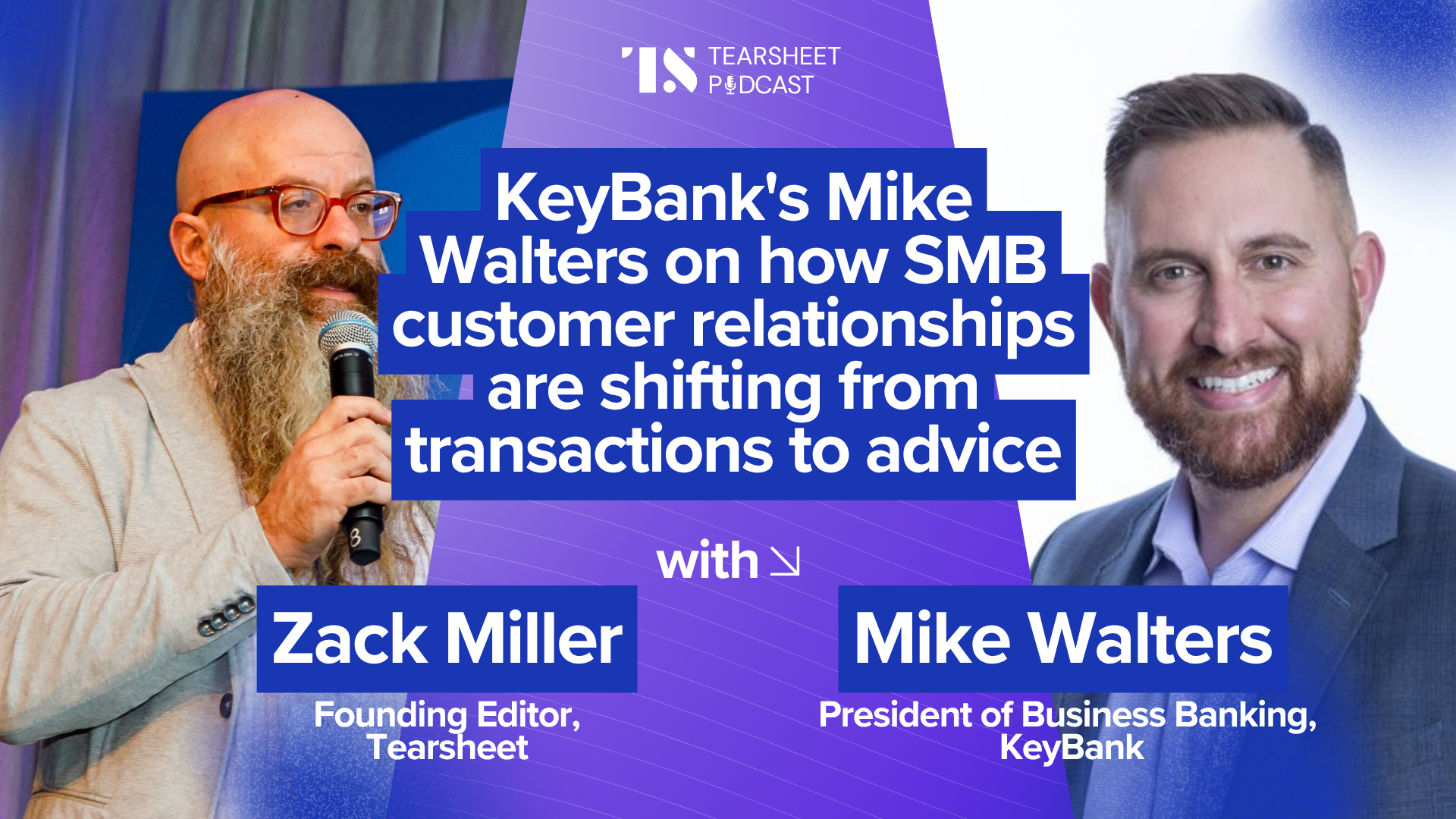
How do you bank the ‘chief everything officer’? KeyBank’s Mike Walters on how SMB customer relationships are shifting from transactions to advice
- KeyBank is transforming SMB banking by becoming a "consultative partner" that eliminates internal silos and follows revenue flows through entire business operations to solve time poverty for "chief everything officer" business owners.
- Learn how KeyBank's President of Business Banking Mike Walters, is expanding beyond traditional banking into strategic advisory services, helping clients optimize operations and sticky business relationships.
This podcast is sponsored by Gusto Embedded.
Payroll has emerged with one of the highest adoption rates across embedded finance categories, according to Tidemark Capital’s Benchmark Report. The right embedded payroll partner can help your institution be more competitive with SMBs, meet strategic goals, and reduce customer churn.
Gusto’s guide will help you assess if adding payroll is right for you, and evaluate product fit, implementation strategies, and revenue models to offer your SMB customers a sticky and profitable payroll product.
Download now
The traditional banking model for small and medium-sized businesses has reached an inflection point. Before banking centered on straightforward product relationships, like loans, deposits, and basic services. However, banks are evolving recognizing that their SMB clients need operational partners who understand the unique challenges of running a business while wearing multiple hats.
KeyBank has embraced this evolution, positioning itself as a consultative partner for its SMB customers. Mike Walters, President of Business Banking at KeyBank, describes the bank’s approach as fundamentally client-centered. “We try to center the client in every decision we make,” Walters explains. “Our clients in the small business space are unique. We use the term owner-operator at KeyBank and we use it very intentionally, because these business owners, they don’t just own the business, they run the business.”
This distinction shapes everything about how KeyBank serves its business clients. The bank has moved beyond traditional banking silos to create integrated service ecosystems that address the full spectrum of business operations. Now the bank focuses on understanding how money flows through a client’s business and identifying opportunities to create efficiencies.
The approach represents a broader industry trend toward comprehensive business partnerships, where banks want to use their central role in SMB operations to become strategic advisors and enablers for everything from cash flow optimization to operational efficiency.
Watch the full episode
Listen to the full episode
Understanding the ‘Chief Everything Officer’
KeyBank’s “owner-operator” terminology acknowledges that small business owners are fundamentally different from corporate executives with specialized teams. “We often use the term CEO in big corporate America, [whereas] a small business owner is a CEO as well, but they’re a chief everything officer,” Walters notes. “They are doing payroll, they’re doing legal, they’re doing everything.”
This framing drives KeyBank’s service philosophy. The bank recognizes that its clients’ most precious asset is time, and many SMB owners suffer from what Walters calls “time poverty.” A dentist might excel at dental procedures but struggle with efficient invoicing systems. A landscaper might understand plant care but lack expertise in cash flow management. This is where the bank needs to step in.
Qualitative before quantitative
KeyBank’s consultative approach begins with conversation rather than data analysis. The bank has developed a structured methodology for understanding how clients operate. “The first part of our discussion with any of our clients is much more qualitative than it is quantitative,” Walters explains. “We have a very structured approach where we talk to all of our business owners about some of the fundamentals of just how they run their business.”
This process involves following a dollar of revenue through the entire business operation: from initial client contact to final deposit. The bank asks detailed questions about payment collection methods, deposit procedures, and cash management practices. Only after understanding these operational fundamentals does KeyBank apply data analytics to identify optimization opportunities.
The approach often reveals significant inefficiencies. Walters has experienced business owners using debit cards for inventory purchases without understanding the cash flow implications, or accepting hundreds of paper checks without considering digital alternatives.
Breaking down internal silos
KeyBank has worked to eliminate the internal divisions that traditionally fragment business banking relationships. “Our clients do not care about a merchant service division or an SBA lending division or a deposit division. These are all internally focused,” Walters observes. “Our clients just see one KeyBank. They see a red brand, and they see a relationship manager, and that relationship manager represents everything to them.”
Rather than routing clients between different departments, KeyBank empowers relationship managers to coordinate comprehensive solutions across all business lines. The goal is to present a unified interface that matches how clients actually think about their banking needs.
Digital Tools for Time Recovery
Technology plays a supporting role in KeyBank’s value proposition, focused on returning time to business owners. The bank’s digital strategy centers on reducing administrative burdens through automation and streamlined processes.
Walters shares the example of a funeral home owner who hadn’t taken a vacation in 20 years because the business couldn’t operate without her physical presence. KeyBank helped implement digital payment collection, remote check scanning, and automated invoicing systems. “When you start to kind of aggregate all the time savings, getting time back to the business owner, I don’t know if that gets her that vacation, but it certainly gets her closer,” Walters reflects.
Expanding the Advisory Role
KeyBank SMB approach extends beyond traditional banking services into areas once handled exclusively by other professionals. The bank now provides guidance on business valuations, equity distribution timing, and strategic planning conversations that were previously the domain of CPAs or business brokers.
“Banks are going to continue to find ways to add value, and maybe on non-traditional things,” Walters explains.
KeyBank’s commitment to relationship-based banking is helping it differentiate and create stickiness in its SMB relationships. While the bank continues to excel at core functions like SBA lending and liquidity management, it recognizes that differentiation comes through advisory expertise that cannot be easily commoditized.
“We cannot commoditize our product, which is advice,” Walters emphasizes. “If it becomes standardized and repeatable, we will lose as an industry, especially at least as a bank. So we have to find ways to continue to show that the advice we give is differentiated.”