Checking In: Where do Goldman Sachs and Apple stand in their individual endeavors?
Today, I’d like to talk about two partners of a formidable alliance that set out to reshape partnerships in financial services. One brought technological prowess, the other financial muscle — but their grand collaboration didn’t unfold as expected. If you’ve connected the dots, yes, I’m talking about Apple and Goldman Sachs.
Today, though, Goldman is back doing what it does best, investment banking and trading, while pushing forward to deepen its AI-related experiments across the business. And Apple is recalibrating its tech and financial services strategy.
We look at what’s been unfolding at both firms since the start of the year. But first, we check in on the current status of the Goldman-Apple partnership.
The Goldman-Apple credit card business
Apple’s high-profile partnership with Goldman Sachs, which began in 2019, soured quickly.
The collaboration at first seemed like a strategic masterstroke — Apple sought a gateway into the financial world, while Goldman was set on overhauling its business around new, modern consumer offerings. But like many business alliances, differing priorities and operational realities led to a quiet unraveling.
The Apple Card, a sleek, consumer-friendly alternative to traditional credit cards, turned into a liability. While uptake of the card was quick, the business model never made sense for GS, which was saddled with all the responsibility for a weird lending portfolio that was rapidly deteriorating. And unlike the old adage, Goldman couldn’t make up for it on volume. Come 2024, Goldman, bleeding money from its consumer banking foray, was eager to offload the Apple Card portfolio. Regulatory scrutiny added further woes, as Apple and Goldman were fined millions for mishandling credit disputes. What once looked like a one-of-a-kind move forward in consumer finance started to resemble a costly miscalculation.
Several financial firms are now competing to take over Goldman’s role in Apple’s credit card partnership. Reports surfaced that Apple was in talks with J.P. Morgan Chase and now Barclays and Synchrony to take over the program. While lenders see potential in working with Apple, many are wary of the original deal’s risks and profitability challenges.
Although Goldman’s credit card agreement with Apple runs until 2030, CEO David Solomon indicated in this year’s January earnings call that the partnership could end sooner.
Inside Goldman Sachs, a quarter into 2025
Checking in on Goldman’s trajectory since the beginning of 2025:
1. Goldman’s new Capital Solutions Group to grow its private credit business
The calm before the storm: the financial industry with and without the CFPB
The Consumer Financial Protection Bureau (CFPB), established in 2010 under the Dodd-Frank Act, has tried to be a sentinel for American consumers, shielding them from predatory financial practices. But ever since Trump set foot back into the Oval Office, the CFPB has barely had a moment to catch its breath.
That’s exactly what we’re diving into today — how the CFPB’s shake-up is raising big questions about its future and rewriting the rules for banks, fintechs, and the industry at large.
A timeline of the crackdown
The CFPB’s inception was a direct response to the 2008 financial crisis, aiming to prevent a recurrence by enforcing stringent regulations on financial entities. Over the years, it secured $20 billion+ in financial relief for consumers, targeting unfair practices by banks, mortgage providers, and credit card companies.
What began as a strong year for the bureau quickly took a turn as the Trump administration’s deregulatory agenda started reshaping its path. On February 1, 2025, President Trump dismissed CFPB Director Rohit Chopra. Following his dismissal, President Trump appointed Treasury Secretary Scott Bessent as the acting director on February 3, 2025. Subsequently, Russell Vought, former budget chief under President Trump, assumed the role of acting director at the CFPB on February 7 after his confirmation as head of the Office of Management and Budget.
From there, the new administration took decisive steps to curtail the CFPB’s operations.
Russell Vought — the newly appointed acting director and a key architect of Project 2025, a blueprint advocating for the agency’s dissolution — issued directives to halt ongoing investigations and suspend the implementation of finalized rules. This move effectively paused the agency’s enforcement actions, leaving numerous cases in limbo.
The CFPB withdrew several high-profile lawsuits, including those against major financial institutions like J.P. Morgan Chase, Bank of America, and Wells Fargo. These cases, which addressed issues such as the handling of the payments platform Zelle, were dismissed without digging deeper, preventing future refiling.
The administration’s actions align with a broader agenda to reduce government oversight and promote industry self-regulation.
Pop the champagne or call the lawyers? The industry’s split reaction
Graphic credit: Tearsheet
The financial industry’s relationship with the CFPB has been contentious. Some firms viewed the bureau as overreaching, often chafing under its str
Stablecoins: The Trojan horse sneaking into traditional finance?
Bitcoin’s been flexing, the government’s nodding, and stablecoins are making new friends.
Pegged to the US dollar or other assets, stablecoins have evolved from a niche crypto experiment into a $221 billion plus market capitalization (of the top 10 stablecoins) and financial firms are definitely paying attention.
Fintechs and financial institutions are moving to position themselves in this growing market. The question is: How can stablecoins impact the future of money, and what challenges lie ahead?
Financial firms’ growing bet on stablecoins
Stablecoins now represent a fundamental shift in how money moves. Their real-world use cases range from international remittances to corporate treasury management, enabling faster and cheaper transactions than traditional banking systems. Stripe has recently called them the “room-temperature superconductors for financial services,” a fancy way of saying they make payments shockingly efficient without melting down the system.
The rise: Stablecoin use cases have been fueled by inefficiencies in the traditional banking sector and sticky inflation. Cross-border payments, for instance, remain slow and expensive due to intermediaries and outdated infrastructure. Stablecoins are also increasingly being used as a hedge against currency instability in emerging markets.
The gray area: Despite their potential, stablecoins exist in a regulatory gray area — a place where innovation can either thrive or be buried under paperwork.
Stablecoin regulation remains a patchwork of evolving policies. US lawmakers are now focusing on creating clearer, more comprehensive legislation. Proposals like the GENIUS Act and the Clarity for Payment Stablecoins Act are looking to define a legal structure for issuing and using stablecoins.
Meanwhile, financial institutions that have already introduced their own stablecoins — or fintechs facilitating stablecoin transactions — operate within specific legal frameworks:
JPM Coin, launched in 2019, operates within J.P. Morgan’s private, permissioned blockchain network. It is used only for institutional clients, keeping it within regulatory boundaries.
PayPal’s PYUSD, launched in 2023, was issued through Paxos, a regulated entity with approvals from the New York Department of Financial Services (NYDFS). This allowed PayPal to offer PYUSD while complying with state-level regulations. By year-end, PayPal plans to make PYUSD available as a payment option for its 20 million+ SMB merchants, enabling them to pay vendors through its upcoming bill-pay service.
Stripe doesn’t issue its own stablecoin but facilitates payments and integrations using existing ones, such as USDC, avoiding direct issuance risks. Meanwhile, Revolut reportedly entered stablecoin development last year, while Visa rolled out a platform to help FIs issue stablecoins.
More FIs are making moves: Bank of America CEO Brian Moynihan shared this month that his bank is prepared to enter the stablecoin business — once US lawmakers permit regulatory approval.
This cautious approach reflects broader concerns within traditional finance about compliance, risk management, and integration into existing financial systems. Banks face strict capital requirements and regulatory scrutiny, making their entry into the stablecoin market more complex. So, banks want in, but only when they won’t get a legal migraine for it.
If banks receive a green light, stablecoins could compete with money market funds, transforming payments and liquidity management. But if regulations become too tight, the momentum could shift to friendlier jurisdictions, leaving US banks looking on like someone who showed up after the game started.
How FIs and fintechs differ in their approach to stablecoins
Graphic credit: Tearsheet
Fintechs — and now banks — are moving more deeply into stablecoins, but their playbooks differ based on their respective strengths and constraints.
Big banks are playing offense. Fintech competition, tech leaps, and workforce expectations are evolving — so should banks.
Traditional banks are already trying on a modern fit — experimenting with tech, balancing brick-and-click, rethinking talent, and making new power couple moves in partnerships.
Two prime examples stood out last week: BNY takes the artificial intelligence route to improve its operations, and Citi continues to use workplace flexibility to navigate talent challenges. While these paths differ, they reflect a shared realization — adapt or risk becoming a museum exhibit.
Graphic credits: Tearsheet
BNY: Merging centuries of banking with AI innovation
Established in 1784, BNY is America’s oldest bank, which has thrived for over two centuries. Yet, instead of clinging to its storied past, the institution is looking forward, betting big on AI as the key to its future.
In a landmark deal, BNY has entered into a multiyear relationship with OpenAI, a decision that signals more than just technological adoption — it’s an illustration that even the most traditional players should innovate or risk being upstaged by a 25-year-old coder in a hoodie.
The cornerstone of this AI-driven transformation is Eliza, BNY’s proprietary AI platform, launched in 2024. Initially conceived as an internal chatbot trained on the bank’s vast institutional knowledge, Eliza has evolved into a multifaceted AI tool that empowers employees to build AI-powered applications. More than 50% of the bank’s 52,000 employees actively engage with Eliza, using it for tasks ranging from lead generation to workflow optimization. By integrating OpenAI’s most advanced models launched this year, BNY is supercharging Eliza with next-gen capabilities. These include Deep Research, which can analyze vast amounts of online information to complete multistep research tasks, and Operator, an AI agent capable of browsing the web like a human.
But why is BNY Mellon making this move now? Necessity. Competition. Strategic vision.
Necessity: AI adoption in banking is no longer optional. From compliance to risk management, the financial sector deals with high complexity. AI offers solutions to streamline operations, reduce inefficiencies, and facilitate decision-making.
Competition: Fintech startups and tech giants like Google and Apple are poised to take over market share if they fall too far behind. To hold its ground, BNY likely needs a tech upgrade to offer more AI-driven services.
Strategic positioning: With banks emerging as some of the most active adopters of AI, BNY doesn’t want to be a bystander. Partnering with OpenAI gives it access to the latest underlying tech, positioning it as a strong player in the industry.
However, this transformation is not without its challenges. Integrating advanced AI framework into a 240-year-old institution is like teaching your grandparents to use TikTok. Ensuring compliance with strict regulatory standards, managing the ethical implications of AI-driven decision-making, and upskilling employees to work effectively alongside AI are all significant hurdles. Moreover, cybersecurity remains a major concern — handling sensitive financial data requires strong protective measures to prevent breaches.
Despite these challenges, BNY is forging ahead, not just out of necessity but out of the foresightedness that AI may likely be a big part of the future of banking. This puts other well-equipped banks on the spot — if the oldest bank in America can adapt, what excuse do the rest have?
Citigroup’s Hybrid Bet: Why sticking to flexibility might just be its smartest move yet
Can fintech’s brightest stars shine on Wall Street?
Klarna and Chime are finally ready to test the public markets, likely this year. The Swedish buy now, pay later (BNPL) firm and the US neobank have reportedly confidentially filed in late 2024 for IPOs, marking two of the most anticipated fintech public debuts in recent years.
But with shifting market conditions, a new administration in the White House, and a mix of investor excitement and skepticism, these IPOs could either be fintech’s grand return to Wall Street — or another cautionary tale.
The possibility of an IPO for Revolut and Stripe has also been brewing since 2023, but neither company is ready to seal the deal just yet.
The case for going public
For Klarna and Chime, the timing makes sense — at least on paper. Markets have started 2025 with a bullish streak, fueled by cooling inflation, a rebounding IPO pipeline, and a government that appears friendlier to fintech innovation. However, alongside that enthusiasm come fiercer competition and sharper investor scrutiny.
After a turbulent couple of years, Klarna has been eyeing a public listing. Its valuation plummeted from a $46 billion peak in 2021 to around $6.7 billion in 2022 before rebounding to an estimated $15 billion. Going public could help Klarna raise fresh capital, expand further into the US, and compete more strongly with rivals like Affirm and Apple’s Pay Later service.
As for Chime, with over 20 million customers, it is one of the biggest digital banking players in the US. However, it hasn’t raised funds since 2021, when it was valued at around $25 billion. A public listing could provide it with capital to fuel growth and potentially diversify beyond its core product offerings, which include a fee-free digital banking experience.
The aspirations and tactical execution
The post-pandemic era has turned IPOs into a proving ground rather than a victory lap. Companies can no longer bank on hype alone — they need solid profitability, sustainable growth, and a narrative that withstands intense scrutiny. The Federal Reserve’s tighter monetary policies, global market volatility, and the shift from a liquidity-driven to a fundamentals-driven investment climate are creating higher entry barriers.
Both Klarna and Chime will be entering a relatively less forgiving market and heightened investor concern than in 2021, a year that saw 61 fintech IPOs — far more than the 16 that have launched in the past three years combined.
Last week, I teased a mystery topic, letting you stew in curiosity about what was coming. Well, the wait is over! Given that Valentine’s Day was just last Friday, I’m leaning toward a theme that fits the season: unions & collaborations.
We often dive into stories of partnerships that start with fireworks and flawless roadmaps — only to crash and burn for one reason or another. But today, let’s moonwalk through this. Let’s talk about rivals who went from side-eyeing each other to shaking hands (at least in the business world).
Take banks and fintechs, for example. Their early days were more ‘battle for dominance’ than ‘let’s work together’ — fintechs painted themselves as challengers, while banks saw them as pesky invaders. But time and market realities have a way of reshaping narratives.
Now, banks and fintechs are increasingly recognizing their strengths. It’s a classic ‘you complete me’ scenario — if corporate romance were a thing.
Graphic credits: Tearsheet
But let’s hit rewind for a moment. How did these once-feuding forces go from wary opponents to strategic allies? And where do these kinds of relationships stand now?
Let’s dig in.
Block vs. J.P. Morgan Chase: From competition to cooperation
J.P. Morgan Chase initially saw Square (now Block) as a major small-business payment competitor. In 2014, CEO Jamie Dimon famously warned that Silicon Valley was “coming to eat our lunch.” Square’s success with small business payments and its Cash App product placed it in direct competition with Chase’s merchant services.
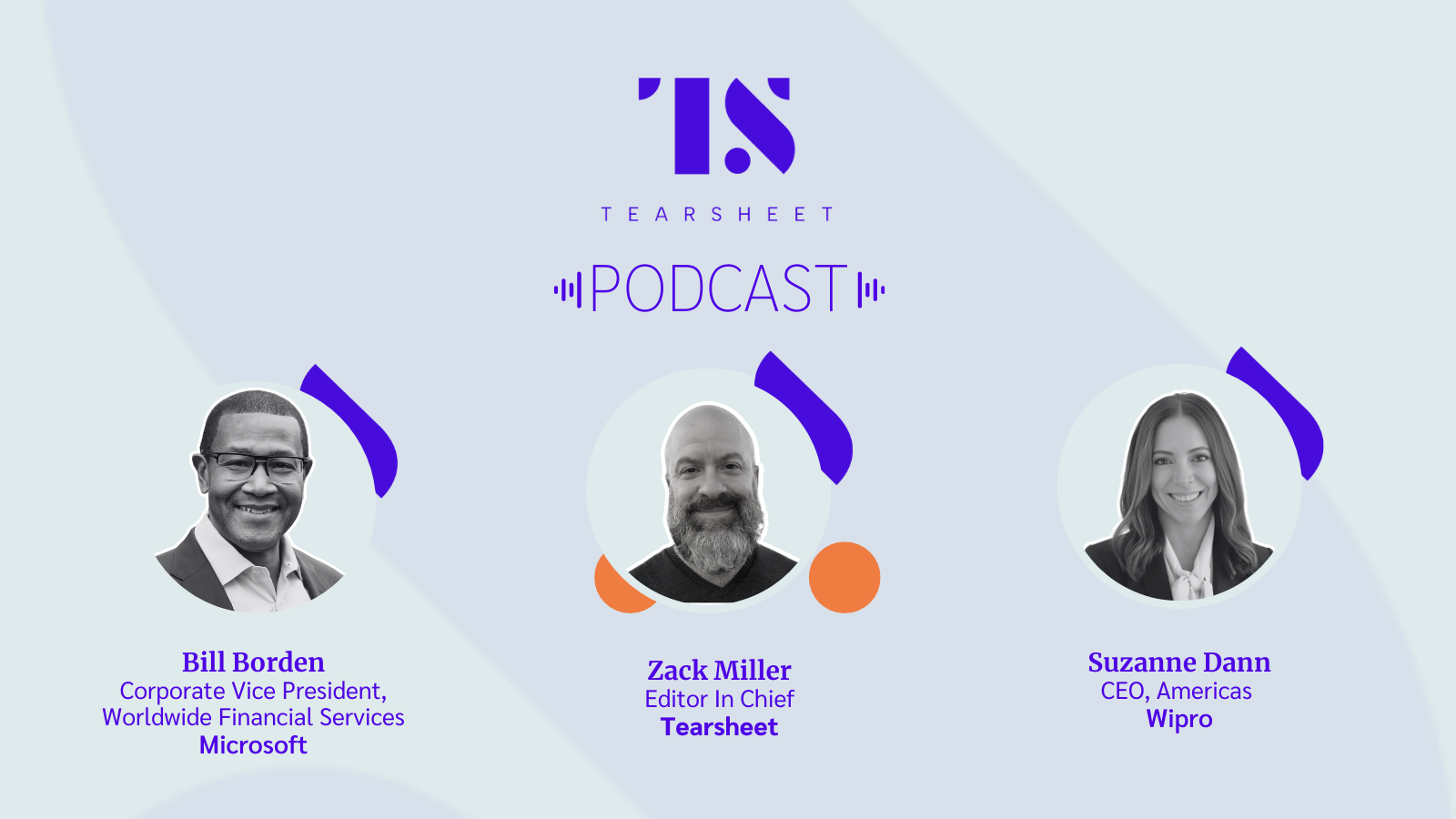
Today, we’re joined by Bill Borden, Corporate Vice President, Worldwide Financial Services, at Microsoft, and Suzanne Dann, CEO for the Americas at Wipro. Together, they discuss their collaboration on leveraging Azure OpenAI to enhance generative AI in finance. This partnership focuses on improving customer experiences, streamlining processes, and ensuring responsible AI practices in the financial industry.
As Suzanne puts it, “My role is to help clients digitally transform by bringing together the right industry expertise, technology, and integration experience.” Bill adds, “Our goal at Microsoft is to build products and services that truly meet the unique needs of financial institutions.”
We’ll explore how cognitive assistants, powered by generative AI, are reshaping customer interactions, loan origination, and even the broker experience, all while maintaining a focus on security, reliability, and expanding AI access across the sector.
Powered Cognitive Assistants for GenAI in Finance
Cognitive assistants are intelligent systems designed to enhance the capabilities of financial professionals. They do this by providing real-time insights and personalized customer interactions. Unlike traditional chatbots, these assistants leverage generative AI and natural language processing. This aims to offer deeper, context-aware support.
“It’s not like a chatbot that is not intelligent. It has all the intelligence built in, and that’s the real differentiator,” explains Suzanne.
Enhancing Customer Interactions
Cognitive assistants can transform how banks and financial institutions interact with their clients. These AI tools offer personalized advice by understanding a customer’s history and preferences. It makes interactions more meaningful and efficient.
“It’s almost like you’re talking to a human who has all the knowledge,” Suzanne notes. She highlights the human-like intelligence of these assistants.
Loan Origination and Investor Onboarding
The partnership between Microsoft and Wipro is focusing on two critical areas. First, loan origination and second, investor onboarding. These processes are often time-consuming and data-intensive. This makes them ideal candidates for AI-driven optimization. “Half the time is spent on loan processing and manual data entry. That can all be removed,” Suzanne points out, emphasizing the efficiency gains from AI.
Improving Broker Experience
Large insurance companies may use Azure OpenAI to improve the broker experience. Cognitive assistants improve productivity. They focus on customer satisfaction by organizing data and giving quick, relevant responses.
“Now they can use this cognitive assistant either through the contact center agent. Or directly to answer their questions,” Suzanne explains.
Responsible AI and Governance: Accuracy and Reliability
The rapid adoption of generative AI brings with it challenges related to accuracy and reliability. Microsoft and Wipro are dedicated to creating safe, secure, and compliant AI systems. “We’re building all types of tools and capabilities into our approach that allows for safety and security,” Bill elaborates.
Democratizing Gen AI in Finance
One of the significant achievements of this partnership is the democratization of AI. It makes advanced tools and platforms accessible to a broader audience. This democratization ensures that AI benefits are widespread and inclusive. “It has democratized AI and made it available to anyone,” Suzanne states.
Data Modernization for GenAI in Finance
Combining Wipro’s consulting experience with Microsoft’s technology creates seamless AI solutions. Generative AI gets better at giving accurate and personalized responses as it learns over time. “Generative AI… is constantly learning. And it is about what data you can provide it to learn from,” Suzanne says. “The power of large language models at a scale that we now can access anybody can access… is the unlock”, Bill explains.
The Big Ideas
Generative AI in financial services is evolving by offering personalized and efficient solutions.“What generative AI offers us and these cognitive assistants is the power to learn and iterate,” says Suzanne. She sheds light on the future of AI in banking.
Microsoft and Wipro’s Partnership combines technology with industry expertise. By doing so, it helps to build AI solutions that address real-world problems. “Our opportunity and excitement at Microsoft is extending our cloud capabilities to specific financial services,” Bill explains.
Cognitive assistants in banking are the next frontier. They are not just advanced chatbots, they are intelligent systems that enhance human capabilities. “It’s almost like having the smartest person next to you who knows everything about what you do,” Suzanne notes.
Responsible AI Practices are crucial to building such AI systems. It includes ensuring that AI systems are accurate, reliable, and compliant is crucial. “We’re building responsible AI that’s safe and secure, but also usable by all,” Bill emphasizes.
The real-world impact focuses on several aspects of generative AI. Improving broker experiences and automating loan origination show AI’s real benefits. “We’re seeing so many of these POCs moving to production,” Suzanne highlights.