


How BILL is rebuilding for the Fortune 5 million and gearing up to take big swings on AI
- BILL processes over 1% of US GDP in payments, and its next move is to use task-based automation to further deepen the value it delivers to its customers.
- Chief Product Officer Michael Cieri, shares how the firm is weighing opportunity vs. risk and how its crafting agents for the high-trust domain it operates in.
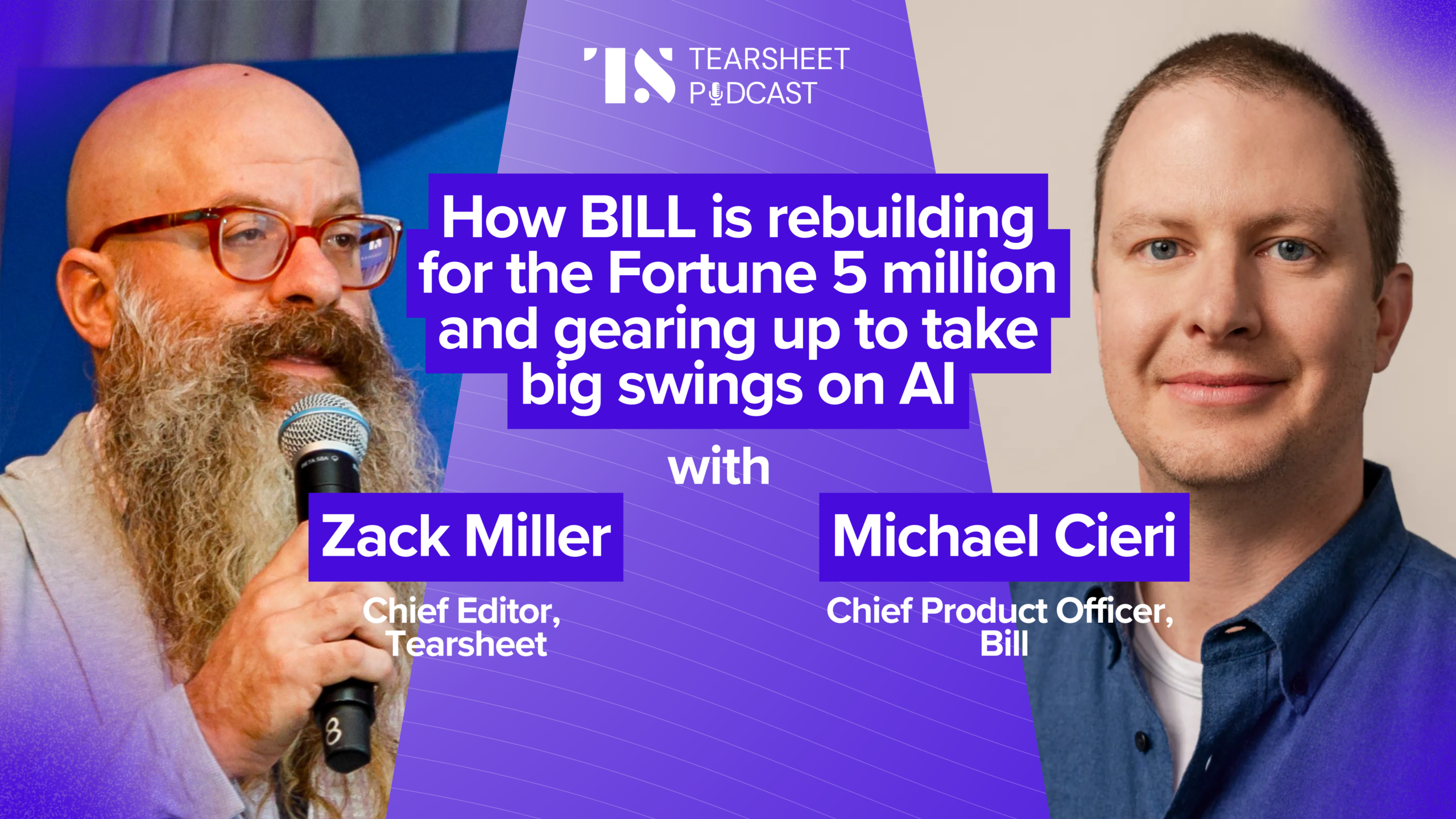
For most small and midsize businesses, financial operations still look a lot like they did a decade ago. Bills get keyed in manually. Receipts pile up. W-9s get chased down at tax time. While the tools have multiplied, the work hasn’t gone away. “Most finance teams work in an incredibly manual way,” says Michael Cieri, Chief Product Officer at BILL. “There’s a ton of work done by finance professionals that could be automated, and could actually be done better through the use of technology.”
The gap between the promise of modern financial software and the day-to-day reality of running the books at a small business is something BILL has spent nearly two decades trying to close.
The company processes over 1% of US GDP in payments and has moved more than a trillion dollars across its platform – a scale that gives it both a data advantage and a particular sense of accountability. When you’re handling that volume of transactions for the long tail of American businesses, the stakes of getting automation wrong are very high.
Cieri joins us on the show to talk through where BILL’s product thinking stands today: how Cieri’s team decides when to take big swings versus make incremental improvements, how it builds and validates AI features for a high-trust domain.
Watch the episode
Listen to the full podcast
Subscribe: Apple Podcasts I SoundCloud I Spotify
The real problem is the fragmentation
BILL describes its target market as the “Fortune 5 million”: the large set of small and midsize businesses that don’t have internal IT shops or engineering teams but still need to run serious financial operations. These businesses have more software options than ever, but that abundance hasn’t translated into less manual work. “Customers end up skipping a lot of newer functionality because it doesn’t work that well together,” Cieri explains. “They do lots of things manually.”
Cieri frames BILL’s core mission around two things: returning time to finance professionals by automating the repetitive work, and improving financial outcomes by helping businesses make better decisions about how they move money.
The trust barrier is part of the equation too. SMBs sitting at different points on the adoption curve – some comfortable leaning on technology, others not – require a platform that can serve both ends of the spectrum without forcing anyone into a model they’re not ready for. “This is one of the things people are most nervous about,” Cieri says of AI in finance. “Having AI hallucinate, or something going wrong.” BILL’s response has been to lean hard into its compliance posture, security infrastructure, and licensing record as the foundation for earning that trust.
Task-based automation before agentic ambition
The conversation about AI in finance has tended to race ahead of what’s actually delivering value for customers. Cieri is candid about the marketing vs. deliverable gap. A few years ago, the narrative was about wholesale transformation of white-collar work. What’s actually worked, he says, is narrower and more practical. “Instead of this big bang change, we’ve found success with task-based automation of things that are just repetitive – things people do day in and day out that eat up a bunch of time.”
Two examples from BILL’s recent product work illustrate the approach. The first is a W-9 agent that handles the process of collecting supplier tax information ahead of the 1099 season – a task that might otherwise consume days or weeks of someone’s calendar. The second is in spend and expense management, where the goal is to make routine transactions essentially touchless: swipe, spend, and move on, with the system handling receipt capture and IRS compliance in the background.
These task-oriented solutions focus on the kind of friction that finance teams actually live with, and eliminating them compounds meaningfully over time. BILL measures the value here in time-per-transaction before and after, and the KPI is clear enough to inform what gets built next.
Reimagining what was already “solved”
One of the more interesting threads in Cieri’s thinking is the idea that innovation at BILL is about going back to problems the company already addressed and asking whether the original solution still holds up. “We’ve been building BILL for 20 years,” he says. “Is this still needed? If we were to do this today, with a bunch of smart people starting in a garage, would we build it that way? Probably not.”
The internal framing Cieri uses is “reinvent and reimagine” – a lens the product team applies to major components of the platform that were built under different assumptions about how software gets used. Some core assumptions have changed though: those systems were designed for human operators. Now the base axiom is that the human operator becomes more of a check, an exception-handler, coaching the AI that does the day-to-day execution. Building for that change means rethinking UI, workflow logic, and the degree to which customers can dial automation up or down.
This recalibration is happening at the same time BILL is managing a broader organizational transition. In May 2026, CEO and founder René Lacerte outlined the company’s direction as it moves through this next phase. The company also announced a set of leadership appointments designed to support its transition toward becoming an AI-native company – changes that reflect how seriously BILL is taking the structural rethinking of how financial software gets built and used.
Building AI for a high-stakes domain
Finance is a domain where the cost of AI error is immediate and concrete. Cieri’s team has built a shared AI platform over the past 12 to 18 months that sits on top of a common data lake, with an orchestration layer that routes different tasks to different LLMs depending on what’s required. The development model started centralized – weekly meetings, a unified AI roadmap, tight coordination – and has since moved toward a decentralized structure where individual product teams build agents on top of the shared platform. The next chapter, Cieri says, involves centralizing again around multi-agent orchestration: sequences of tasks that hand off between agents based on how earlier steps were resolved.
Validation is taken seriously. BILL uses proprietary evaluation frameworks to score AI efficacy, particularly for non-deterministic outputs where there’s no single right answer. Target accuracy rates run close to four nines for sensitive operations. Customer satisfaction and time-savings metrics are tracked alongside technical performance, and token cost is increasingly factored into the equation as the platform scales.
“We have 20 years of data. We’ve moved over a trillion dollars,” Cieri says. “That data, when you mine and leverage it correctly to train and prompt AI, gives us the right to encode bills better than anyone else, sniff out fraud, fat-fingered bills, and missed payments better than anyone else.” That data corpus is what makes the platform’s AI outputs demonstrably different from what a general-purpose LLM could produce, with context specificity visible at the moment of execution.
Sequencing the automation roadmap
One of the more careful distinctions Cieri draws is between workflow automation and payment automation. BILL has moved aggressively on the former – reducing the manual overhead that surrounds financial transactions without touching the transactions themselves. On the latter, the company is more deliberate. “We’re still building trust and the right to automate more of the payment side,” he says. “Earning the trust to move money agentically – that might be chapter two, chapter three.”
This sequencing reflects a broader philosophy about how to earn the right to do more. Activation in the first six months is a key metric: are customers actually running their bills and transactions through the platform, or did they sign up and drift back to old habits? From there, the goal is to expand share of wallet and product adoption, pulling in expense management, procurement, and other surfaces once the core accounts payable relationship is established.
On the product strategy side, Cieri describes a framework-driven approach to deciding where to take big swings versus where to improve incrementally. “Right now we’re in the “bigger innovation, take bigger swings” phase,” he says, “because the technology unlock is incredible, and the speed at which the tech continues to evolve leads us to believe there are big swings to take.” That posture will eventually rebalance, the company will need to consolidate and deepen what it builds, but for now, with the pace of AI development still accelerating, BILL is betting on moving fast on new ground.