
Payments, Podcasts

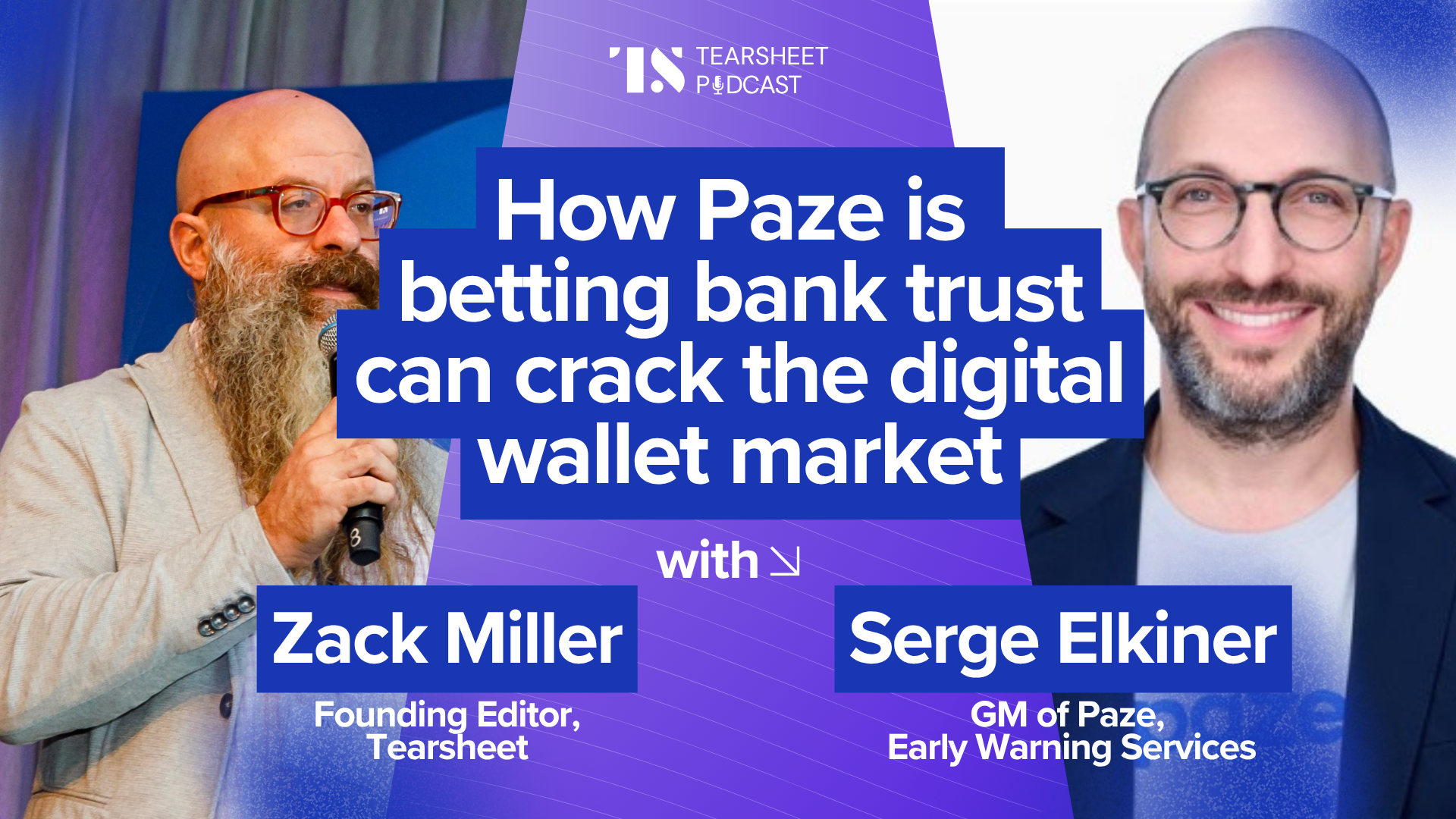
How Paze is betting bank trust can crack the digital wallet market

  • The digital wallet space is crowded, but Paze is betting that consumer trust in banks — not tech giants — is the unlock.
  • In this episode, Serge Elkiner, General Manager of Paze at Early Warning Services, breaks down how the bank-backed wallet is building toward critical mass through merchant expansion, issuer growth, and a deliberate focus on the consumers other wallets haven't won yet.
close

Email a Friend

How Paze is betting bank trust can crack the digital wallet market

Early Warning built Zelle into the dominant peer-to-peer payments network in the U.S. — processing over a trillion dollars in yearly transactions. Paze is their next bet: a bank-backed digital wallet for e-commerce checkout, backed by the same seven major banks, designed to bring that same institutional trust to online shopping.

Serge Elkiner came on as GM in late 2024, brought over from Visa where he ran product for money movement globally. His mandate is to unlock what that network can do at checkout — with 165 million eligible cards now in place and distribution deals closing with Fiserv, Worldpay, and ACI.

Today we talk about what it takes to convert infrastructure into consumer behavior, and whether the banks can do for e-commerce what they did for P2P.

Watch the episode

Listen to the full podcast

Serge Elkiner and Paze

I’m the general manager of Paze, one of the business units of Early Warning Services. The mandate is really to take Paze and bring this new payment checkout system to the masses — both on the consumer side and on the merchant side — really making sure that our goal of becoming one of the top three wallets for checkout in the next five years becomes reality. We certainly have a chance given the backing of the banks. We are the wallet of the banks, and that’s what’s exciting about what we can do and how we can position it.

Building on what Zelle taught us

Early Warning did over $1.2 trillion in 2025 — it continues to grow, which is quite impressive. We learned a lot from the Zelle journey, and at Paze, we believe we can replicate that.

The ecosystem is shifting. You still have today, primarily, a lot of usage of guest checkout and manual entry of your debit card, your credit card, or alternative payment methods. Consumer wallet usage overall — not just ecom, but ecom and in-person — remains around 9-10% of transactions depending on the source. In ecom, it’s a little higher, crossing the 20-25% range, but you still have 75% of people not using wallets.

What the research really showed is that some of these people don’t specifically trust the solutions that exist today. They have a distrust of big tech. They have a high trust and high confidence in the security of the banking system and their banks. So we believe that having a solution that’s really backed by your bank enhances that trust and that security — what we call “protectionists” and “security seekers” — those who really see value in a product brought to them by their banks. That’s why we believe we have a fighting chance to generate big market share in the wallet space.

We took 2025 to lay the foundation for the product itself. When I came in, I found a product that had the right reason to be, but it wasn’t yet where it needed to be to really scale. So we had to work on the product through late 2024 and all of 2025.

Targeting the right consumer: protectionists and security seekers

The challenge is, how do you onboard them? We took a page from the Zelle book: we don’t want you to have to download an app. You claim your wallet through your bank app. That’s very important, because we really want people to understand that Paze is from your bank. This is not a different entity. This is not a different company. This is the bank.

If you ask anybody today who owns Zelle, everybody answers their own bank — Bank of America, or their credit union. Nobody really knows it’s Early Warning Services. And we want the same thing with Paze. We want everybody to think, okay, that’s a feature of my bank account. It’s a feature of my credit card.

So those security seekers, those protectionists — they go into the bank app, they see Paze, they register just by claiming their wallet in two clicks, and then they’re ready to shop. The next time they show up, they put in their email or phone number, authenticate with a six-digit PIN or a passkey, and their cards are already there. No manual entry. No adding cards. Your financial institution participates in Paze, therefore your cards are there.

The habituation challenge: getting into daily spend

We shifted strategy to habituate people to use Paze — to show up in more places where they use it on a daily basis, or at least more than just a few times a year. We have Fanatics, which is an amazing partner, and United Airlines — but how many tickets do you buy every year? So we needed to go into more daily spend.

We launched PayRange, which is a laundry service — you do your laundry quite a bit. And we recently announced that Domino’s has joined as well. You eat pizza a little more often than a few times a year. These are the shifts we needed to make on the merchant side.

We also realized that a merchant accepting a payment method isn’t just direct to merchant — there are enablers. We’ve announced deals with Fiserv, Nuvei, FIS, Worldpay, ACI, and others. Those platforms also help us enable small and medium businesses. We now have hundreds of thousands of SMBs enabled with Paze as of a few months ago.

The multi-wallet world and where Paze fits

Consumers won’t have 100 wallets, but it’s completely viable to have a couple. Think about everyday life today — you use Apple Pay, you use PayPal, you may have another option. Different solutions for different needs. You may have one that’s more of a default offline, one you use more online. That’s normal.

What we want to make sure is that Paze is there for consumers who choose to use Paze anytime they want to pay for something. We start online. We hope to be offline one day. But ultimately, we want consumers to know that we are there for you whenever you need the banks or credit unions to have a payment solution.

Building the three pillars: merchant, product, consumer

In 2026, it’s really about reaping the benefits of the product work and the go-to-market strategy. We’re getting more merchants on board — more places to shop. We’re getting more issuers on board. Citi is a recent addition. We’re at 160 million-plus credentials at Paze and will cross 200 million in 2026.

We’re starting the flywheel: get the merchants, get the consumers, build brand awareness, incentivize them to shop. Brand awareness is about making sure people know Paze is from their bank and credit union — a trusted and safe way to shop digitally. And then the incentives: points, discounts, statement credits. We need to incentivize people to use Paze the way any traditional financial services marketing works.

Then 2027 is about putting a multiplier on 2026. More brand awareness, more merchant reach, more usage acceleration.

Scaling an entrepreneurial startup within the banking ecosystem

Paze is really a startup within this ecosystem. We’re owned by the banks, but it’s still in its startup phase. As with any startup, you have to work on all cylinders to get your product-market fit, to get the consumer to adopt it, to get the merchant to adopt it.

I built a startup that we successfully sold to Visa. So I’ve been through the ups and downs of that journey, and there’s no difference for Paze. What attracted me to this opportunity is that you can decide to disrupt the financial ecosystem in the United States — from within. You have the backing of the largest institutions. You have the success of Zelle that could be replicated. You have the opportunity to transform this industry together — not just one company, but with the banks, with the enablers, with the merchants. That’s very unique. Very few products give you that excitement of proving it.

What 2026 is really about: execution

2024 was listening. I got here with no clue — let me listen to everybody: stakeholders, merchants, issuers, consumers, enablers. Q1 of 2025, that was my role.

Then the rest of 2025 was fixing what was broken or what we hadn’t done yet based on what we heard. 2026 is very much focused on execution. I believe in the strategy. The strategy is the right one — we’re seeing early wins with the new merchants we’ve launched. Now it’s: let’s focus on execution, and execution is scaling.

Are the systems ready? Do we have customer service ready? Do we have every operational process ready? I’ve brought in new leaders. They’re in place today, all focused on: let’s get everything ready to scale. It’s not about a brand new product feature or a complete pivot. We know where we’re going. We know what we have to do. The answer is in the data and in the execution.

0 comments on “How Paze is betting bank trust can crack the digital wallet market”

Partner, Podcasts

How Huntington modernized without touching the core ft. Qolo

  • Commercial banks are modernizing by augmenting their core systems, layering virtual account infrastructure and unified platforms on top to handle rising complexity.
  • In this episode, Deepak Kapoor of Huntington National Bank and Rouzbeh Rotabi of Qolo discuss how connected deposits and virtual account structures enable banks to innovate faster, simplify reconciliation, and deliver more flexible, API-driven financial services without overhauling their core systems.
Zack Miller | April 09, 2026
Payments, Podcasts

Squarespace’s Corey Zettler on building a financial services suite for small businesses

  • Squarespace has expanded beyond website building to offer a growing suite of financial tools for small businesses, including payments, capital, and a new integrated balance account with a Visa debit card.
  • On the Tearsheet Podcast, director of product Corey Zettler explains the company's build-vs-partner approach, what it's learned from three product launches, and how it plans to deepen its financial services offering for service.
Zack Miller | April 08, 2026
Innovation, Partner, Podcasts

How KeyBank and Qolo are modernizing corporate treasury without ripping out the core

  • Legacy treasury systems force companies to manage dozens of accounts manually. Virtual account management offers a modern fix without replacing core infrastructure.
  • KeyBank's Bennie Pennington and Qolo's Patricia Montesi discuss building a real-time VAM platform together, processing $40B+ in transactions.
Zack Miller | March 26, 2026
Partner, Payments, Podcasts

How Modern Treasury is building a payments platform for a hybrid money world

  • Modern Treasury recently launched an integrated payments platform blending fiat & stablecoins.
  • Tune in to find out how stablecoins complement fiat rails, why working capital is the biggest opportunity, and what instant payments means for enterprises.
Zack Miller | March 10, 2026
Partner, Podcasts

Why banks need to adopt a product mindset for their digital channels

  • Most banks and credit unions still manage digital banking as IT projects rather than products that need constant refinement based on user behavior.
  • Listen to this podcast to learn how a product-led approach transforms digital banking from a feature factory into a strategic channel that drives adoption, reduces support costs, and improves customer satisfaction.
Zack Miller | January 14, 2026
More Articles