


Why banks need to adopt a product mindset for their digital channels
- Most banks and credit unions still manage digital banking as IT projects rather than products that need constant refinement based on user behavior.
- Listen to this podcast to learn how a product-led approach transforms digital banking from a feature factory into a strategic channel that drives adoption, reduces support costs, and improves customer satisfaction.
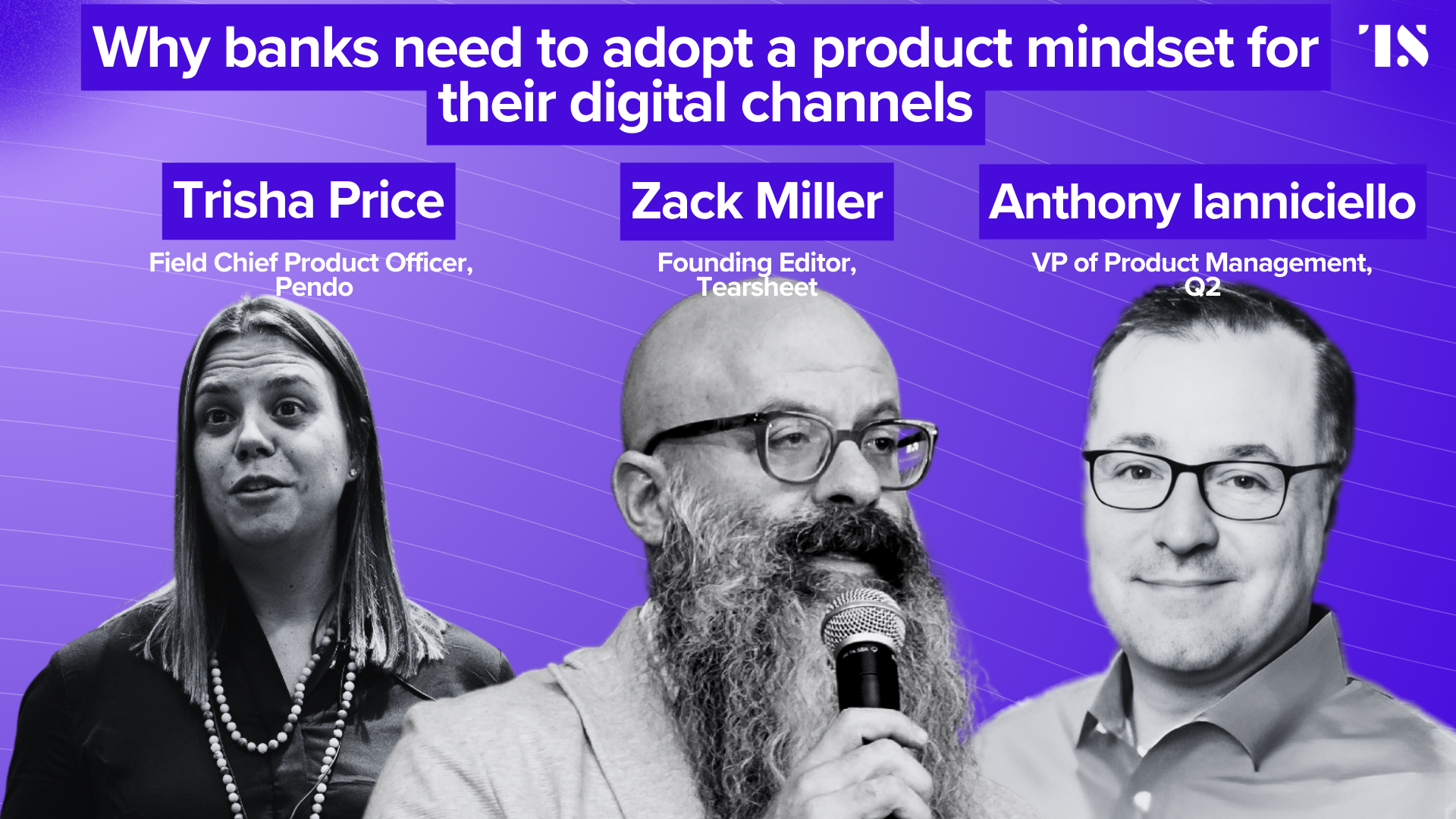
Digital banking has become the largest branch of modern banking, yet most banks and credit unions still aren’t approaching these experiences with a product mindset. They’re managing digital channels the way they’ve always managed technology: as IT projects, rather than products that need constant refinement based on user behavior.
The result is an ecosystem where institutions miss opportunities to serve different customer segments effectively and struggle to demonstrate ROI on their digital investments.
“Banks sell rails, and fintech sells outcomes,” said Datos Insights’ Christine Barry, a quote that Anthony Ianniciello, VP of Product Management at Q2, says encapsulates the fundamental shift that needs to happen. “That really gets to the heart of how you shift that mindset away from, I have this thing, and I have it for you, as opposed to, here’s what I really want to drive for your success.”
Q2 has partnered with Pendo, a product experience platform, to help regional and community financial institutions make this transition. Trisha Price, Field Chief Product Officer at Pendo and host of the Hard Calls podcast, brings a cross-industry perspective on how companies leverage behavior data and analytics to build better products.
Listen to this podcast to learn how banks and credit unions are using product management principles, user behavior data, and in-app guidance to transform their digital channels from cost centers into strategic growth drivers.
And for a deeper dive into how Software Experience Management can boost banker productivity and drive measurable ROI, download the full ebook here.
Watch the episode
Listen to the full podcast
The project mindset problem
Many financial institutions still approach digital banking with organizational structures that fragment ownership across IT, marketing, and channel management teams. “I see so many FIs treat digital experience upgrades to their systems as a project, not as an outcome,” Price said. “It’s very much like, hey, we need to get this project done. But at the end of the day, they think about it as a start date and an end date. And you can’t drive outcomes when you have a start date and an end date.”
The mindset shows up in concrete ways. Price recounted working with a bank that insisted on including a branch dropdown in their online deposit account opening flow because their internal cost allocation required it. “If you’re a user and you’re trying to open up a deposit account online, why in the world would you put a branch?” she said. “The whole point is they don’t want to go to the branch.”
What product thinking unlocks
The evolution that Ianniciello has observed across Q2’s 450 financial institution clients centers on moving from broadcasting the same messages to everyone toward understanding different customer segments and delivering targeted, relevant communications.
One bank discovered through customer surveys that its traditional segmentation model for small business customers, based on employee count and revenue, was fundamentally flawed. Instead, customers fell into three groups based on their preferred interaction method: “click, call, and come in.” This insight led to the development of targeted features and messaging that dramatically improved engagement.
Another credit union used behavioral data to identify 6,500 members paying interest rates of 35% to 45% on payday loans. By targeting these specific members with messaging about better loan options available through the credit union, they made “a huge difference to the community,” according to Ianniciello. “It’s great when you’re talking about outcomes to focus on the outcomes of their institution,” Price said. “But I love how you’re mixing the outcome that’s good for the financial institution with what’s a good outcome for the actual consumer.”
Measuring the ROI
For institutions struggling to justify investments in product capabilities, the returns are evident across multiple dimensions. A large international financial institution, utilizing Pendo’s surveying capabilities, doubled CRM interactions from its relationship managers, delivering the productivity gains the bank had promised when it initially invested in the CRe.
“Being able to use analytics and a product mindset helped them actually ensure that they got an ROI that they had already said they were going to get,” Price explained. “But it’s really hard to actually achieve that ROI just because you put a system in place, if you don’t get a change in people’s behavior.”
The approach also dramatically reduces the cost of launching new features or managing digital banking migrations during mergers and acquisitions. Rather than ramping up call center staff to handle questions when things change, institutions can now proactively educate customers through targeted messaging, videos, and guided tours. “They’re much faster, and they’re no longer having to staff at the level that they feel like they had to,” Monticello said.
Fraud prevention provides another powerful example. By using segmentation tools to identify customers most susceptible to phishing or romance scams, institutions can deliver targeted in-app warnings to these individuals. One institution reported stopping over $1.2 million in attempted fraud through this approach.
Breaking down silos and building trust
Making the transition requires integrating three traditionally separate functions: IT, marketing, and digital channel management. “Financial institutions that are working really well together — you need to get those three roles today working together,” Ianniciello said.
However, the greater challenge is the organizational culture. “The biggest change is trust and empowerment,” Price said. “It is very hard for financial institutions not to be top down and to be able to articulate, here’s what your roadmap is for the next 18 months. Well, you can’t be outcome-focused if top-down is driving what a roadmap is for a digital project. Your teams need to be empowered to make decisions based on the data and the outcomes.”
The AI imperative
Looking ahead, both executives see AI as amplifying the importance of product thinking. Ianniciello notes that Q2 is focused on bringing together data from multiple sources into a unified intelligence layer that AI can leverage effectively. “Context is kind of king in some of these LLM solutions,” he said.
Price sees financial institutions lagging behind other industries in AI experimentation due to overly cautious approval processes. “They were, like, we can’t turn on any AI because it takes 10 months to get through a process, even to try something,” she said about a recent advisory board meeting. “Guys, 10 months in the AI world is literally may as well be 100 years.”
The solution, she argues, is working with trusted partners who meet security and compliance requirements while enabling rapid experimentation. The institutions that get this right are transforming their relationship with customers, moving from transaction providers to trusted financial partners who demonstrate a genuine understanding of customer needs through every interaction.
Learn more about how Q2 and Pendo are helping banks and credit unions adopt a product mindset here.