


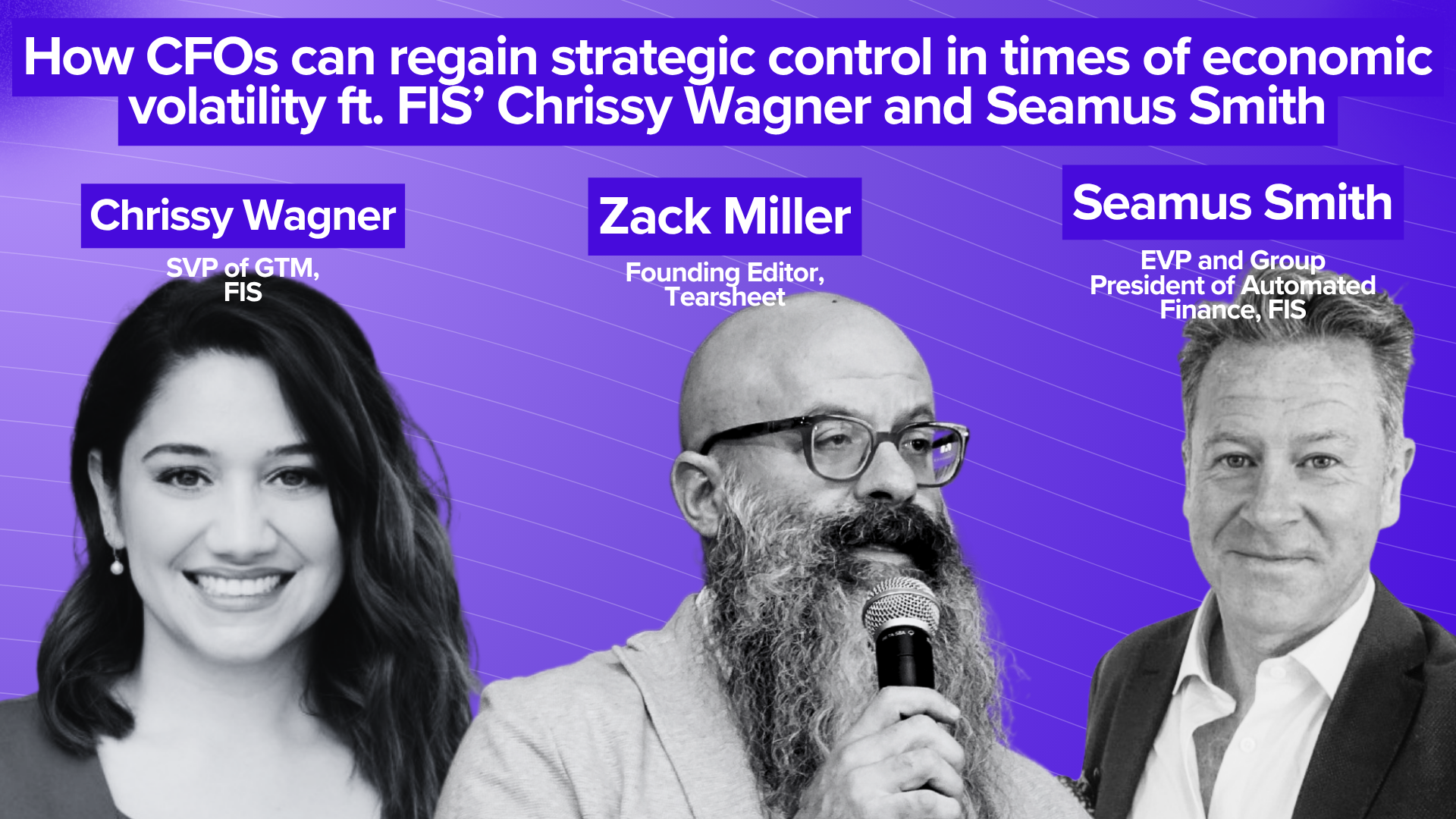
How CFOs can regain strategic control in times of economic volatility ft. FIS’ Chrissy Wagner and Seamus Smith
- CFOs are abandoning quarterly planning for week-by-week assessments as trade tensions and supplier volatility force short-term thinking over strategic growth.
- Seamus Smith and Chrissy Wagner of FIS explain how data quality, AI-powered credit risk management, and digital check solutions help finance leaders navigate uncertainty while modernizing their operations.
In an environment marked by trade tensions, tariff uncertainty, and rapid supplier insolvency shifts, Chief Financial Officers are being forced to rethink how they manage their organizations. The traditional quarterly planning cycles are giving way to week-by-week assessments as volatility becomes the new normal.
“There is a short termism, that’s being forced by the current volatility in the environment,” said Seamus Smith, EVP and Group President of Automated Finance at FIS.
This compressed timeline creates its own set of challenges. While businesses naturally operate on medium and longer-term cycles, leadership attention is increasingly consumed by immediate concerns. Now the challenge for CFOs has become balancing the urgent demands of short-term risk management with the strategic thinking required to position their organizations for growth.
But there are strategies firms can take to get ahead of the uncertainty: Chrissy Wagner, SVP of GTM at FIS, noted: “There’s a level of certainty in an uncertain environment that leveraging technology and automation can provide.” CFOs who want to build resilient strategies need to find a way to harness data to gain visibility and control when traditional planning frameworks are no longer sufficient.
Listen to the podcast to learn about how FIS is helping CFOs navigate supplier volatility through integrated data solutions, the practical applications of AI in credit underwriting and collections, the impact of paper checks in modern finance, and the importance of taking a data-first approach to modernization strategies in the CFO’s office.
Watch the episode
Listen to the full podcast
Subscribe: Apple Podcasts I SoundCloud I Spotify
The challenges facing CFOs
Recent survey data from FIS and Oxford Economics reveals that cybersecurity tops the list of CFO concerns – which isn’t surprising given the increasing sophistication of threats. But the second and third most pressing pain points tell a more nuanced story about operational challenges: inefficient processes and mismatched payments coupled with lack of visibility into money flows are directly impacting bottom lines.
These issues become particularly acute as organizations grow through mergers and acquisitions. “[M&A] brings components of organizations together that don’t necessarily talk to each other,” Smith explained. “It creates complexity and a lack of visibility. Those are things that should frighten any CFO worth their salt.”
Beyond operational inefficiency, there’s a deeper anxiety about technological change itself. According to the same study, 41% of respondents indicated they lack confidence that their organizations are agile enough to adopt new technology at the required pace. Wagner highlighted this as a significant source of stress: “Technology is constantly changing and evolving. And so if you’re the CFO of an organization – of any size – you’re evaluating: Is it AI? Is it machine learning? What do I need to automate?”
The pressure to make the right technology investments and avoid costly missteps adds to the challenge of an already turbulent environment.
Supplier risk and working capital in uncertain times
One of the most immediate concerns facing CFOs is supplier volatility. As global trade tensions escalate and tariffs shift, the financial health of suppliers can change rapidly, creating ripple effects throughout supply chains.
FIS addresses this through credit risk management assessments that combine internal data with information from partners like Equifax and Dun & Bradstreet. “We amalgamate data sources, and we help businesses understand the risk that they have in their supplier environments,” Smith said. “That’s critical when you’re managing a business that has a big supplier network and a lot of inflows.”
FIS’ expertise in risk management capability have proved to be a north star for clients during recent tariff disruptions. The company conducted webinars to help clients better utilize existing features in their software to gain visibility into tariff impacts. “This isn’t vaporware or a phantom use case. This is a real technology in the hands of business users, and the responsible use of AI capabilities to help in the midst of tariff disruptions,” said Wagner.
Working capital management has also taken on renewed urgency. With economic volatility, buyers are extending payment terms and paying at the last possible moment, putting pressure on sellers’ cash positions. Wagner advocated for a back-to-basics approach: “Getting cash in the door is super critical to maintaining their ongoing business, and so I actually think back to the basics of, how do we improve DSO (Day Sales Outstanding)?”
The company’s acquisition of Demica, a supply chain finance enablement business with over 250 funders in its network and $40 billion in assets under administration, reflects a strategic bet on expanding working capital solutions. Smith noted an interesting geographic divide: “In Europe, supply chain finance is a much larger portion of a business’s working capital solution. In the US, it’s actually quite small, and we think there’s a great opportunity to support CFOs by broadening options.”
The foundation: Starting with data quality
Any successful financial modernization attempt needs to begin with data, and the CFO’s desk is no different: “You’ve got to trust your data, you’ve got to clean it,” Smith insisted. “Every organization will say, ‘But we’ve got loads of data.’ But how good is it? How clean is it? How are you utilizing it? How is it driving insights?”
Poor data quality leads to opaque visibility and unreliable insights, regardless of how sophisticated the software built on top of it might be.
“You have to balance the need for data with what are two or three business problems I need to solve, and how can technology and the data, the combination of both, help me solve that problem,” added Wagner.
This problem-first approach prevents organizations from undertaking expensive data consolidation exercises without clear objectives. Wagner argues that CFOs should identify specific business challenges, then work backward to determine what data and technology solutions are needed. “When the small wins come, that builds the momentum,” she said. “You get those wins on the board, and then you can say: I can justify moving further down the technology.”
Smith added that any modernization attempt must be directly linked to business objectives. A high-margin, low-growth business trying to accelerate growth needs to ensure its financial systems can properly handle the additional risk that comes with expansion. Conversely, a high-growth, low-margin business focused on profitability requires different financial capabilities.
The persistent check problem
Despite technological advances, paper checks continue to be a dominant payment method in the industry. “[Checks not only cause] inefficiencies, but they also open the doors to fraud, because one of the single biggest sources of fraud sits in checks and antiquated payment systems that are much easier to penetrate than modern electronic payment methods.”
The solution may lie in reimagining what constitutes a check rather than eliminating them entirely. Changes to the Universal Commercial Code – which defines commercial payments in the United States – are enabling digital instruments that meet the legal definition of a check. Several organizations are developing solutions around this legislative shift.
“Rather than saying there will be no checks, you can say, a check can be a digital instrument,” Smith explained. “We, as a responsible actor, have got to jump on. We’ve got to help businesses understand there’s a new way of managing what you currently do in check volumes.”
From digitization to Agentic AI
While digitization has delivered significant benefits over the past decade, artificial intelligence has fundamentally shifted the technological space. “Digitization has been generally a net positive. It’s helped us do things faster, but it’s mainly helped us digest larger volumes of what we already know,” Smith explained. “But clearly, there’s a bunch of technologies with us today and gathering a lot of pace that are going to change that game. Because these technologies are creative. They’re capable of decision making.”
The return on AI investments is already compelling. Smith cited research showing that for every dollar spent on AI investments today, there’s a $3.70 return – a figure that continues to improve. Both executives have teams actively reassessing products to leverage these new capabilities.
The next generation of financial leaders entering the C-suite won’t face the same uncertainties about technology that current executives grapple with. “They won’t be faced with the same sort of fear and concerns around what happens if I implement this technology. They are going to look for ways to do what they do better, faster, and more effectively.”