




Banking

How banks and consumers are responding to the distant potential of Fed rate cuts

  • Earlier hopes of three rate cuts in the year are dwindling to uncertainty over whether any cuts will materialize at all.
  • The impact of sustained higher rates has already permeated banks’ NII as borrowing by businesses and consumers declined, coupled with higher funding costs for banks. Conversely, consumers are grappling not only with expensive borrowing costs but also with a significant portion experiencing loan rejections.

close

Email a Friend

How banks and consumers are responding to the distant potential of Fed rate cuts

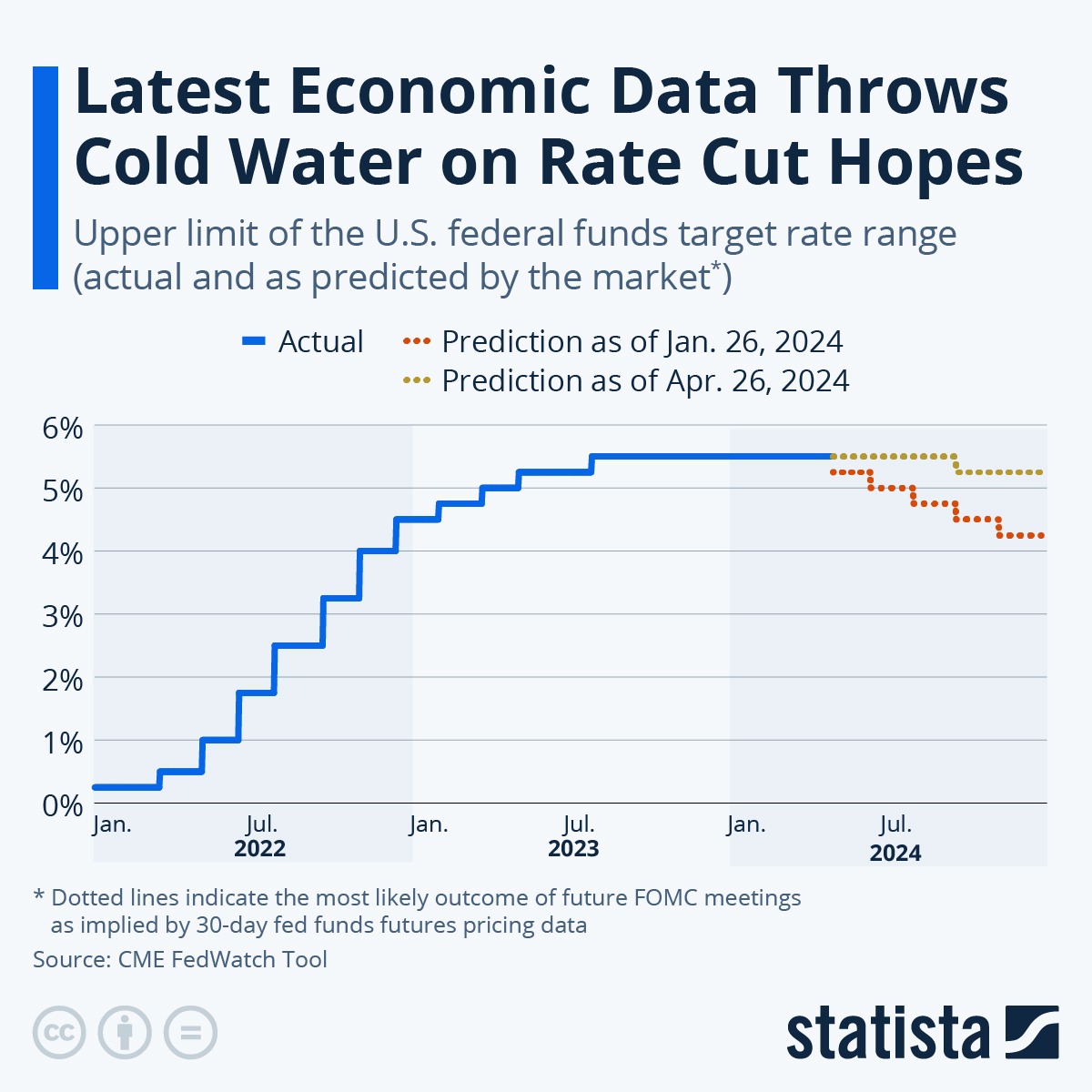
The optimism around the ease in the Federal Reserve’s combat against inflation has dissipated just one quarter into the current year.
Source: Statista

Following the release of the Fed’s most recent projection materials in mid-March, which still foresaw three 25-point rate cuts by year-end, subsequent economic data has dampened any expectations of immediate rate reductions.

During a recent policy forum, Fed Chair Jerome Powell cautioned that interest rates might linger at elevated levels for a longer duration than initially anticipated. “The recent data have clearly not given us greater confidence, and instead indicate that it’s likely to take longer than expected to achieve that confidence,” he remarked. Powell affirmed the Fed’s readiness to uphold the current level of restraint for as long as necessary.

After a phase of enthusiasm surrounding rate cuts, markets are now responding to these developments, with earlier hopes of three rate cuts in the year dwindling to uncertainty over whether any cuts will materialize at all.

As each month passes, the continued stretch of high-interest rates is intensifying pressure on both banks and consumers alike.


subscription wall for TS Pro

0 comments on “How banks and consumers are responding to the distant potential of Fed rate cuts”

Banking, SMB Finance

How BILL is becoming the financial backbone of the SMB economy

  • BILL is embedding AP payments directly into major ERP and payroll platforms, turning fragmented SMB finance stacks into one seamless workflow with an 8M-business network behind it.
  • New AI agents are slashing manual work in tax form collection and reconciliation by 80%+, part of BILL's bigger bet on becoming the financial infrastructure layer for the "Fortune 5 Million."
Rabab Ahsan | August 10, 2026
Banking, Member Exclusive

How banks have stopped thinking in products and started thinking in customer journeys

  • As banks weave AI into their customer experiences, many are looking for ways to translate years of customer data into a more complete picture of each customer's needs and context.
  • The difference isn't the data itself, but how well a bank makes sense of a customer's context and goals and builds the right response around that.
Sara Khairi | August 06, 2026
Artificial Intelligence, Banking, Data, Member Exclusive

Before chasing AI, Bank of America wants banks to fix their data first

  • Bank of America has resisted the urge to use AI as a shortcut to efficiency, a temptation that has driven many companies into expensive and poorly conceived AI investments.
  • EricaAssist offers the clearest example of Bank of America's data-first AI strategy, with the bank recently enhancing the employee assistant by integrating Gen AI capabilities.
Javarya Kamran | August 06, 2026
AI Innovation, Banking, Member Exclusive

Why banks can’t policy their way out of shadow AI

  • Banks are cracking down on "shadow AI" with stricter policies, but experts say that's treating the wrong problem entirely.
  • Institutions buy AI tools before mapping the workflows they're meant to support and employees notice when the sanctioned option can't keep up.
Rabab Ahsan | August 04, 2026
Banking, Partner

Regions Bank chose a modern core. Here’s what that journey looks like.

  • Regions Bank ($155B+ in assets) partnered with Temenos in 2023 to move from its legacy core systems to a SaaS-based modern core, aiming to boost customer responsiveness and offload infrastructure management.
  • Under Chief Transformation Officer Paul Weiss, the bank is now roughly two years into what could make it one of the first major US banks to complete such a transition.
Rabab Ahsan | August 03, 2026
More Articles