


How Citizens is using Value-Added Services and a command center approach to empower SMBs
- SMB customers need more than just the traditional checking account from their banks, firms that want to capture and retain SMB customers need to go further and build products that help make running an SMB easier.
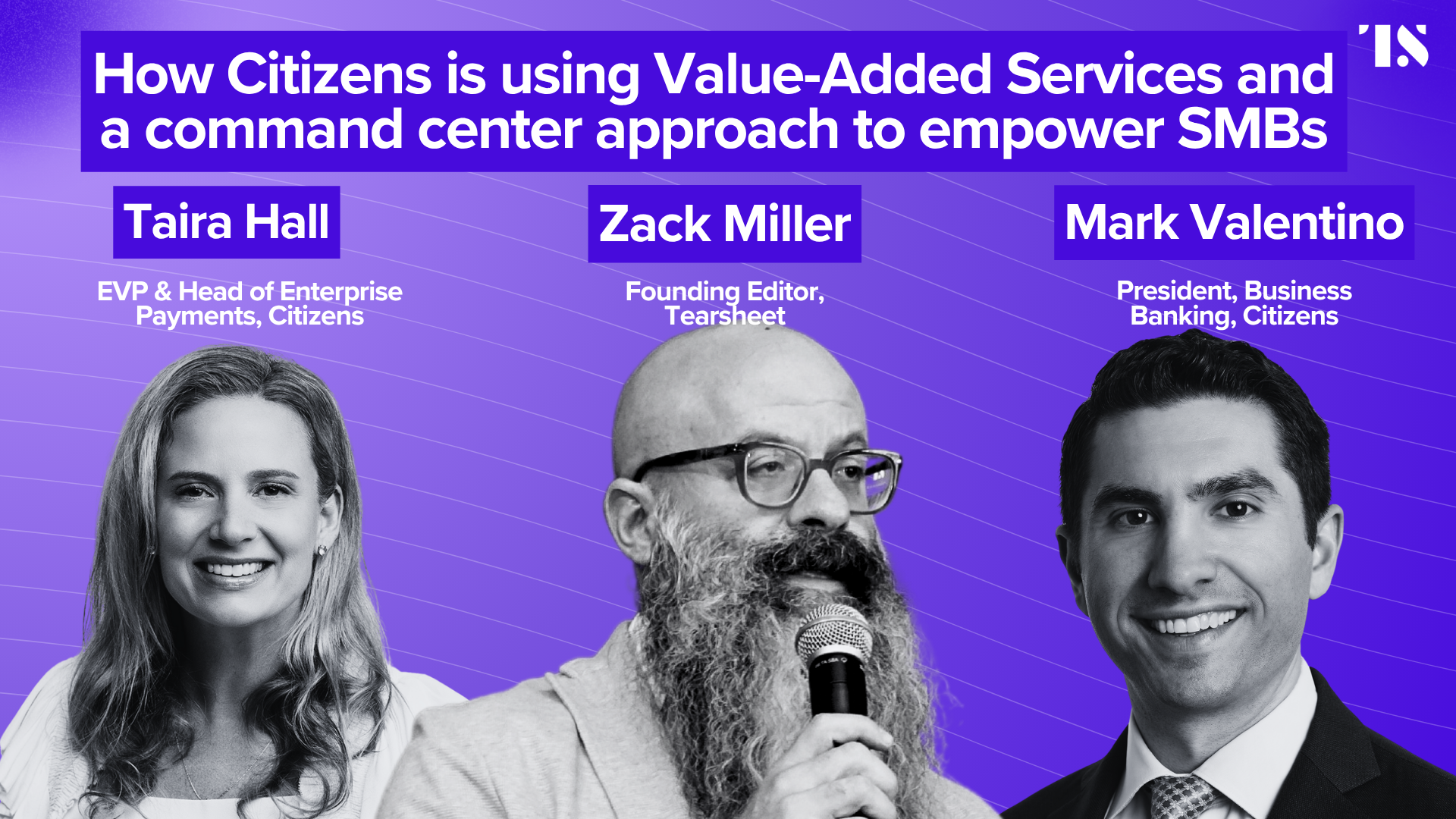
- On the show today, Mark Valentino, President of Business Banking at Citizens, and Taira Hall, EVP and Head of Enterprise Payments at Citizens, join to talk about how the bank aiming to become a command center for SMB owners.
This podcast is sponsored by Gusto Embedded.
Payroll has emerged with the highest adoption rate at 71% across embedded finance categories, according to Tidemark Capital’s Benchmark Report. The right embedded payroll partner can help your institution be more competitive with SMBs, meet strategic goals, and reduce customer churn.
Gusto’s guide will help you assess if adding payroll is right for you, and evaluate product fit, implementation strategies, and revenue models to offer your SMB customers a sticky and profitable payroll product.
Download now
Traditional banking services alone aren’t enough to serve the diverse needs of small and medium-sized businesses. Banks need to go further and think of their digital footprint as a launching pad for SMB owners by adding value-added services.
On the show today, Mark Valentino, President of Business Banking at Citizens, and Taira Hall, EVP and Head of Enterprise Payments at Citizens, join to talk about how the bank is building more comprehensive solutions through value-added services for SMB customers.
Valentino and Hall dive into how the bank is moving away from a purely transactional relationship to become more of a command center for SMB owners, highlighting how SMB owners’ needs and the broader focus on CX is leading this change.
Tune into the show to explore how traditional FIs can evolve to become modern digital hubs for SMB owners through the addition of Value Added Services like spend management, a focus on APIs, and a robust partnership-first strategy. Both Valentino and Hall provide a strategic overview and practical examples – melding the worlds of business banking and payments together to forge a powerful narrative about how Citizens is evolving to meet the changing expectations of small business owners.
Watch the full episode
Listen to the full episode
Understanding the needs of SMB customers
Citizens Bank has invested considerably in driving a deep understanding of what small businesses need to thrive in today’s economy.
“The general trend that we’re seeing for small businesses that come to us for banking needs is that they want to be able to do everything right now. And they want to be able to do more sophisticated things as they grow,” Valentino explained. This realization has guided Citizens’ approach to developing platforms that can serve businesses at different stages of growth.
It’s also changed what role Citizens is looking to play in the lives of its SMB customers – now banking solutions have to go further than transactions and build experiences that not only allow for money to flow but support the day-to-day in managing an SMB. “The broader industry is headed to more of a command center style platform for small businesses to actually be able to run their business off of your online banking platform,” he said.
The command center idea is leading SMB owners looking for value-added services embedded within their banking platforms, according to Hall.
How to make the banking platform into a command center
One of the central challenges for small businesses is balancing using new digital tools with fragmentation.
“Most small business customers can have anywhere from 10 to 15 different logins for different services that they’re using to power their business,” Hall noted. “So it’s a lot of thinking about, how do you reduce those number of touch points?”
To tackle this challenge, Citizens has been employing the ‘command center’ philosophy and integrating the services SMBs need to access within its platform. Cash Flow Essentials is the firm’s platform designed specifically for businesses that have outgrown basic online banking but aren’t ready for sophisticated commercial banking tools. “We actually added that platform at around $50 per month, versus a commercial platform, which can cost thousands of dollars per month but actually gives them a lot of the same capabilities,” she added.
Moving from transactions to advisory services
A significant evolution in Citizens’ approach has been the shift from merely processing transactions to providing meaningful advisory services and insights for small business customers.
“It’s one thing to give me a view of my transactions. It’s another to be predictive, or spot fraud early, or detect duplicate payments that you might not be able to catch,” Hall explained. “We used to say you want to help support businesses. What they need to be doing every day is focusing on their customers and focusing on what they do best.”
“In my mind, the trifecta is payments, accounting and payroll –if you think about the three components of really managing that business… so each of those is coming together in a way that we can start to think about what is the surrounding for that. We’re being very thoughtful in which providers [tp work with] and also not overwhelming people. This idea of strategic partnership for us means a lot,” she said.
To fulfil its role as the advisor for SMBs, the firm has developed a partnership focused approach that extends their value chain beyond traditional banking services:
- Travel spend management through Navan: “It’s not just about having a corporate card anymore. It’s really about how do I manage my travel and expenses,” Hall explained, describing Citizens’ partnership with Navan. “Everything from having the authorization and the approval, the virtual card in cases where people don’t have an actual physical card on hand, but really trying to surround the customer on their entire travel journey.”
- API-based connectivity: The bank has also launched an open banking API to facilitate connections with third-party platforms. “Citizens has just announced our open banking API, which is really an opportunity for us to take our customers with their permission and put their data, so their transaction data, their balance information, into these other ecosystems and platforms where they operate,” Hall shared.
How AI can help SMBs be more competitive.
As SMBs grow they come up against the need to deliver the same quality of services as much larger competitors, Valentino and Hall think AI will help SMB owners close the gap.
“I think AI has a huge opportunity to provide a profound impact to small business owners,” Valentino shared. “One of the first basic use cases of generative AI is being more productive, allowing you to build things more quickly, or get more educated more quickly on topics that might be useful to you.”
Hall pointed to possible applications in the payments space: “Within payments, there’s so many applications, like intelligent payment routing. The market’s really moving to the stance of ‘you tell me what the outcome is, and I’ll tell you the best way to get there.'”
Raising the bar on customer experience
Citizens’ ultimate goal is to provide a customer experience that rivals the best consumer experiences in any industry, not just banking.
“What companies can you think of that provide the best in class consumer experience? I think we all kind of gravitate towards the same,” Valentino said. “Why should banks not aspire to be able to provide that same experience overall?”
This commitment to experience extends across all channels. “You do not want that in-person experience to fall flat on its face when that same customer interacts with you in a different channel,” Valentino added.
“I think that’s where we’re trying to go as an institution.”