


“Take a hard look at your current ecosystem. If you were to double the assets under your management today, would your current ecosystem sustain that growth?” Finastra’s Kristen Lista, on what FIs need to do to compete in SME lending
- Traditional banks are losing market share to non-bank FIs who are proving to be more agile in their SME lending approaches.
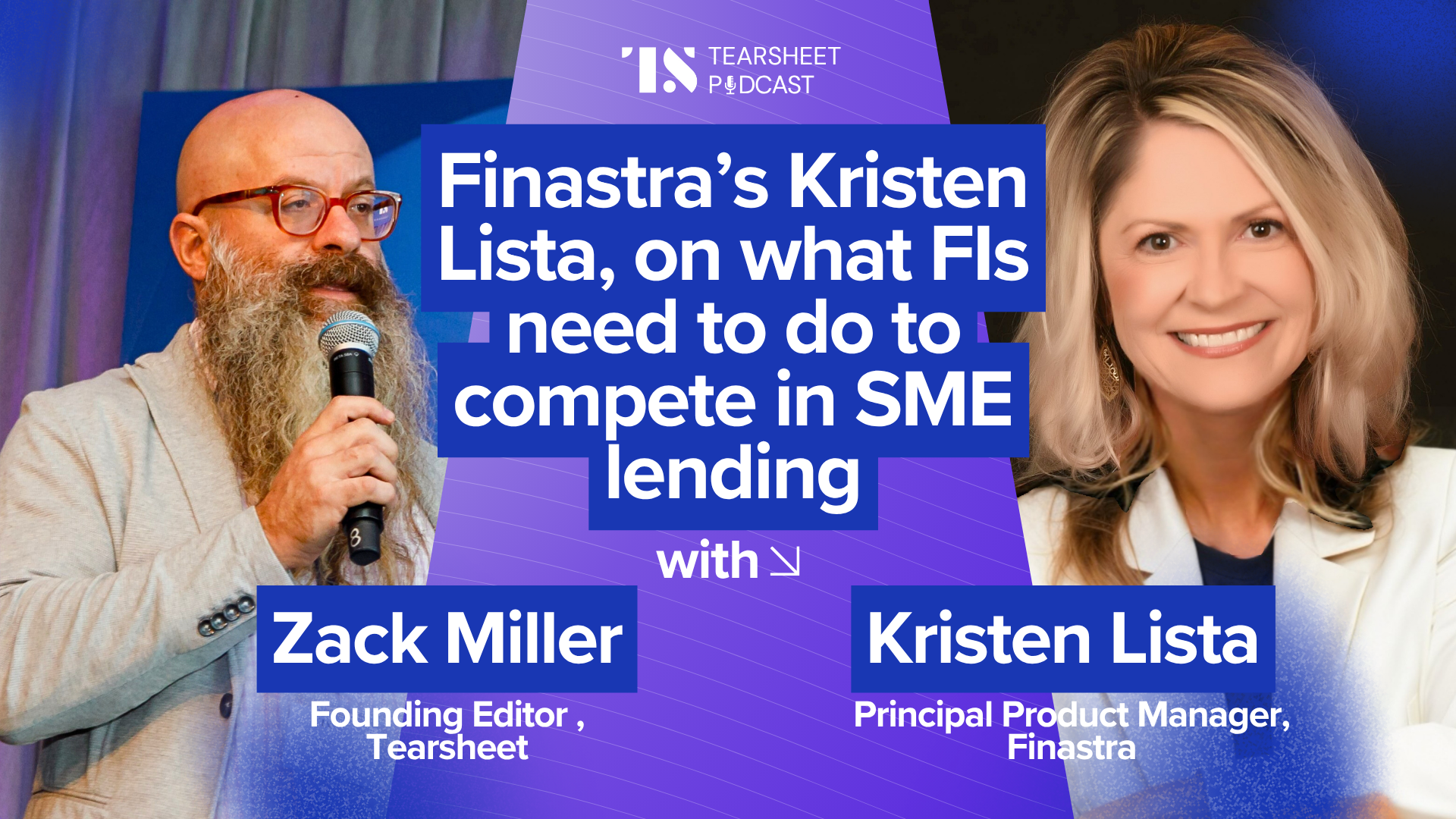
- Finastra’s Principal Product Manager Kristen Lista joins the Tearsheet podcast today to discuss how consolidating technology and decreasing the time between application and access to funding can fuel traditional bank's SME lending approaches.
Non-bank financial institutions (NBFIs) are capturing more and more market share in SME lending by leveraging technology to offer quicker lending solutions. This puts pressure on FIs to evolve their approaches while managing costs and improving service quality.
Finastra’s Principal Product Manager Kristen Lista joins the Tearsheet podcast today to discuss the most critical areas where FIs need to focus: consolidating technology to improve efficiency, decreasing the time between application and access to funding, enhancing back-office operations, and creating more client-centric experiences.
Lista offers a valuable look inside the complex web of challenges that FIs are facing when trying to improve the SME lending products. From technology integration strategies to practical advice on process improvement, Lista offers an actionable blueprint that can help FIs better compete in the SME lending space, driving growth and customer loyalty.
Watch the full episode
Listen to the full episode
Barriers SMEs face in accessing funding
Limited credit history, lack of collateral, and sitting outside FI’s credit box prevent SMEs from tapping much-needed financial resources.
Addressing these barriers requires financial institutions to embrace digital transformation: “To overcome these barriers, FIs have to innovate and embrace digital transformation, and that helps to provide faster, more efficient lending decisions, ultimately getting to that time to say yes much quicker to provide for the SMEs funding needs.”
The threat of new entrants
Traditional financial institutions face significant challenges competing with more agile non-bank lenders in the SME space. Lista points out that NBFIs have gained market share by utilizing technology to streamline the lending process.
“Traditional FIs really are struggling to compete with non-bank financial institutions in the SME lending space, because NBFIs leverage technology to offer faster, more flexible lending solutions,” Lista noted. She added that financial institutions also face a tighter cost basis in the SME lending space, which means they need to find ways to reduce costs without compromising service quality, which is very tough to do.
But beyond technology and cost challenges, FIs may be overlooking a chance to diversify their offerings: “There’s really an opportunity and a need for FIs to grow into different asset classes as well, such as moving from SME lending into commercial and syndicated lending, which can help FIs diversify their risk and open new revenue streams.”
How technology can help FIs build better CX
CX and bank office efficiency play a critical role in the relationship SMEs have with their FIs – technology in validating financial statements, automating underwriting, and enhancing loan servicing capabilities all contribute to the quality of service SMEs receive from their FIs.
Lista also highlighted a frequently overlooked area, loan servicing. It’s here that FIs have a particularly important investment to make: “Loan servicing is kind of an afterthought in digital transformation, but it really can’t be an afterthought anymore. Loan servicing capabilities have to have that digital transformation, as well, and provide for better communication and transparency for bank clients.”
The importance of modernizing back-office operations
One reason why FIs have struggled to keep up with the pace of their competitors is their historical underinvestment in back-office operations.
“FIs really haven’t focused on the back-office servicing operations of the SME lending process,” Lista said. “There’s a lot of reasons for that. Primarily, they’ve been underfunded because banks thought that the back-office was not revenue generating, and so they would really focus their resources and their budget going towards client-facing systems.”
Blueprint for customer retention and growth
At a time when FIs have to play catch up with their NBFI counterparts, the key to their success may lie in focusing on customer needs, expectations, and experience.
On the revenue front, Lista noted that while SME loans are typically lower in value, they’re higher in volume, creating a unique opportunity: “In order to grow their revenue, they have to prioritize the customer experience to get that retention and loyalty, and if they do that, they may see an approximate two and a half times increase in their revenue growth compared to those who do not prioritize customer centricity.”
To-do list: What FIs can do to better serve their SME customers
FIs that want to improve their SME customer experience can take the following steps:
– Gain a full system view: Undertake a detailed overview of the systems involved from loan initiation through servicing and termination. “Key systems that you should look at are customer portals, your borrower portals. You should be looking across the ecosystem at KYC, AML systems, loan origination systems, loan documentation systems, and, of course, your loan servicing system.”
– Evaluate potential for automation: Integration between these systems that contribute to the loan servicing process is crucial: “It’s important to look at what they’re doing, what the purpose is, but also, how do you automate and integrate these systems together and piece them together in an automated way throughout the ecosystem?”
– Don’t overlook KYC and AML – they impact CX: KYC and AML processes have a significant impact on turnaround time and customer experience. When considering modernization strategies, this is a critical area of evaluation with a CX lens. Complex KYC and AML processes can impact onboarding success and impact client retention. “If they don’t have smooth transitions from a portal to a KYC system, for example, the borrower is going to feel the delay and the impact,” said Lista.
– Find technology partners that can technological lift in automation: Tools like Finastra’s offerings can help FIs create a consolidated and streamlined lending ecosystem.
“Finastra offers a lot of solutions to enable this consolidated and streamlined end-to-end ecosystem,” Lista said. “Our products help FIs to digitally transform their ecosystems to provide those right SME offerings and mirror up with their demands and expectations.”
– Integrate teams into SME strategy: “FIs must not only look at the technology, but they must also integrate their people and processes within the technology as well,” Lista advised. “Enhancing collaboration across business segments—the front office, the back office, the middle office—and also working with their IT departments and their technology departments internally. That collaboration is key.”
To read more about what FIs can do to build competitive lending experiences and products for SMEs and find partners that can accelerate modernization efforts and positively impact bottom lines, please visit Finastra’s website.
0 comments on ““Take a hard look at your current ecosystem. If you were to double the assets under your management today, would your current ecosystem sustain that growth?” Finastra’s Kristen Lista, on what FIs need to do to compete in SME lending”
You must be logged in the post a comment.