
Banking, Banking as a service, Member Exclusive

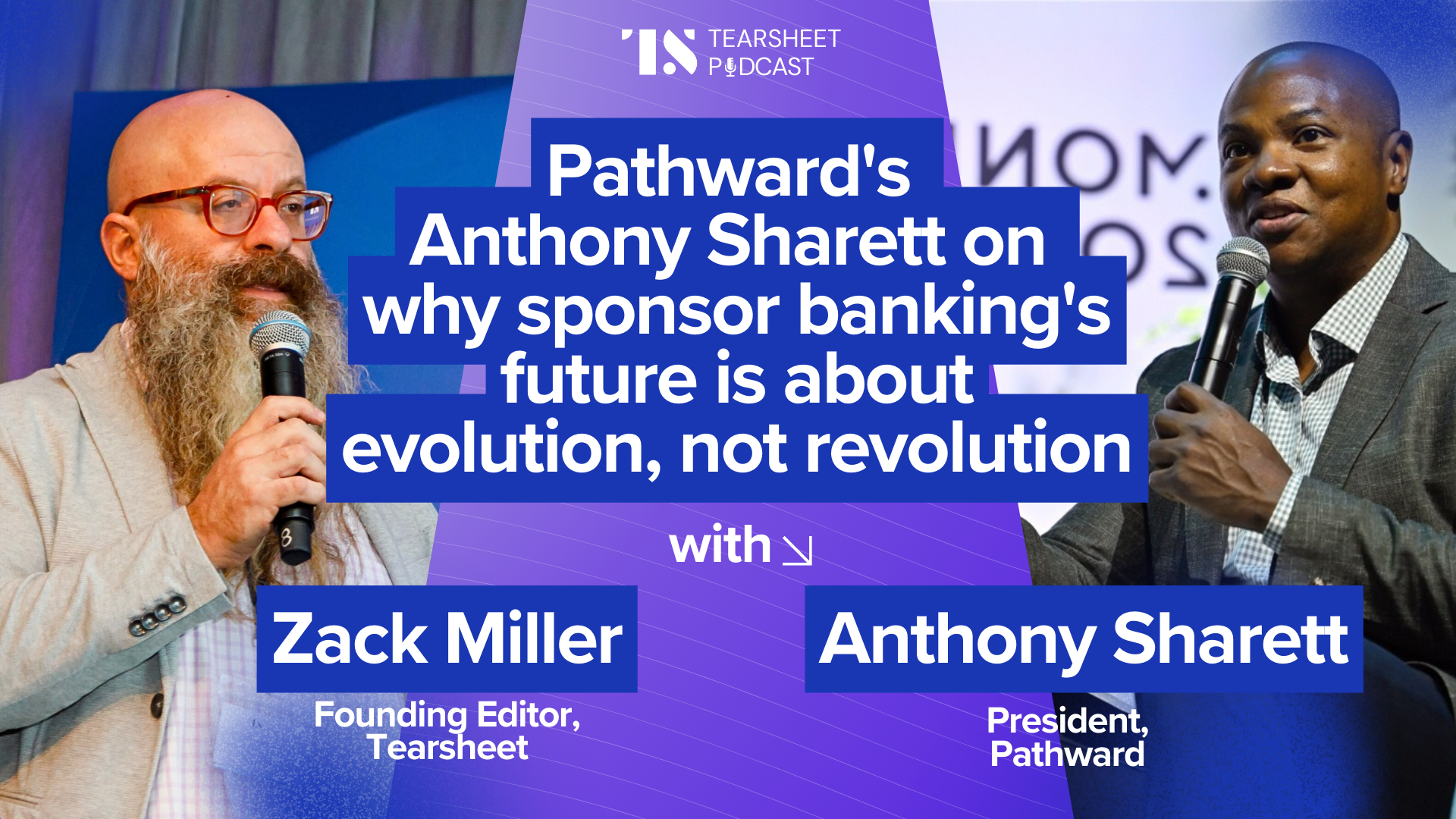
Pathward’s Anthony Sharett on why sponsor banking’s future is about evolution, not revolution

  • After 20 years in sponsor banking, Pathward president Anthony Sharett argues that successful bank-fintech partnerships require the right people, multi-threaded opportunities, and true co-creation.
  • While over 100 banks now call themselves sponsor banks, Suro believes the next frontier lies in AI, embedded finance, and educating all stakeholders about what's possible.
close

Email a Friend

Pathward’s Anthony Sharett on why sponsor banking’s future is about evolution, not revolution

Sponsor banking has become one of the most scrutinized business models in financial services. The headlines focus on enforcement actions and regulatory pressure, but behind that noise is a more interesting question: when done right, how do bank-fintech partnerships actually expand financial access to people the traditional system has left behind?

My guest today is Anthony Sharett, President of Pathward. Before joining Pathward he led Nationwide Pet Insurance and served as Interim President of Nationwide Bank. At Pathward, his mission is powering financial inclusion through partnerships with fintechs and platform companies.

We’re going to talk about how the sponsor banking model actually works, what makes these partnerships succeed or fail, and why Anthony believes these relationships are essential to expanding financial access beyond what traditional banks can reach on their own.

Watch the episode

https://youtu.be/BbQ3gVzgWTQ

Listen to the episode

Subscribe: Apple Podcasts I SoundCloud I Spotify

Read the whole transcript (for TS Pro subscribers)

Tearsheet Pro

0 comments on “Pathward’s Anthony Sharett on why sponsor banking’s future is about evolution, not revolution”

Member Exclusive, Opinion

Letter from the Editor: Financial services have always relied on one thing. AI is taking it away.

  • As AI agents assume more responsibility for commerce, the transaction remains visible, but the decision-making behind it becomes increasingly opaque.
  • Financial services are reconstructing the decision trail AI has hidden. That's why the industry's conversation increasingly revolves around intent, context, governance, permissions, explainability, and accountability.
Sara Khairi | July 10, 2026
AI Innovation, Member Exclusive, Payments

Paper still defines payments’ last mile. J.P. Morgan Payments thinks AI and robotics can tackle that.

  • Most payment discussions assume the biggest challenge is moving money from Point A to Point B. What if the bigger bottleneck is actually the operational noise surrounding the payment?
  • Investing in checks sounds like a step backward, but J.P. Morgan Payments is doing exactly that – because paper checks still create the greatest operational friction in the modern financial system.
Sara Khairi | July 09, 2026
Banking, Business of Fintech, Member Exclusive

Revolut’s US bet: A bank charter, a stablecoin pitch, and a graveyard of European challengers that tried before it

  • Revolut filed for a US national bank charter in March 2026 to break free from its partner-bank arrangement.
  • The firm is betting on stablecoins and cross-border/multi-currency banking to win over international-minded US customers, backed by a $500 million commitment and a buildout led by new US CEO Cetin Duransoy.
Rabab Ahsan | July 07, 2026
AI Innovation, BNPL, Member Exclusive

Why BNPL infrastructure needs to learn a new acronym: KYA (Know Your Agent)

  • As AI agents take a larger role in commerce, BNPL providers may need to rethink whom or what they evaluate when approving transactions.
  • Zip Co's Rory Herriman believes a future payments ecosystem may need to prove that an agent had authority to act, but also that the action reasonably reflected the user's objectives.
Sara Khairi | July 02, 2026
Member Exclusive, Podcasts

Trust, stablecoins, and the AI margin squeeze: What McKinsey and QED’s fintech report means for banks

  • Max Flötotto, who leads McKinsey’s global retail banking practice, and Mike Packer, a partner at QED Investors, just co-authored a report mapping where fintech goes next — and they agree on almost everything in it.
  • We dig into why “a feature is no longer a fintech,” why only 1% of stablecoin volume is actual end-user payments, and why the simplest version of banking — deposits and loans — may be the part most at risk from AI agents.
Zack Miller | July 01, 2026
More Articles