
10-Q, Member Exclusive

Why Affirm’s most important product isn’t BNPL at checkout (alone) anymore

  • Quarterly filings often hide clues about how a fintech is evolving and where it’s headed. Affirm’s Q4 2025 results are a case in point.
  • Buried in the product numbers of the latest earnings is a story: Affirm card’s rise as the firm's second growth engine.
close

Email a Friend

    The story of how Affirm found its second growth engine


    Big announcements are often greeted with fast fanfare, but sometimes clues of fintech’s evolution and a company’s growth roadmap are tucked inside quarterly filings. That’s the case with Affirm’s Q4 2025 results, which came out at the end of August.

    The earnings figures were notable: $876 million in revenue, up 33% year-over-year, a swing to $69 million in net income, and Affirm’s GMV growth year-over-year was about 43%, from $7.2 billion to $10.4 billion in Q4.

    Given how often Affirm has been boxed in as a BNPL (buy now pay later) pure-play, the move into sustained profitability on its own could have carried the story. This time, though, the detail worth dwelling on was buried in the product data, and how a specific product is emerging as Affirm’s second growth engine. The first growth engine remains BNPL at checkout.

    The product in focus is the Affirm Card, which has steadily grown over the past five years since its launch. It’s a debit card that lets users decide whether to pay upfront or make payments over time, all managed through the Affirm app.
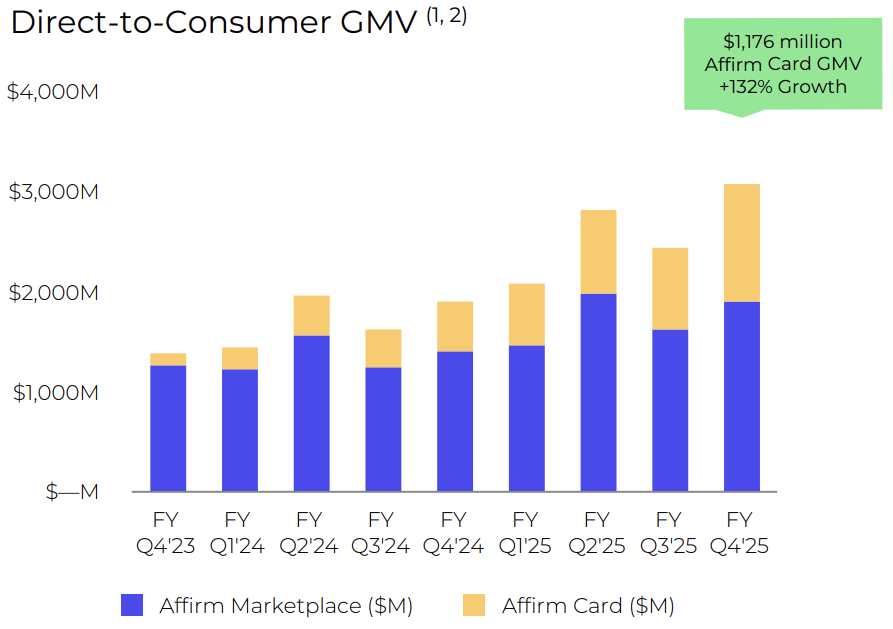
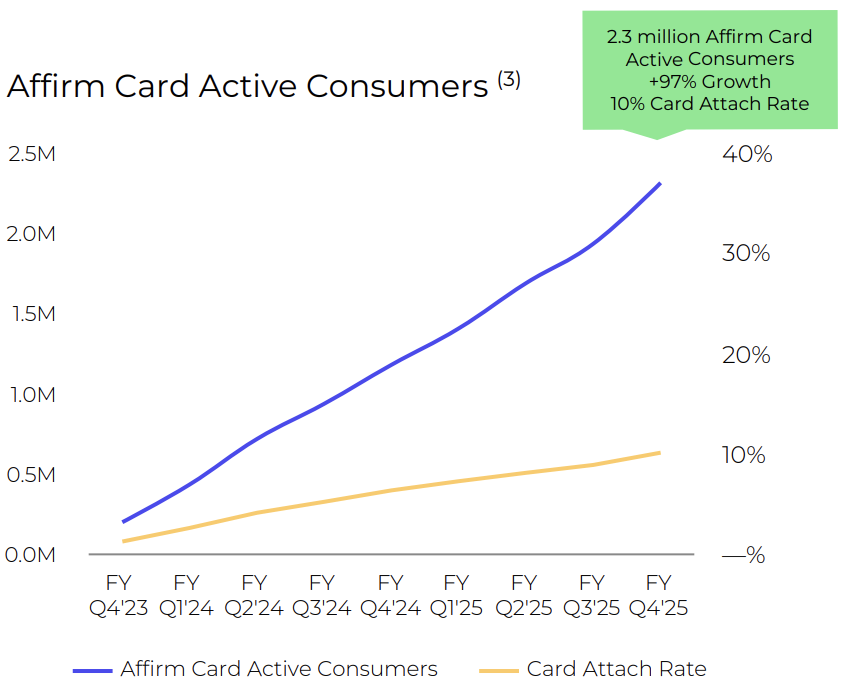
    Chart Source: Affirm

    In the recent earnings, Affirm card GMV more than doubled, up 132% to $1.2 billion. Active cardholders nearly doubled, reaching 2.3 million, and in-store spend increased by 187%. These are beyond just signs of adoption; more like Affirm turning its card into a core payments habit. With early AdaptAI deployments driving an average 5% increase in GMV for adopting merchants, you get a picture of the fintech doing more than selling installments. Affirm is moving into an infrastructure that merchants, especially SMBs, can build on.


    subscription wall for TS Pro

    0 comments on “Why Affirm’s most important product isn’t BNPL at checkout (alone) anymore”

    10-Q, Member Exclusive

    Green Dot and the case to make financial experiences feel calmer

    • Green Dot is shifting to prioritize "Cortisol UX", a philosophy that aims to absorb user stress by embedding signals into its architecture that increase predictability of interactions.
    • The product team is focusing on slowing down paths such as transaction confirmations to reduce cognitive load and uncertainty.
    Sara Khairi | May 11, 2026
    Banking, Lending, Member Exclusive

    LendingClub rebrands to Happen Bank as its identity catches up to its model

    • LendingClub (soon Happen Bank) did what few scaled fintechs manage cleanly: it let the business lead, and the brand follow.
    • The company remains lending-centric, but is building out a broader post-loan experience.
    Sara Khairi | May 07, 2026
    10-Q, Member Exclusive

    Coinbase is building on a dual-engine structure, but trading still sets the tone

    • Coinbase is working to expand beyond its crypto identity into a broader financial services platform, but the shift is still too early to call a clean transition story.
    • A dual-engine model best captures Coinbase at present: trading is the volatility engine, subscriptions and infrastructure the baseline.
    Sara Khairi | May 04, 2026
    Artificial Intelligence, Member Exclusive, Payments

    How agentic commerce is making execution, intent, and credit actionable inside payments

    • Agentic commerce is narrowing the gap between execution, intent, and credit within payments.
    • Across the payments stack, companies like Stripe, American Express, and Affirm are applying agentic AI to smooth the path from intent to execution.
    Sara Khairi | April 30, 2026
    10-Q, Member Exclusive

    Can Robinhood build sustainable revenue streams that are not tied to how often people trade?

    • In 2026, Robinhood’s strategy has been about expanding what surrounds its core trading engine.
    • The actual question is: Can episodic trading behavior be converted into persistent reliance on Robinhood?
    Sara Khairi | April 27, 2026
    More Articles