A recent survey found that 52% of financial-services respondents are actively adopting agentic AI. However, the bigger question now is how much of the actual work these agents are now being trusted to do – moving beyond analysis and recommendations to execution.
This boundary is increasingly central to how these systems are evaluated through model-risk and vendor-review processes, whether banks add agents to banking workflows through vendors like nCino or build and deploy agents on their infrastructure through Google Cloud.
nCino customers see agents as an extension of their workforce
nCino is introducing agents into existing banking jobs rather than treating them as a separate AI layer. nCino’s Digital Partners, a suite of AI agents designed for specific banking functions, includes agents for analyst, processor, and service roles, and the company describes them as a “dual workforce” in which AI handles data-heavy work. At the same time, bankers retain time for judgment, relationships, and growth.
From the bank’s perspective, the important question is therefore which part of a banker’s workflow the institution is comfortable handing over to the agent. A commercial banker, for example, can have an agent collect and analyze information needed for a relationship review and prepare the work, rather than spending hours doing the underlying research manually. The banker then reviews that work and remains responsible for the consequential judgment.
For nCino’s latest customer, ConnectOne Bank, the interest in the vendor’s agentic technology is to free its bankers from administrative work so they can spend more time on higher-value work.
Over the past year, technology vendors have been using a new phrase to describe AI for financial institutions: adapted for banking. Whether the language is “trained on banking data” or “wrapped in a banking interface,” the implication is the same: a general-purpose model was retrofitted for an industry that it was never designed for.
However, this approach equates knowledge to understanding. Banking is not a general knowledge domain; it is a structured system of relationships between products, policies, regulations, risk frameworks, and supervisory expectations that bankers spend years learning to navigate. A model that has read about banking is not the same as a model designed to work within it.
Titan was built for banking. The platform combines three things. Banking-native models trained to reason through real regulatory and supervisory logic. A context layer grounded in both industry knowledge and each institution’s own policies and data. And agents that put that intelligence to work across risk, compliance, underwriting, and operations, all while keeping humans in control.
This architecture earned Titan the AI Startup of the Year Award at Tearsheet’s AI Innovation Awards 2026. Tearsheet spoke with Arjun Sirrah, Titan’s Founder and CEO, about why banking-native AI requires a different foundation, what it takes to reach production inside a regulated institution, and where the market is headed.
Arjun Sirrah, Founder & CEO, Titan
Q: Why did Titan choose to build banking-specific models instead of adapting general-purpose LLMs?
Arjun Sirrah, Titan: Banking doesn’t need generalist AI that knows a little about everything. It needs AI that understands the industry at a deep level, including the relationships among products, records, policies, risk tolerances, and both regulatory and supervisory expectations. A general-purpose model wasn’t built to understand why a commercial credit decision differs from a consumer lending decision, how an institution’s policy may differ or be more restrictive than the underlying regulation, or what an examiner will expect to see after that decision is made.
We understood that distinction because our team has lived inside banks. We’ve built and implemented banking products, managed operations and technology, and worked through second-line reviews, audits, and examinations. That experience showed us that banking context wasn’t something to be added at the end. Security, auditability, regulatory reasoning, and institutional accountability had to be designed into the platform.
That’s why Titan combines secure access to foundation models with banking-native models, a banking context layer, and supervised agents. The goal isn’t to make AI sound more like a banker. It’s to give it the structure and context needed to actually reason through real banking work in a way that a banker, risk officer, or examiner can follow and trust.
Q: What was the hardest part of building banking-native models that FIs could actually deploy in production?
Arjun Sirrah, Titan: The hardest part was building a platform around models that could not only produce an accurate, relevant answer, but also one that banks could safely use in a live workflow with confidence and verify.
To reach production, banks must solve several problems all at once. They have to select the appropriate model, protect sensitive information, control access, understand how an output was produced, ground that output in current policies and procedures, document what happened, and determine where human review is required. Then that technology has to fit into an actual workflow without forcing an institution to replace every existing system or redesign its operating model overnight. Assembling all of those pieces independently and correctly is a genuinely hard problem.
That’s why Titan was built around three components that work together: banking-native models, context, and agents. The models include Titan’s Banking Model, designed for the precision and regulatory reasoning banking requires, alongside secure access to frontier LLMs, routed to the right model for the task. The context layer grounds every output in a proprietary knowledge graph that encodes how banking works across products, regulations, and risk frameworks, and in some deployments, a second knowledge graph or ontology built from the institution’s own policies, procedures, and data. The agents then connect that intelligence to real banking workflows, handling the searching, retrieving, and documenting, while surfacing recommendations to human experts for review and final decision. Production readiness comes from making all three work as a single system rather than assembling them independently.
Q: What is one lesson you’ve learned about building banking-specific models that surprised you?
Arjun Sirrah, Titan: A key lesson is that governance doesn’t have to slow AI adoption. When it’s designed in from day one, governance can actually accelerate it.
Banks aren’t resistant to useful technology, but they’re risk-averse by nature, and their hesitation usually comes from unanswered questions, things like: Where is the data going? Which model is being used? What information informed the response? Can we reconstruct what happened? Who reviewed the recommendation? If those questions are addressed only after a pilot, the project will likely stall just as it begins to show value. But if these are answered right at the start as part of the design itself, the various teams can evaluate the same system together.
We’ve also learned institutions don’t have to start with the most autonomous or complex use case. They can begin by giving employees a secure, governed alternative to unapproved shadow AI tools, then ground those outputs in the institution’s approved policies and procedures, and finally introduce supervised agents into targeted workflows. This way, governance is the foundation for scaling, allowing an institution to move from experimentation to production with greater ease and confidence, rather than a gate at the end of innovation.
Q: Titan’s Banking Agents automate underwriting, risk, and compliance workflows. What makes banks comfortable trusting these models and agents with higher-stakes decisions?
Arjun Sirrah, Titan: Trust begins with defining the AI agent’s role correctly right from the start. Titan’s agents aren’t designed to replace the accountable banker or make opaque final decisions. They’re designed to do the legwork: collect the needed information, retrieve the relevant policies and procedures, analyze that data against those requirements, and finally produce a recommendation for a human to review. The banker remains responsible for the judgment and review at all the appropriate control points, and ultimately, the final decision.
Several design principles reinforce this approach. The agents are grounded in the institution’s own products, data, policies, and risk tolerances. Their work is logged, traceable, and reviewable at any time. They combine AI reasoning with defined tools and approval steps, and they surface their findings to human experts rather than hiding the process behind a black-box answer. This gives risk, compliance, and business teams the ability to inspect not only the recommendation, but the context and reasoning behind it.
Institutions become much more comfortable when AI expands the capacity of their people without removing the judgment or accountability. The machines handle the repetitive but important tasks: the searching and retrieving, the staring and comparing. This lets the people focus on the actual decision-making that requires experience, interpretation, and responsibility.
Q: Since launching in 2025, what has been the biggest change you’ve seen in how banks approach AI adoption?
Arjun Sirrah, Titan: AI is beginning to be treated less as an isolated experiment and more as a new operating layer within banking infrastructure. That is the biggest shift we’ve seen since launching in October 2025, and it has happened faster than most expected.
Early conversations were mostly centered on experimentation, model selection, and general-purpose productivity. Banks were testing tools, but many hadn’t really established the path from an individual use case to a fully deployed, controlled enterprise capability. Increasingly, the conversation is now about production: replacing ungoverned AI usage, grounding outputs in actual institutional knowledge, selecting workflows with clear operational value, and building the auditability and human oversight required to scale both responsibly and effectively.
What’s also emerging is a deeper realization about why so many early AI deployments underdelivered. It wasn’t the model. It was the absence of banking context. General-purpose models don’t understand the relationships between a bank’s products, policies, regulatory obligations, and risk frameworks. Without that structure, outputs may sound reasonable but don’t reflect how banking actually works. Institutions are starting to ask harder questions about what knowledge their AI is reasoning from, and whether that knowledge was built for banking or borrowed from somewhere else entirely.
We’re also now seeing institutions think more holistically. They’re no longer looking for a chatbot or a single-point solution. Instead, they’re examining their data, processes, and operating models as a whole, and asking how AI can improve the way the institution works across risk, compliance, underwriting, and operations if the right context is invoked at the right time. Titan’s rapid growth since emerging from stealth, and the pace at which institutions are replacing generic, ungoverned tools with governed, auditable capabilities, reflect that shift.
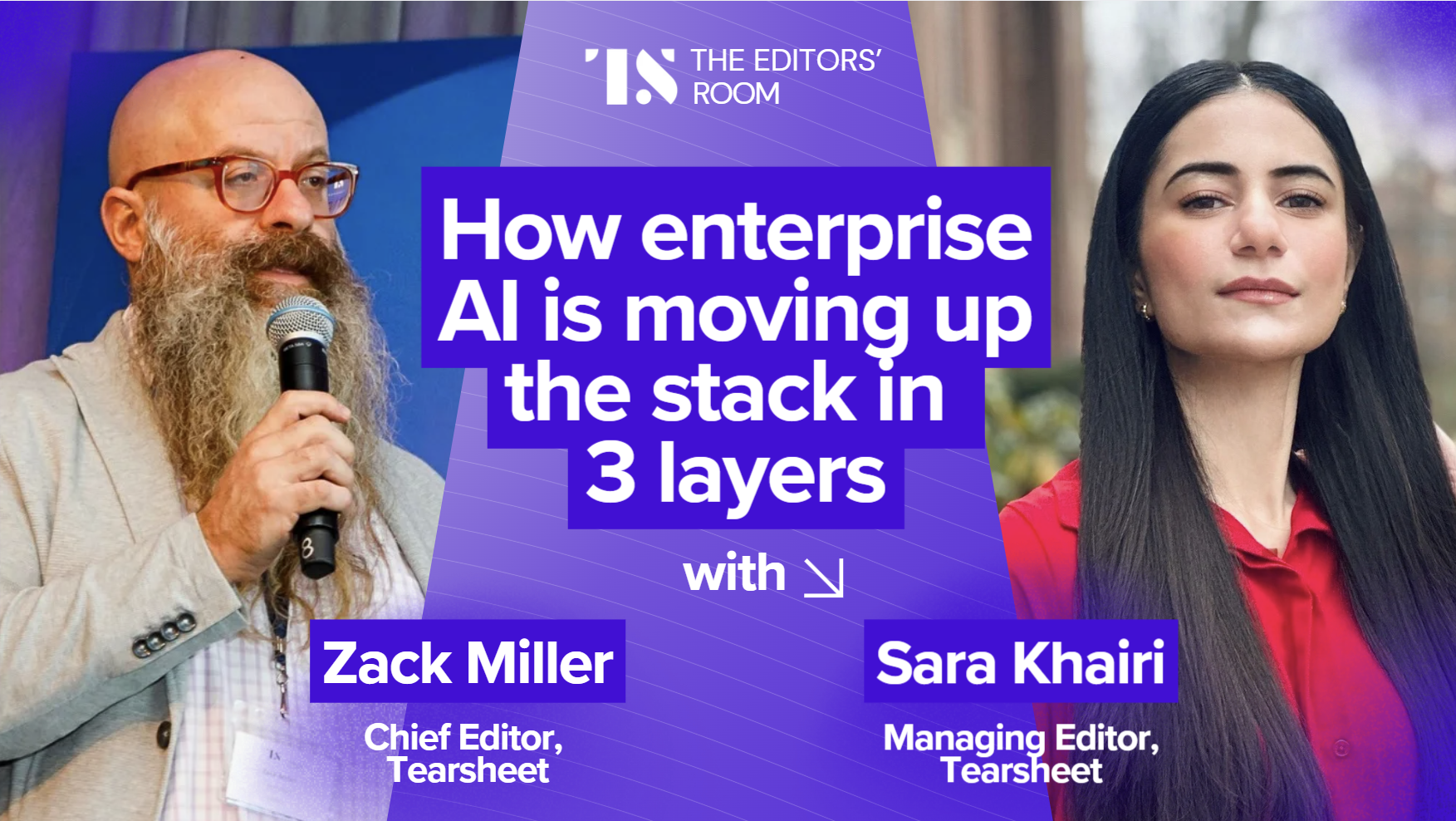
Welcome to The Editors’ Room, a new Tearsheet Podcast series where Editor-in-Chief Zack Miller and Managing Editor Sara Khairi take the conversations that usually happen behind the scenes about our biggest stories and put them on the record.
This isn’t a rehearsed interview or carefully choreographed panel answers. It’s just two editors comparing notes, challenging each other’s takes and trying to make sense of what is actually happening in financial services. Think of it as pulling up a chair after the meeting ends.
It’s the stuff we usually debate after the calls end: what a new product actually means, which industry trends have legs, and where the hype gets ahead of reality. Raw, conversational, and occasionally accompanied by a blooper.
For our inaugural conversation, the topic was AI and, more specifically, what would you happily delegate to AI and what would you never hand over? From there, we got into the bigger question of how enterprise AI is taking shape.
On that first question, Zack’s line is creativity. AI can handle planning and logistics, and he uses it as an editorial sparring partner, asking questions, challenging ideas, and pushing him to dig deeper. But the creative judgment stays human.
Sara draws the line at decision-making. Take an expensive laptop: she’ll happily let AI compare the options, but she wants to be the person who clicks buy.
It turns out that tiny distinction – AI can help make the decision, but shouldn’t necessarily make it – is becoming a much bigger question in financial services.
The company has launched assistants for paychecks, refunds, and debt, but the more interesting part is what happens beneath the surface. The assistants share a common financial context, giving them a broader view of a customer’s financial life rather than forcing each one to operate in a silo. But their workflow deliberately separates calculation from conversation.
Credit Karma’s optimization engine first analyzes the customer’s income, loans, interest rates, and goals, runs scenarios, and determines an appropriate strategy. Only then does generative AI step in. Its job isn’t to invent the answer but to explain the answer, turning the optimization engine’s structured output into a personalized, understandable recommendation. Then it hands the decision back to the customer.
For both editors, that human-in-the-loop approach is the point. AI can do the homework and can surface the options. But when it comes to your money, someone still needs to take the test.
The chatbot era may be running out of steam
That architecture also points to where financial AI may be headed next.
Zack sees the traditional chatbot interface becoming less compelling. Instead of making customers sit down for a conversation with a bot, AI could increasingly appear inside workflows, surfacing a recommendation, asking for approval, or prompting the next action when it matters.
Sara’s view is similar, with one caveat: chatbots are fine when the problem is simple. When a customer has a complicated, highly specific issue, generic answers can quickly turn the experience into chatbot ping-pong.
That raises another problem: the metrics. Banks love reporting interaction volumes. But a million chatbot conversations don’t necessarily mean a million successful outcomes. Customers might simply be talking to the bot because they can’t reach a human.
The better question is whether AI is actually improving outcomes, whether customers are solving problems faster, making better decisions, or becoming more engaged.
In other words, headline numbers aren’t the same as meaningful numbers.
Agentic AI is moving faster than expected
And then there’s the agentic wave. Only months ago, agentic AI was still largely a conversation. Now banks and fintechs are launching agents left, right, and center.
Zack admits he initially underestimated how quickly the technology would move. Having watched other tech trends take years to mature, he expected a longer runway. AI has been a different beast.
The next phase could see banks build libraries of specialized agents across functions, eventually pushing more toward agentic banking and agentic commerce.
But there’s a catch. The more autonomous these systems become, the bigger the governance question gets. If an agent makes a bad decision, who is accountable? What data did it use? Who approved the action? Can the decision be explained?
The technology may be moving quickly, sure, but the rulebook has some catching up to do.
The 3 layers that now matter the most
That is why Zack is particularly interested in companies building what he calls the decision-making layer. Taktile, for example, is developing a library of agents alongside a layer that coordinates them. The idea is that building individual agents isn’t enough. They need to work across the messy reality of a customer’s financial life.
Banks still operate across product and data silos; customers don’t. A decision-making layer becomes the air traffic control, seeing across those systems, understanding the customer, and determining which agent, product, or action should come next.
If there’s a pattern emerging across enterprise AI, it’s this: give the agents shared context, give each one a job, and have an orchestration layer keep everything moving in sync.
This is how the bigger enterprise architecture is taking shape.
That’s ultimately what we kept coming back to in our first Editors’ Room: AI is forcing the industry to decide what machines should do, how they should do it, and what humans should never stop deciding for themselves.
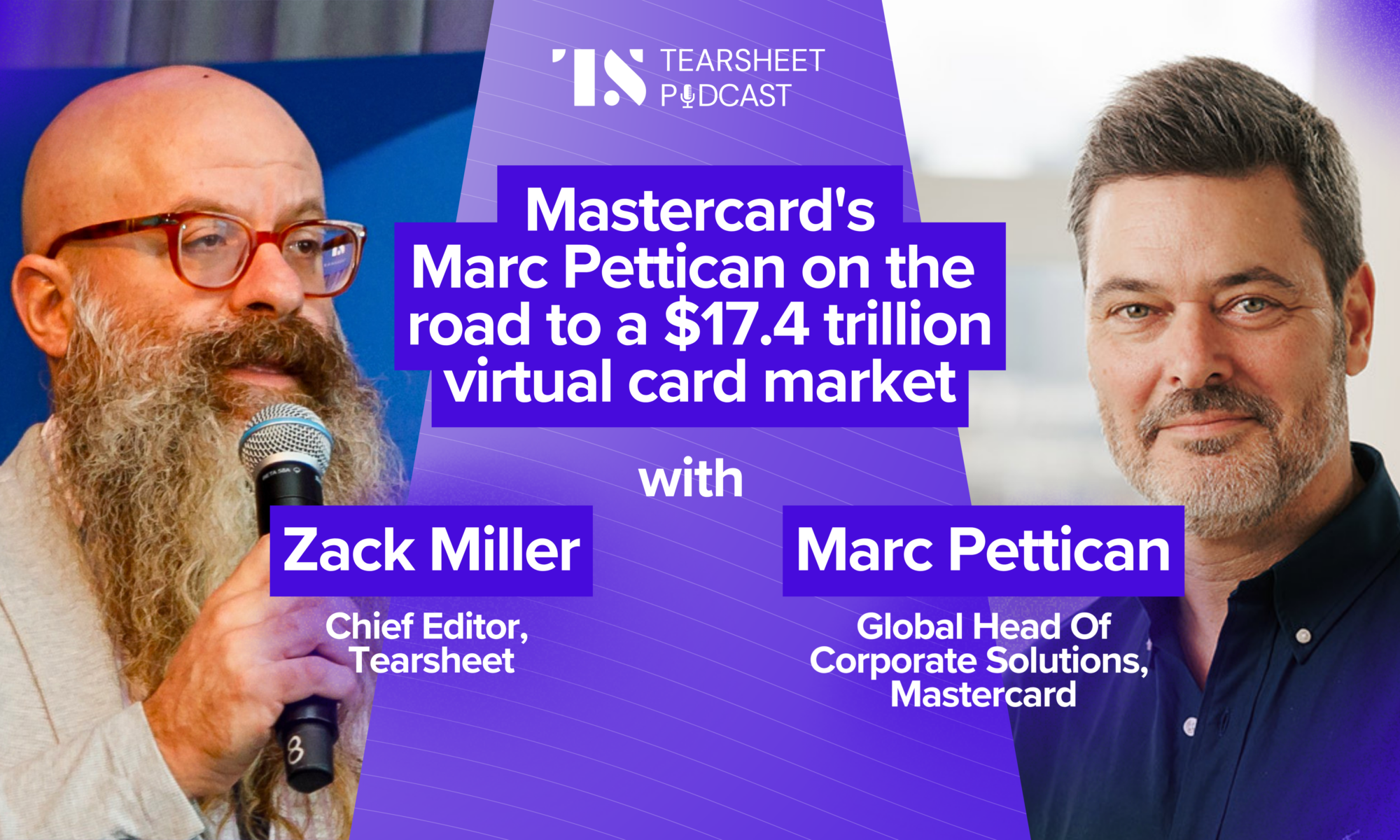
Every accounts payable and accounts receivable department runs on the same friction: invoices chased four or five times, payments late more than 30% of the time, and credit control teams that can run 20, 30, even 50 people deep at a mid-sized corporate. Virtual cards were built to solve exactly that problem, and the growth numbers show it — spend is projected to hit $17.4 trillion by 2029, according to Juniper Research. Today I’m joined by Marc Pettican, global head of corporate solutions at Mastercard, who’s spent decades working both sides of the payments ecosystem, from the merchant acquiring side to leading commercial cards.
We get into what’s really driving virtual card growth beyond the macro tailwinds, how Mastercard balances network economics between buyers and suppliers, and the build-versus-partner calculus behind expanding from travel into verticals like fleet and logistics, healthcare, insurance, and marketplaces. We also dig into embedded finance and the challenge of staying visible in the stack even as payments become invisible to the end user — plus where Mastercard sees its right to win in agentic payments, account-to-account transfers, and stablecoins. Marc closes with his advice for commercial card heads at mid-sized banks over the next twelve months.
Top-line Takeaway: For Mastercard’s Marc Pettican, the future of commercial payments isn’t about replacing one payment rail with another—it’s about orchestrating them all. As accounts payable and receivable remain burdened by manual processes, delayed payments, and working capital pressures, Pettican argues that virtual cards are becoming the foundation for re-engineering B2B cash flow. That strategy extends beyond travel into industries like healthcare, insurance, and logistics, while embedding payments directly into enterprise workflows and connecting cards, account-to-account transfers, and stablecoins. Mastercard’s role, he says, is to serve as the trust and orchestration layer that enables businesses to move money smoothly, regardless of how they choose to pay or get paid.
Read the whole transcript (for TS Pro subscribers)
Building an equal-sided ecosystem, from Barclaycard to Mastercard
The ‘Letter from the Editor’ series features exclusive insight and opinion-driven analysis from Tearsheet editor Sara Khairi.The focus is on linking ideas, questioning assumptions, and tracking shifts across both mature and emerging trends in financial services.
This is now PRO-only content. Subscribe to PRO so you never miss a Letter from the Editor exclusive.
[Writer’s Note: We’re back with a fresh weekly edition after taking last week off for the Independence Day weekend.]
Issue # 8
Over the past few months, I’ve been speaking with financial leaders preparing for agentic commerce. Lenders are rethinking how they evaluate risk. Merchants are wondering what happens when shoppers are no longer people clicking through websites, but software acting on their behalf. Meanwhile, BNPL providers are increasingly considering approaches similar to KYC for AI agents as autonomous software takes on a larger role in initiating transactions.
These conversations couldn’t have been more different. They involve different products, different business models, and different parts of the financial ecosystem. Yet I kept hearing variations of the same concern: how do you know that a transaction truly reflects what the customer intended?
Financial services have rarely had to ask that question. The industry has largely taken comfort in the assumption that somewhere in every financial interaction, there was a visible human decision. Someone clicked Buy, signed the loan agreement, reviewed the repayment terms, or tapped Confirm before the money moved.
That moment became evidence that the customer had understood the decision, accepted its consequences, and intended for it to happen. Modern financial infrastructure grew around that assumption. Fraud systems learned to distinguish normal human behaviour from suspicious activity. Lenders inferred confidence and commitment from the choices customers made during the application process. Banks built dispute processes around the idea that, somewhere along the journey, there had been a clear expression of consent.
Now that proof is becoming harder to find.
As AI agents begin researching products, comparing prices, selecting merchants, arranging financing, and eventually completing purchases, what changes is the industry’s ability to observe the decision that led to it.
In many ways, it explains why so many companies across financial services suddenly seem to be working on similar problems, even if they’re using very different language to describe them.
BNPL was designed for people making purchasing decisions. Agentic commerce shifts those decisions to software. The result is an infrastructure mismatch: autonomous buyers operating on systems built to verify human intent.
As AI agents begin purchasing, financing, and managing transactions on behalf of consumers, BNPL providers may become an early test case for questions the broader payments ecosystem is only beginning to recognize:
How do you verify intent when the buyer is software?
How do you underwrite a purchase when the decision-making process is invisible?
And who bears responsibility when an agent acts exactly as instructed but produces an outcome the consumer never wanted?
Agentic commerce separates intent from action
BNPL providers are accustomed to customers selecting a product, reviewing the price, choosing a financing option, and accepting the repayment terms. Every step creates signals that help lenders assess both risk and intent.
The model works because the person making the purchase and the person assuming the debt are the same. Agentic commerce breaks that link.
The two announcements Coinbase made this month reflect the firm’s expanding ambitions.
The company introduced a stablecoin-backed credit card that allows users to borrow against digital assets rather than rely solely on traditional credit underwriting. Days later, it launched Coinbase for Agents, a system that enables AI agents to trade, pay, and execute financial workflows within Coinbase accounts on behalf of users.
The moves answer a pertinent question that increasingly faces financial institutions: What happens when both money and the instructions that move it become programmable?
Turning stablecoins into financial utility
Crypto adoption has struggled with a practical problem. Digital assets could appreciate, but accessing that value often required selling them.
Coinbase’s new stablecoin-backed credit card changes that equation. Rather than liquidating holdings, users can use stablecoins as collateral to access credit. The model expands purchasing power while keeping assets inside the Coinbase ecosystem. It also potentially opens access to consumers with significant digital-asset holdings who may not qualify for traditional unsecured products.
The development reflects how stablecoins are evolving beyond their original role as digital dollars and into infrastructure supporting payments, lending, and liquidity management.
Building for an agent economy
Coinbase for Agents lets users authorize AI agents to monitor balances, execute trades, rebalance portfolios, make payments, and eventually purchase services on their behalf.
The company’s leadership has been vocal about where it believes this is heading. During Coinbase’s recent earnings commentary, CEO Brian Armstrong argued that AI agents will become major economic actors, capable of autonomously participating in commerce and financial transactions. The firm also disclosed that more than 90% of on-chain agentic stablecoin transaction volume has already occurred on Base in Q1 2026.
That figure suggests Coinbase is preparing for an agent economy, as it is already seeing early evidence of it.
The infrastructure question
Both of Coinbase’s moves are fundamentally rooted in infrastructure.
As crypto-backed payments move closer to mainstream commerce, merchants care less about the origin of funds than about settlement reliability, reconciliation accuracy, fraud controls, and accounting continuity.
The same standard applies to AI-driven transactions. An autonomous agent that can trade or spend money is only as useful as the payment rails, cash-flow systems, and compliance controls beneath it.
The opportunity and the complexity of aligning payments and autonomous execution help explain Coinbase’s push to build both sides of the equation simultaneously: the asset layer through stablecoins and the decision layer through AI agents.
The company believes that the next competitive battleground may be the operating layer that connects capital, payments, credit, and autonomous agents into a single system. And these announcements suggest Coinbase wants to own that layer.
The financial services industry is obsessed with what AI agents can do. Can they search? Can they reason? Can they negotiate? Can they shop?
The answers are arriving faster than anyone expected. Agents can already browse websites, compare products, fill carts, and increasingly complete transactions. Every few weeks, a new demo appears showing an AI assistant navigating the web with fewer clicks and more autonomy than before.
But inside one of the world’s largest payments businesses, a new question has emerged. What happens after the agent becomes capable?
Michael Lozanoff, Global Head of Merchant Services at J.P. Morgan Payments
That is where Michael Lozanoff, Global Head of Merchant Services at J.P. Morgan Payments, believes the real work is happening. “The capability question is largely being solved,” he says. “Models are getting smarter, and the ability to browse and compare items is maturing. But capability without governance is the next challenge.”
While much of Silicon Valley is racing to build smarter agents, J.P. Morgan Payments is addressing the trust, identity, and governance infrastructure needed to manage autonomous agents.
Every day, banks and lenders make millions of decisions: who gets onboarded, which credit applications get approved, which transactions get flagged for AML review. For decades, those decisions were made by people working through slow, rules-based processes with legacy systems underneath them. Increasingly, the industry is asking whether AI agents can do that work better, faster, and at a fraction of the cost.
Taktile builds decision infrastructure for regulated financial institutions. The Berlin-born company, now in New York and London, is betting that dropping a foundation model into an existing workflow isn’t the answer.
The decision problem at the core of financial services
Financial institutions run on decisions. Whether a customer can open an account. Whether a business is creditworthy. Whether a transaction appears to be money laundering. These aren’t generic AI problems; they require domain-specific intelligence, auditability, regulatory compliance, and a coherent way to keep humans in the loop when it matters.
Taktile’s agentic decision platform addresses this set of challenges with a layered architecture — an AI Agent Manager, Decision Engine, Agentic Case Manager, Context Layer, and enterprise-grade infrastructure — to enable financial institutions to deploy autonomous agents across onboarding, underwriting, AML, fraud, and claims without compromising governance.
Beyond wrapping a model
Taktile argues that deploying AI in financial services requires more than connecting to an API from OpenAI or Anthropic. It requires domain-specific agent intelligence, business-user-controlled guardrails, human-in-the-loop escalation workflows, dedicated financial data context, and strict system governance. Foundation models provide the intelligence layer; the infrastructure around them is where financial deployments actually succeed or fail.
Taktile claims its customers across banking, lending, payments, and insurance experience measurable outcomes: 10% increases in approvals through smarter onboarding, up to 95% automation rates for SMB underwriting, more than 75% reduction in AML false positives, and significantly faster fraud detection.
Case study: One of the world’s largest insurers
The most telling data point in Taktile’s story is one of the world’s largest financial services firms. The global insurer already has a formal partnership with one of the top AI labs. And yet when it came to deploying AI agents across its business, this insurer chose Taktile as its strategic partner. The company has expanded across multiple business lines globally, with claims processing automation rates more than doubling.
The relationship with the insurer illustrates where value is accruing in the enterprise AI stack: the foundation model is necessary but not sufficient. The winning platforms likely orchestrate those models with auditability, workflow controls, regulatory compliance, and financial-services-specific knowledge baked in. That’s where institutions are placing their bets.
What it means for the industry
Taktile’s customer list includes Monzo, Mercury, Questrade, Ualá, and Kueski, among others. The platform currently powers more than 30 million weekly decisions for over 150 customers, and the company is expanding its agent library and building exclusive data products with partners including Equifax and Dun & Bradstreet.
The foundation model wars are getting most of the attention. The less visible question — who owns the infrastructure layer where those models actually get deployed in regulated industries — may prove equally consequential.
Disclosure: The author may have, or be considering, financial interests in the company mentioned in this article. This article does not constitute financial advice, investment recommendations, or an offer or solicitation to buy or sell any securities. The information presented is based on representations made by the company and publicly available sources. Readers should conduct their own due diligence and consult with a qualified financial advisor before making any investment decisions.
Join our 4dFI investment and education syndicate to learn more about emerging financial services models and the companies shaping them. Visit tearsheet.co/4dFI to join today.
The recent wave of fintech deals suggests companies are buying the operational layers that sit underneath transactions, approvals, servicing, and money movement before AI systems begin running more of those processes themselves.
That is the thread connecting the recent acquisition moves by firms like NMI, Anthropic, Coupa, and SoFi. These firms serve different sectors, customers, and business models, but they are all moving in a similar direction: gaining control over the infrastructure layer where future AI-driven commerce will operate.
Payments are moving closer to the bank rail
NMI, which provides embedded payments infrastructure for software platforms, ISOs, and banks, recently acquired Dwolla, an account-to-account payments company specializing in ACH and real-time bank-transfer infrastructure.
The deal expands NMI beyond payment acceptance and deeper into direct money movement. Dwolla’s API-based infrastructure gives businesses direct access to account-to-account payment rails, enabling money movement across ACH and real-time networks for payouts, supplier payments, lending flows, and other bank-based transactions without relying entirely on card networks.
NMI CEO Steve Pinado said the deal strengthens his firm’s position in “the next generation of money movement,” including agentic payments and stablecoin-enabled settlement. That suggests NMI sees a future in which payments increasingly occur through software systems acting on behalf of users and businesses.
In that environment, controlling the infrastructure layer that connects bank rails, workflows, and embedded finance platforms is valuable, with global account-to-account payment volumes projected to reach $195 trillion by 2030.
Embedded finance is shifting away from just embedding checkout toward embedding transaction logic itself. And it also helps explain why infrastructure players increasingly want tighter control over onboarding, orchestration, payouts, reconciliation, and settlement rather than simply processing transactions.
AI companies are starting to buy distribution infrastructure
Anthropic, the company behind Claude, acquired Fractional AI, a San Francisco-based startup that helps enterprises build and deploy generative AI applications inside business workflows, particularly for midsize and private equity-backed firms.
The acquisition aligns with Anthropic’s broader push into enterprise AI consulting and implementation. The company is also building an enterprise consulting venture backed by firms including Blackstone, Apollo, and General Atlantic to accelerate Claude adoption across midsize businesses. Fractional AI becomes the implementation layer.
The move reflects a growing realization across the AI industry. OpenAI, Anthropic, and others increasingly appear to be rediscovering what cloud software firms learned years ago: having a powerful model alone is not enough. Enterprise adoption depends as much on implementation, integration, and operational support as it does on the underlying technology itself. Companies increasingly need deployment and workflow expertise to embed AI systems deeply into day-to-day business operations.
Anthropic’s financial trajectory gives the strategy additional weight. The company reportedly expects revenue to surge from $4.8 billion in Q1 2026 to $10.9 billion in Q2 2026, while compute costs decline materially as a percentage of revenue. That combination gives Anthropic room to aggressively expand enterprise adoption while competitors are still absorbing heavy infrastructure costs.
Coupa and SoFi are building operating systems
Coupa, a cloud-based spend management and procurement software company, acquired Tonkean, an AI-native workflow orchestration platform focused on procurement, legal and internal operations teams.
Tonkean’s technology lets employees submit requests in natural language while AI agents coordinate approvals, workflows and back-office processes across existing enterprise systems without requiring companies to fully replace their infrastructure.
The acquisition gives Coupa workflow orchestration capabilities that are becoming increasingly important in enterprise AI.
Over the last two years, Coupa has assembled different layers of what it calls an “agentic trade network” through acquisitions like Cirtuo, Scoutbee and Rossum. Tonkean adds workflow coordination and multi-agent execution, pushing Coupa beyond analytics and recommendations into operational automation itself.
That’s a prudent move because enterprise AI is increasingly moving from assisting workflows to running parts of them. Tonkean says its platform helped customers reduce procurement workflow cycle times by 50% and increase process adoption by 2.2 times, suggesting companies are becoming more comfortable allowing AI systems to coordinate procurement operations directly. That also raises the stakes around governance, permissions, and data integrity. Once workflows become autonomous, infrastructure reliability becomes the product.
A similar pattern can be seen in SoFi’s recent acquisition of Peach Finance, a SaaS lending infrastructure platform that provides a full loan servicing and management stack for lenders.
While SoFi is still often viewed through its consumer-finance roots, its acquisition strategy increasingly resembles that of a financial infrastructure company. The company is steadily expanding its enterprise technology footprint: Galileo added payments infrastructure, Technisys added core banking capabilities, and Peach Finance fills a key gap in loan servicing infrastructure.
The strategy increasingly resembles a vertical consolidation of the financial stack.
That broader ecosystem logic also helps explain SoFi’s growth metrics. The company says 43% of new product adoption now comes from existing users. That signals ecosystem density, which is more durable than customer acquisition momentum. And dense ecosystems tend to become harder to displace because each additional operational layer increases dependency.
Across all four deals, the key shift is the growing recognition that as software begins to make decisions, route workflows, and initiate transactions autonomously, value increasingly accrues to the companies that control the underlying infrastructure it runs on.