






Every once in a while, you meet someone and you just look in the mirror and think: hey, I’m not worthy. What am I doing with my life?
Today’s guest Elie Ayache is part entrepreneur, part philosopher, and part technologist.He takes aim at Taleb’s Black Swan model (and in general our view of probability and market pricing) and provides a new model of how to view contingent claims and their relationship with the market’s pricing mechanism. He walks the talk, growing and expanding his software firm’s client base with institutional investors.It’s possible that with time, his software and theory will have a significant impact on how contingent claims are viewed, priced and traded.
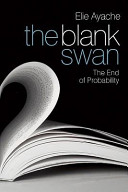
We discuss his new book, The Blank Swan: The End of Probability. I learned a ton about how this all works (even if I didn’t understand everything Ayache spoke about).
Listen to the FULL Program
The End of Probability: A new way of thinking about derivatives — with Elie Ayache by tradestreaming
About Elie Ayache
 Elie Ayache was born in Lebanon in 1966. Trained as an engineer at l’École Polytechnique of Paris, he pursued a career of option market-maker on the floor of MATIF (1987-1990) and LIFFE (1990-1995). He then turned to the philosophy of probability (DEA at la Sorbonne) and to derivative pricing, and co-founded ITO 33, a financial software company, in 1999. Today, ITO 33 is the leading specialist in the pricing of convertible bonds, in the equity-tocredit problem, and more generally, in the calibration and recalibration of volatility surfaces. Elie has published many articles in the philosophy of contingent claims, as well as a book, dedicated to the philosophy of writing.
More Resources
- The Blank Swan: The End of Probability (Amazon)
- ITO 33 (Ayache’s firm)
- Audio transcript (coming soon)