


How Huntington modernized without touching the core ft. Qolo
- Commercial banks are modernizing by augmenting their core systems, layering virtual account infrastructure and unified platforms on top to handle rising complexity.
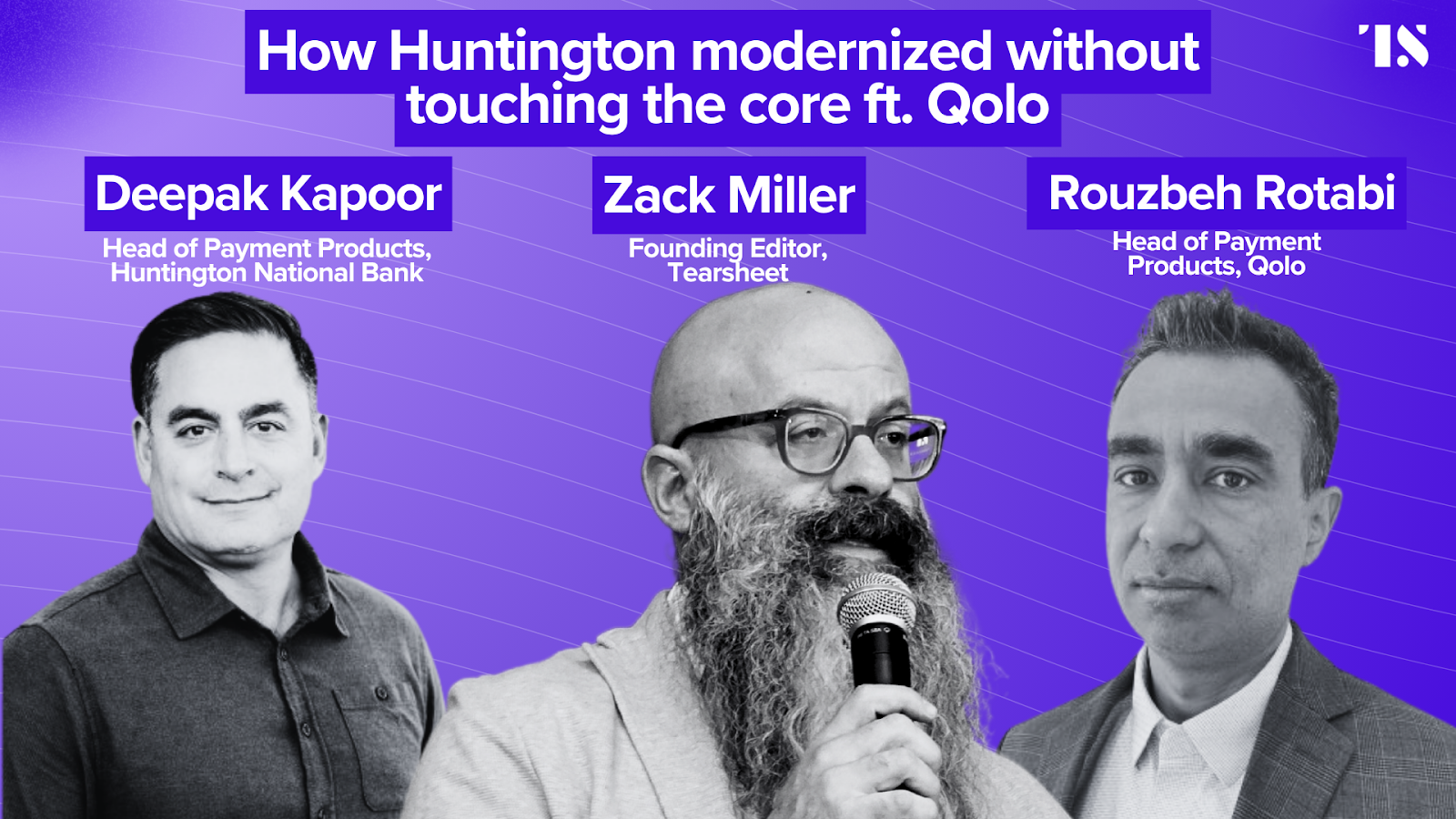
- In this episode, Deepak Kapoor of Huntington National Bank and Rouzbeh Rotabi of Qolo discuss how connected deposits and virtual account structures enable banks to innovate faster, simplify reconciliation, and deliver more flexible, API-driven financial services without overhauling their core systems.
The pressure building on commercial banks today comes from several directions at once. Corporate treasurers are younger, more digitally native, and less tolerant of manual reconciliation. Business structures are more complex: A franchisee group running fifty locations needs fifty entities managed cleanly, not fifty separate bank accounts generating a month’s worth of reconciliation work. And the banking core, the ledger system that underpins it all, was never designed to flex at this pace.
The standard prescription for this problem is core replacement. However, banks are increasingly moving toward augmentation. Rather than replacing the core, banks are building around it, layering modern infrastructure above it to deliver capabilities the core was never meant to provide.
Huntington National Bank’s connected deposits product, built in partnership with payments infrastructure provider Qolo, is one example of that approach in practice. For Deepak Kapoor, Huntington’s Head of Payment Products, the realization was straightforward: “We quickly realized we don’t have all the Lego pieces in place to build the card that we want to build, and the ledger and the virtual account provide us with that missing Lego piece that we needed.”
The result is a virtual account structure that sits above the core and behaves, externally, like a real bank account, complete with routing numbers, inbound wires, and automated reconciliation, without requiring banks to touch the underlying system of record.
Watch the episode
Listen to the full podcast
Three forces converging on the commercial bank
The shift toward virtual account management is not happening in isolation. Rouzbeh Rotabi, Head of Payment Products at Qolo, points to three overlapping pressures that are compressing the timeline for banks to act.
The first is demographic. The CFOs and treasurers that banks are serving today are not the same generation that accepted dot-matrix reports and manual reconciliation as a cost of doing business. “The people who are the corporate treasurers or the CFOs have become their younger generation, and what they’re looking for is more digital-native solutions,” Rotabi said. “That puts extra weight inside of the banking infrastructure, because you have to meet the customer where they’re at.”
The second force is structural complexity. Business entities are no longer simple. E-commerce companies move money across borders. Franchise operators run dozens of legal entities simultaneously. Payroll, accounts payable, and collections each carry different cash management logic. What once required a single account now demands a layered structure that the traditional core was not built to handle cleanly.
“[For] the banking infrastructure, it’s time for things to change, things to adapt. The consumer demands are becoming higher, and the banking infrastructure is staying flat,” noted Rotabi.
The third is the banking infrastructure itself. Most banks are actively evaluating virtual account management but have not yet made a decision, according to Rotabi. The window is open, but it will not stay that way indefinitely.
Modernizing above the core
Core replacement remains one of the most operationally fraught projects a bank can undertake. Timelines stretch to five to seven years. Every dollar must be accounted for through the transition. The risk of something going wrong is high, and the cost of delay is compounded.
What Qolo’s model proposes is a different framing – treat the core as what it fundamentally is: A debit and credit system for tracking deposits and reporting financial statements, and build the value-added services elsewhere. “You basically make the core from the provider to a debit and credit system, and then you have all these other services around it so that you can modernize your infrastructure,” Rotabi said.
For Huntington, the practical expression of that philosophy is connected deposits. Qolo’s platform holds the sub-accounts, runs daily reconciliation, and passes a single net figure back to the core, keeping the core in balance without multiplying the number of accounts it needs to manage. The commercial client interacts with the Qolo sub-ledger; the core never sees the complexity.
Kapoor is direct about why building in-house was not the answer. “Building something in the core is very hard. For us, it became, how do we marry both the worlds and leverage capabilities that we can partner with versus build ourselves.”
What virtual accounts actually change for commercial clients
The case for virtual accounts is easiest to understand through a specific use case. A title company processing a property transaction needs to hold buyer and seller funds in segregated accounts for the duration of the deal, then release them cleanly at closing. Under a legacy setup, that means opening a physical bank account, a process with real friction and ongoing reconciliation overhead.
“In five seconds, you open a bank account for your transaction. It stayed active for whatever duration was required. The money came into that account and went out from that account. There’s no reconciliation to be done,” said Kapoor.
The same logic applies across the verticals Huntington has identified as priorities: healthcare, government, escrow, and franchise groups. Each has its own version of the multi-entity, multi-account problem. Connected deposits give each vertical a single master relationship with the bank, a sub-ledger they can navigate through APIs, and automated reconciliation that replaces the “army of people,” as Kapoor put it, that was previously doing that work manually.
Importantly, Kapoor frames the client-facing API access as its own value proposition, distinct from the reconciliation benefit. “Clients have their own systems. They have their own workflows, and they would like to embed these payment capabilities within their workflow,” he said. The bank’s role becomes an infrastructure provider rather than a portal operator.
Consolidating the fragmented vendor stack
One of the less visible costs of the legacy commercial banking setup is vendor fragmentation. Banks that assembled their payment capabilities over time often ended up buying ACH from one provider, card issuing from another, and ledgering from a third, leaving internal product and engineering teams to stitch the integrations together and manage the ongoing maintenance load.
Qolo’s platform is built on the premise that unifying those three capabilities: ledger and tracking, card issuing, and money movement, onto a single platform reduces that load substantially. “If you can bring one modern solution into the fold, you’re going to create more surface area that you cover. You’re going to have less load weight,” Rotabi said. “I don’t want to sit as the 38th priority on the core when there’s only a list of seven that we’ll ever get to.”
For commercial clients, that consolidation translates into something the CFO’s office can actually feel: fewer vendor relationships, more predictable costs, and a single point of contact for services that were previously distributed. “The CFO is now saying, I don’t need seven vendors. I can get more from my bank,” Rotabi said. “I can probably get economies of scale on cost, and I can simplify my end employees’ experience.”
Internal alignment as a prerequisite
Technology partnerships are only part of the equation. Both Kapoor and Rotabi pointed out the internal organizational change that has to happen alongside any infrastructure modernization effort.
Kapoor credits Huntington’s CFO Zach Wasserman with being an active driver of the initiative, and singles out the Payments CIO function as increasingly central to the bank’s ability to move quickly. “More and more banks are realizing that payments is its own infrastructure,” he said.
Rotabi notes that the personas Qolo engages most productively at banks, EVPs of payments, CIOs, heads of deposits and treasury, are already aligned around the need for modern infrastructure. The barrier is less often conviction than coordination: bringing the right internal stakeholders to the table at the same time and building a shared vocabulary for what modernization actually means in practice.
For Huntington, the foundation is now in place. The next phase is building on top of it: connecting virtual accounts to risk platforms, developing vertical-specific UX flows, and expanding use case coverage across the fifteen-plus segments the bank has identified.
As Kapoor frames it, “the foundation has to be strong. Similar to when you build a house, you have to have strong foundations.”