
Banking

Fewer branches and loan products are amplifying customer turnover for CUs

  • Despite the rise in digital banking adoption, consumers are reluctant to entirely abandon traditional brick-and-mortar branches and face-to-face interactions, particularly those who primarily use CUs for their financial needs.
  • CUs may risk losing customers, though, to banks that often have more branches and ATM networks, better online and mobile app technologies, and a wider range of products.

close

Email a Friend

Fewer branches and loan products are amplifying customer turnover for CUs

A growing majority of Americans are embracing digital banking options, with 71% choosing to handle their bank accounts through mobile apps or computers. This preference was also notable among consumers of major banks like Bank of America, JPMorgan, and Wells Fargo, as indicated by their financial results in the final quarter of 2023, underscoring the shift toward digital. This image has an empty alt attribute; its file name is kLS82d56ryiMN9snJj4UHtnAUvBPa34Jdw1rG14bVVyLjqlDB-LQY5EKn5R7hsxYegN49_tQzb_6-_3_8Bby7YVs7Jl2QaHYWQwQ8_X5PDa1jpRdRoUFHQ2imOKr6j2T4YdLenzF3sd5tLYW1e0RtQY
Despite the upward trend in digital banking adoption, consumers are hesitant to completely forgo traditional brick-and-mortar branches and personal interaction when addressing complex financial needs, especially those who rely on credit unions [CUs] as their primary financial service providers.

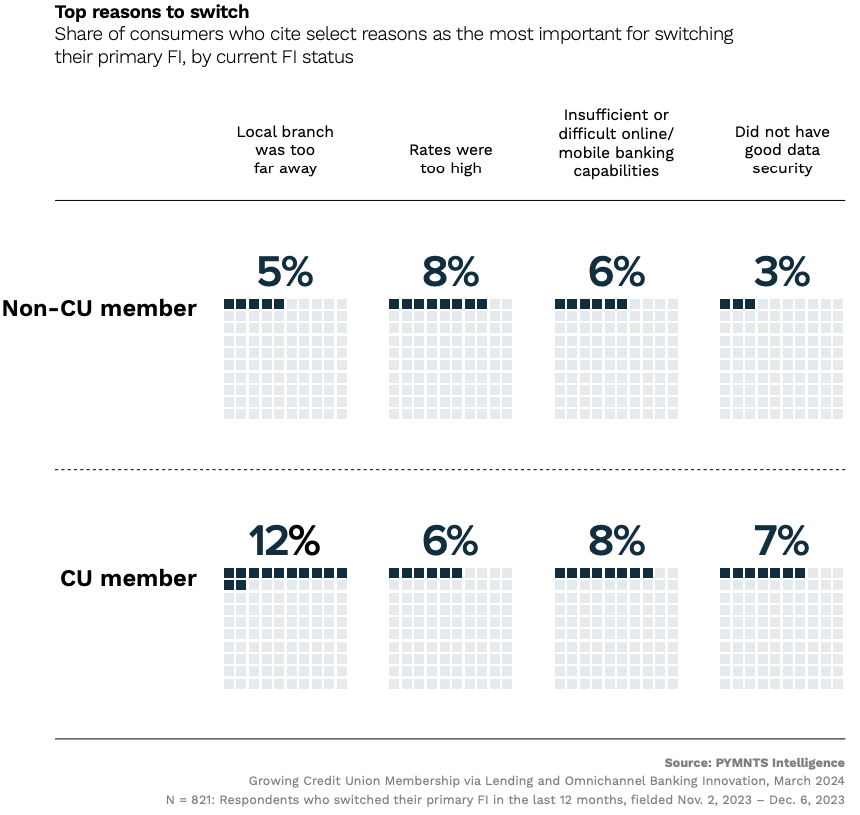
In fact, according to a recent report by PYMNTS, the lack of local branches and subpar mobile apps are the top two reasons 1 in 5 CU consumers switched financial service providers in the last year.


subscription wall for TS Pro

0 comments on “Fewer branches and loan products are amplifying customer turnover for CUs”

Banking, Member Exclusive

For U.S. Bank, embedded finance was step one. The self-reinforcing model is step two.

  • U.S. Bank is focusing on three levers: speed of integration, intelligence of response, and depth of embedding in decision flows.
  • The strategy sets up a self-sustaining cycle: usage grows from integration, data flows from usage, and products evolve in near real time.
Sara Khairi | April 09, 2026
Banking, Data, Member Exclusive

What a bank-client relationship looks like when banks control the data behind the UX

  • Client–bank relationships have long revolved around a destination model: clients log in, navigate dashboards, export data, assemble insights. Grasshopper Bank is rewriting that dynamic by moving from a destination to a ‘layer’.
  • The digital bank has launched its MCP server to bridge a critical gap: letting clients use modern AI tools with their financial data without sacrificing banking security or control.
Sara Khairi | April 02, 2026
Banking, Member Exclusive

Why fintechs are transitioning from partners to principals in banking

  • The wave of charter filings in the first quarter of 2026 underscores shifts in fintech business and regulatory dynamics.
  • Direct supervision by banking regulators is demanding, but fintechs increasingly see it as offering greater operational certainty than fragmented licensing and partner oversight.
Sara Khairi | March 19, 2026
Artificial Intelligence, Banking, Banking as a service, Innovation

Truist’s Dontá Wilson: ‘Innovation without empathy is empty’

  • Truist's Dontá Wilson leads 20,000 teammates across digital channels and 1,900+ branches, and he's reimagining both.
  • He breaks down Truist's insight-driven branch model, real AI deployments, and why innovation without empathy is empty.
Zack Miller | March 04, 2026
BNPL, Creating win-win partnerships, Embedded Finance, Member Exclusive, SMB Finance

How embedded BNPL optimizes cash flow for SMBs: Inside the Intuit-Affirm partnership

  • The Intuit-Affirm partnership embeds BNPL directly in QuickBooks invoices, transforming accounting into a real-time decision layer.
  • In the new fintech partnership model, platforms manage workflows and customers while specialists handle the decision layer to drive scalable results.
Sara Khairi | February 26, 2026
More Articles