


Stablecoin infrastructure is rewiring cross-border payments
- Stablecoin rails are maturing into production-ready infrastructure, giving fintechs and enterprises a faster, cheaper path for cross-border payments.
- Regulatory clarity and bundled compliance APIs have lowered the barrier enough that the question is no longer whether to adopt, but where to start.
For years, cross-border payments have had problems with fees, long settlement times, and lack of transparency. Unfortunately, these problems have been well understood yet largely unsolved. The systems underpinning international money movement were built in the 1970s and 1990s for batch processing and domestic connectivity. The era of real-time, global, and programmable transactions was out of sight then, but it isn’t now.
Stablecoins have long been positioned as a potential answer, but adoption stayed shallow. That is changing.
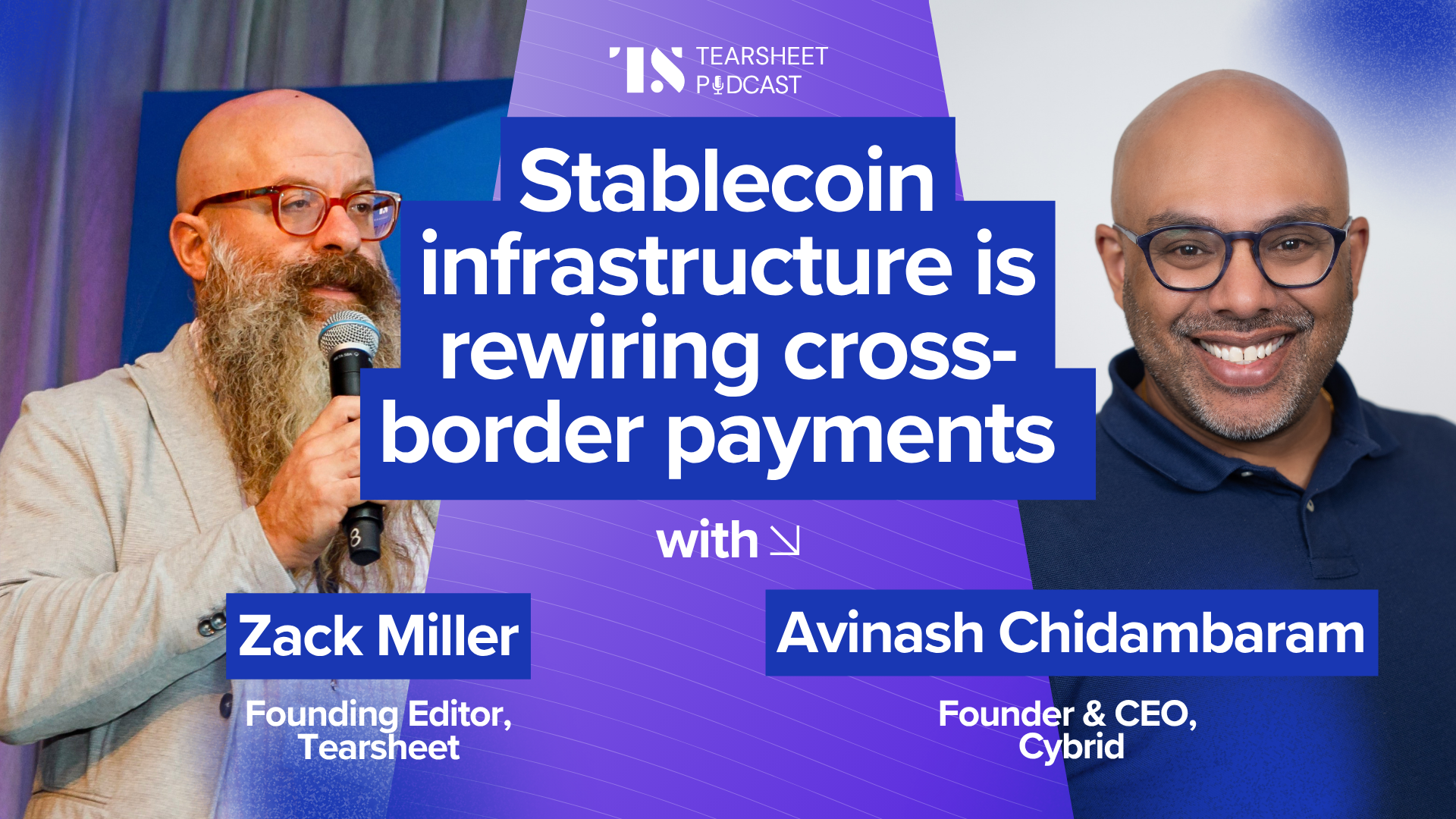
Avinash Chidambaram has spent his career at the intersection of payments infrastructure and emerging digital asset frameworks. As founder and CEO of Cybrid, he now builds the stablecoin rails that neobanks and fintechs use to move money across borders. He is also in the room with key stakeholders in Canada, like regulators and other founders, giving him a unique vantage point into the future of this space.
“We’re an operator,” Chidambaram says. “We’re actually doing stablecoin payments, so when we go through the process of getting registered with the regulators, when we talk to legislators, we’re trying to give them that perspective.”
Looking ahead, Chidambaram sees a market that has cleared a threshold.
Regulatory frameworks are no longer in their infancy. Enterprise appetite now centers strategic implementations rather than exploratory ones. And the infrastructure stack (compliance, custody, FX connectivity, accounting) has been bundled into APIs that product teams can actually consume.
Watch the episode
Listen to the full podcast
The regulatory picture has evolved
Even as recently as 2023, Chidambaram said conversations with legislators about stablecoins were largely educational. Fast-forward to 2026, and a lot has changed. Today, they are around operations and implementation. He added that policymakers across jurisdictions have moved past the basics and are now debating finer questions: which blockchains to support, how to think about validator risks from a sovereignty standpoint, and whether a domestic sovereign stablecoin makes more sense than a central bank digital currency, he shares.
The GENIUS Act in the US is a particularly meaningful inflection point that has set a benchmark for stablecoin legislation that other regional jurisdictions are now working from. In Europe, MiCA has done similar work, and the impact is visible: roughly 200 stablecoins are now issued globally.
“[With increasing regulatory clarity,] people understand what the risks are,” Chidambaram says. “People understand what kind of capital controls are required, and now they’re really starting to understand what the value props are.”
Yet discussions about implementation don’t mean everyone is rushing to push something out the door. Now, the uphill battle is not lack of awareness but the pace of work.
National frameworks, particularly around a sovereign stablecoin issued by a central bank, take considerable time to design and implement. In the meantime, the private market moves at its own speed. Chidambaram’s read on where most legislators have landed is that they understand the value proposition and are focused on getting the capital adequacy and redemption risk questions right, rather than blocking adoption.
The structural problem with legacy rails
Legacy rails were designed for domestic batch processing, and the workarounds built on top of them have multiplied over decades into layers of intermediaries, correspondent banks, card networks, clearing houses, and separate compliance vendors. Each layer adds cost, settlement delay, and opacity. And, most importantly, creates a structural problem rather than merely a technological one.
“Modern businesses are forced to operate on top of these really fragmented systems,” Chidambaram says. “They were never designed for real-time, global, programmable payments.”
The practical consequence for a fintech or enterprise trying to automate payments within a software workflow will give any decision maker pause: Connecting an ERP’s purchase-approval logic directly to a payment execution layer means threading through all of that fragmentation, and doing so in a way that still satisfies a compliance team running AML screening, KYC, and reporting across multiple jurisdictions.
By comparison, stablecoins might almost feel like magic. Rather than trying to connect fragmented systems, stablecoins bypass intermediaries by connecting two parties on a shared ledger. While the compliance obligations remain, the technology allows those checks to run before the payment executes, rather than managing them across a relay of institutions that each see only part of the transaction. And because the transaction is on-chain, both sender and recipient know when the money has landed.
Stablecoins in production
When Cybrid walks enterprises through the stablecoin payment flow, one detail lands particularly hard: traceability.
“We talk to enterprises,” Chidambaram says, “and they’ll tell us: ‘I sent $20,000 to my supplier, and he’s like, you didn’t send me all the money.’ And everyone just agrees that this is just how it works. That’s kind of crazy.”
With stablecoin infrastructure underneath, that conversation does not happen. A company acquires US dollar-backed stablecoins, sends the payment directly to the recipient’s wallet, and can confirm receipt on-chain in roughly two minutes. The FX price is guaranteed at the time of the transaction, not settled at whatever rate applies three days later when the funds actually arrive. For enterprises buying goods from overseas suppliers, that certainty has real value on both sides of the transaction.
Once payment execution is fast and programmable, the logic can move into the software stack. An ERP that flags a low-inventory condition can trigger a supplier payment approval workflow, route the CFO a notification, and execute the transaction on approval, without anyone logging into a separate banking portal.
“That feels kind of magical, but that’s actually here today,” Chidambaram says. “And that’s what we’re enabling.”
What actually unlocked adoption
Stablecoins have existed for roughly a decade, and for most of that time they were closely associated with crypto trading infrastructure. Initially, their core value prop was a faster way to move in and out of cryptocurrencies on exchanges than routing through a bank. That association was accurate as a description of where the volume lived. But the problem is it also shaped how enterprise and institutional audiences thought about the technology. For better (and worse), they thought of stablecoins as a crypto-adjacent instrument rather than a payments tool.
With increased regulatory clarity and the maturation of the operational stack around stablecoins, the “stablecoins as crypto-adjacent” narrative has changed.
“Every fintech, every bank now has someone in their organization whose job it is to figure out what is our stablecoin strategy,” Chidambaram says.
Compliance, mixed custody, fiat connectivity, accounting that meets IFRS standards has perhaps been the most significant change, and organizations like Cybrid assembled those components and wrapped them in an API. For fintechs fielding c-suite pressure to develop a stablecoin strategy, the availability of a bundled infrastructure layer that already carries SOC 2 compliance and regulatory registrations has materially lowered the barrier to moving forward.
“You’re not thinking about, ‘How do I do this integration to all these different things?’ It’s simple. It’s an API,” says Chidambaram.
Moving from curious to live
For executives who are past the evaluation stage and ready to move toward a pilot, Chidambaram’s advice is to lead with use case specificity rather than treating stablecoins as a general infrastructure upgrade.
He sees the clearest value today in the following categories:
- Cross-border supplier payments
- Global contractor payments
- Marketplace payouts to large and distributed recipient pools
- Treasury liquidity management across multi-jurisdiction entities
Treasury liquidity management, in particular, deserves attention. Stablecoins allow a treasury function to consolidate management across subsidiaries from a single compliance team, a structural efficiency that becomes more valuable as organizations scale internationally.
“CFOs need to start to look for a service provider who offers this compliance stack with the appropriate certifications,” he says, “and then say, ‘Where do I get the most value from this?’”
The scope of integrations required to assemble stablecoin payment infrastructure independently (rails, compliance, FX, accounting, custody, regulatory registration) is substantial, and maintaining those integrations over time is an ongoing cost.
For a company whose core business is e-commerce, marketplace operations, or financial services product development, that integration burden competes with resources better spent on the actual product. The more defensible path is finding a provider that has already assembled the stack and can deliver it as a consumable layer, freeing the internal team to focus on what they are actually building.