Podcasts

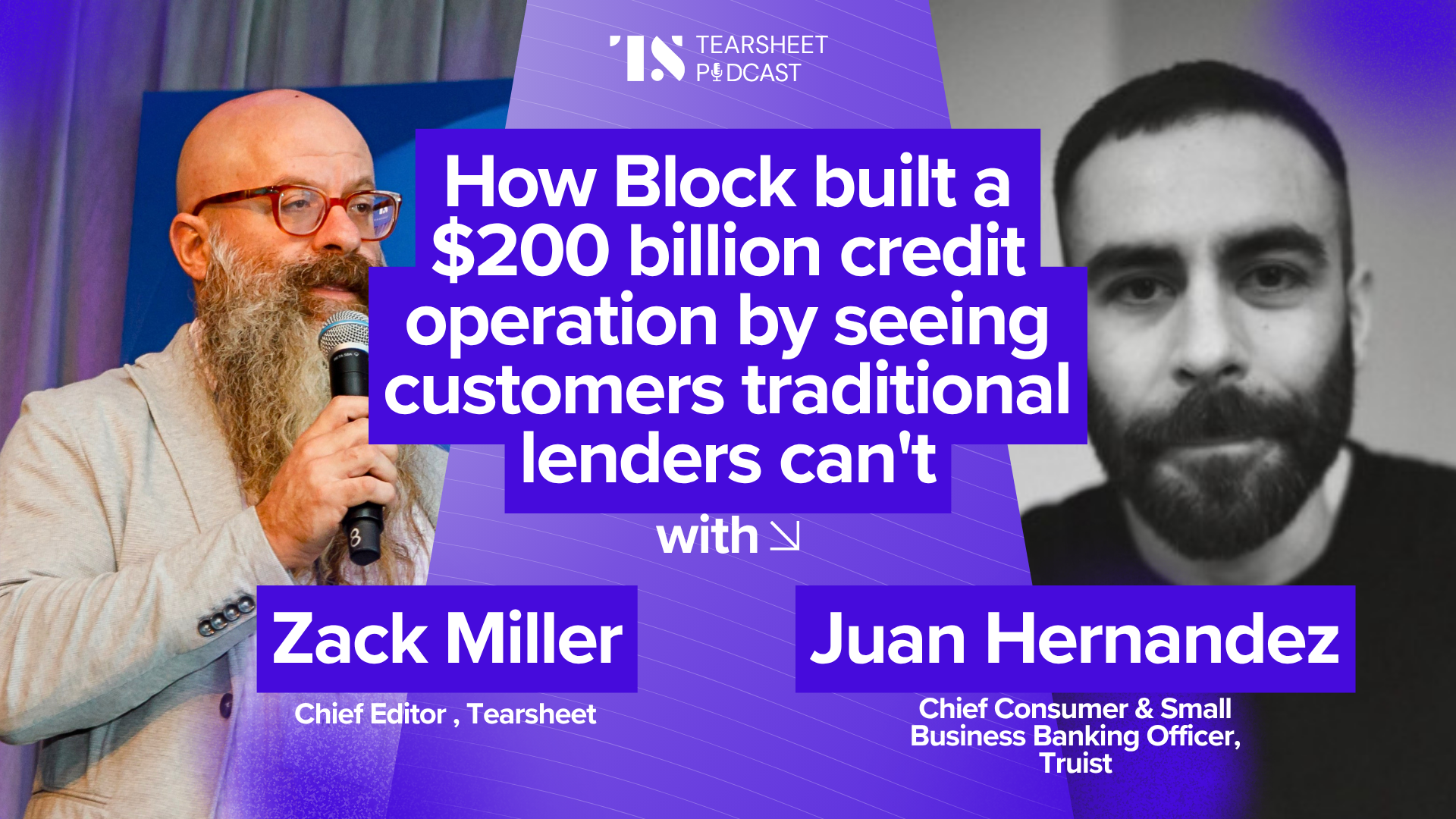
How Block built a $200 billion credit operation by seeing customers traditional lenders can’t

  • Roughly 100 million Americans are invisible to traditional credit systems, either unscored, thin-filed, or misrepresented by data that doesn't reflect their actual financial lives.
  • Juan Hernandez of Block explains how the company used first-party data and alternative underwriting models to extend over $200 billion in credit across Cash App, Square Loans, and Afterpay — while keeping pricing low and access wide.
close

Email a Friend

How Block built a $200 billion credit operation by seeing customers traditional lenders can’t

The credit system in the US was built on a fundamental assumption: that past borrowing behavior predicts future risk. That assumption has left roughly 100 million Americans essentially invisible to lenders — no score, thin file, or a history that doesn’t reflect who they actually are financially today. The result is a system that compounds exclusion, requiring debt to unlock debt, and pricing risk so conservatively for anyone outside the norm that the cost of capital itself becomes a barrier.

Juan Hernandez has spent the last decade at Block building lending products for exactly those customers. As head of credit and underwriting, he leads the teams behind Cash App Borrow, Square Loans, and Afterpay — three distinct products serving consumers and small businesses that traditional underwriting models consistently misread or ignore. Block recently crossed $200 billion in credit extended to customers globally.

The engine behind that number is a data advantage. By underwriting from first-party signals native to the Cash App and Square ecosystems rather than relying on sparse bureau data, Block has built models that are both more accurate and more inclusive. Hernandez sat down with Tearsheet to talk about how they built a credit operation at that scale, what it takes to serve the underserved responsibly, and where the product suite is heading next.

Watch the episode

Listen to the full podcast

What the $200 billion milestone means for the customers block serves

When Block launched Square Loans, it had one goal: get capital to small sellers who couldn’t access it anywhere else. Micro sellers and SMBs with no business bureau file had no path to a loan, might fall back on a consumer credit report and still come up empty, or face mountains of paperwork for an outcome that wasn’t guaranteed. The thesis was to underwrite based on sales volume — using data that was already native to the Square platform, more accurate than bureau data, and frictionless for the customer.

By expanding access that way, Block opened up a channel of capital that changed how those businesses operate. The same principle carried into Cash App Borrow in 2019 and the Afterpay acquisition in 2022. The US consumer faces the same structural problem: new to credit because you just turned 18 or moved to the country, and there’s no easy way in. The system requires debt to unlock debt, and the traditional data sets it relies on are skewed, spotty, and missing whole populations. That dependence is where the problem lives, and where Block has concentrated its work.

The full product suite

Block’s lending portfolio spans three ecosystems. On the Square side: a credit card and Square Loans, with shorter-duration variations in development. Square Loans don’t carry a fixed term but typically pay back in under a year over a flexible period.

On Afterpay in the US: Pay in 4, a six-week product with the first payment at transaction and three more spaced two weeks apart, plus Pay Monthly at three, six, and 24-month durations. On Cash App: Borrow at a four-week duration, with other durations in experimentation, and an Afterpay post-purchase product that lets customers finance a transaction after the fact. The newest addition is the Afterpay Flex debit card, being piloted in the US, which functions as either debit or credit without requiring customers to carry two cards.

The consumer product philosophy reflects a generational shift in how people think about borrowing. Gen Z and younger customers are moving away from traditional revolving cards, skeptical of a model where minimum payments let balances and interest compound indefinitely. Afterpay draws customers who want to settle balances at the end of the period and have visibility into what they owe. That’s the design principle running through the consumer suite.

One DNA across brands

Block operates on a functionalized model where each discipline — engineering, product, risk — reports through its own organization rather than through brand-specific business units. The company moved away from a GM-led business unit structure over the last few years toward this more integrated approach. What cuts across brands is a DRI model: Hernandez is the lending DRI at Block, owning the credit function across Square, Cash App, and Afterpay regardless of brand.

The $200 billion figure reflects that integration. It spans Square Loans, Cash App Borrow, Afterpay Pay in 4, Pay Monthly, and the Afterpay products being built into Cash App.

How underwriting philosophy travels across very different products

The risk philosophy is consistent across all of Block’s lending products despite the surface differences between them. The goal in every case is to maximize access to capital for the customer — merchant or consumer — while managing repayment and loss responsibly.

Square Loans collects repayment as a percentage of processing volume. As sales come in, repayments come out automatically. It reduces cognitive burden for the seller, keeps repayment rates strong, and mirrors the natural rhythm of how that business operates. Borrow on Cash App takes a similar approach through a Pay As You Go feature: as money flows into a customer’s account, it can be directed automatically toward repayment. The design philosophy is the same — make it easy to pay back, remove the friction, reduce the mental load.

The underwriting philosophy is also consistent: use first-party data rather than external data sources. Block isn’t pulling open banking feeds or purchasing bureau data to fill gaps. The data comes from within the ecosystem, from Square’s processing infrastructure for merchants, and from Cash App’s financial suite for consumers. That first-party position means no external dependencies, no permissioning complexity, and a data set that’s genuinely predictive rather than sparse and skewed. For Afterpay customers who also use Cash App, their Cash App engagement history informs their Afterpay limits. The flywheel runs across products.

What happens when margins expand

When Block finds cost efficiencies or margin expansion, through regulatory changes, operational improvements, or anything else, the instinct isn’t to hold that margin. The approach is to reinvest it in access, pushing credit deeper into the populations the products are designed to serve. The aligned incentive is that the business grows when more customers can responsibly access capital, which means expanding access and managing risk aren’t in tension: they’re the same objective.

The traditional credit market prices aggressively for populations outside the mainstream because the data it uses to underwrite them isn’t predictive enough to do anything else. Block’s first-party models are predictive enough to price differently, which is what makes the access expansion possible without sacrificing credit quality.

0 comments on “How Block built a $200 billion credit operation by seeing customers traditional lenders can’t”

Partner, Podcasts

How Huntington modernized without touching the core ft. Qolo

  • Commercial banks are modernizing by augmenting their core systems, layering virtual account infrastructure and unified platforms on top to handle rising complexity.
  • In this episode, Deepak Kapoor of Huntington National Bank and Rouzbeh Rotabi of Qolo discuss how connected deposits and virtual account structures enable banks to innovate faster, simplify reconciliation, and deliver more flexible, API-driven financial services without overhauling their core systems.
Zack Miller | April 09, 2026
Payments, Podcasts

Squarespace’s Corey Zettler on building a financial services suite for small businesses

  • Squarespace has expanded beyond website building to offer a growing suite of financial tools for small businesses, including payments, capital, and a new integrated balance account with a Visa debit card.
  • On the Tearsheet Podcast, director of product Corey Zettler explains the company's build-vs-partner approach, what it's learned from three product launches, and how it plans to deepen its financial services offering for service.
Zack Miller | April 08, 2026
Payments, Podcasts

How Paze is betting bank trust can crack the digital wallet market

  • The digital wallet space is crowded, but Paze is betting that consumer trust in banks — not tech giants — is the unlock.
  • In this episode, Serge Elkiner, General Manager of Paze at Early Warning Services, breaks down how the bank-backed wallet is building toward critical mass through merchant expansion, issuer growth, and a deliberate focus on the consumers other wallets haven't won yet.
Zack Miller | April 01, 2026
Innovation, Partner, Podcasts

How KeyBank and Qolo are modernizing corporate treasury without ripping out the core

  • Legacy treasury systems force companies to manage dozens of accounts manually. Virtual account management offers a modern fix without replacing core infrastructure.
  • KeyBank's Bennie Pennington and Qolo's Patricia Montesi discuss building a real-time VAM platform together, processing $40B+ in transactions.
Zack Miller | March 26, 2026
Partner, Payments, Podcasts

How Modern Treasury is building a payments platform for a hybrid money world

  • Modern Treasury recently launched an integrated payments platform blending fiat & stablecoins.
  • Tune in to find out how stablecoins complement fiat rails, why working capital is the biggest opportunity, and what instant payments means for enterprises.
Zack Miller | March 10, 2026
More Articles