


How KeyBank and Qolo are modernizing corporate treasury without ripping out the core
- Legacy treasury systems force companies to manage dozens of accounts manually. Virtual account management offers a modern fix without replacing core infrastructure.
- KeyBank's Bennie Pennington and Qolo's Patricia Montesi discuss building a real-time VAM platform together, processing $40B+ in transactions.
A mid-market company with dozens of bank accounts shouldn’t have to deploy a small army to figure out where its money is. But for most commercial banking clients, that’s still the reality because the systems tracking it haven’t kept up.
Banks know this. Most of their commercial clients know this. The gap between what legacy infrastructure can deliver and what today’s treasury teams actually need has been widening for years, and the banks that aren’t solving it are starting to lose ground to those that are.
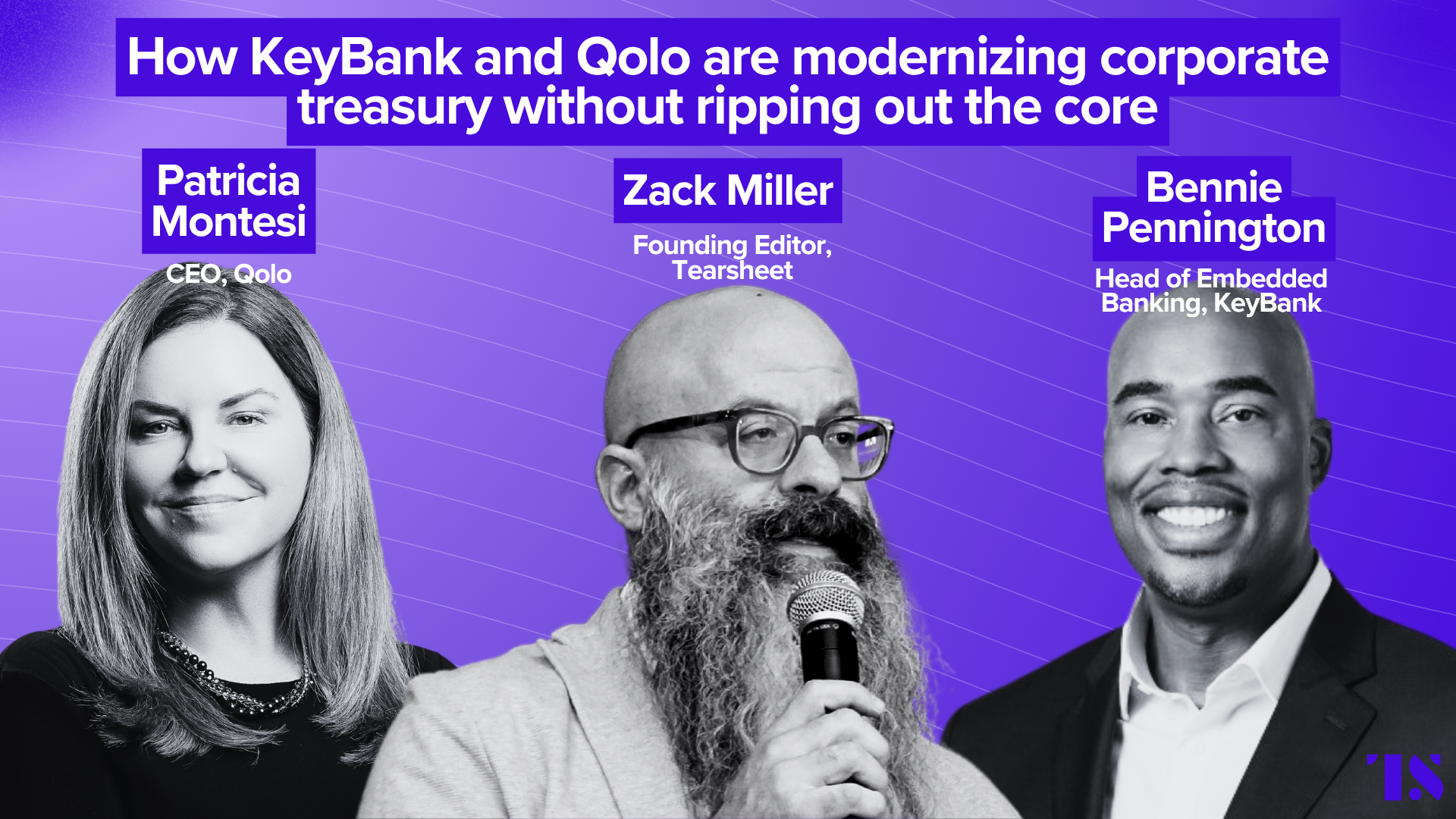
KeyBank and Qolo are building a way out of that problem. Bennie Pennington, Head of Embedded Banking at KeyBank, and Patricia Montesi, CEO of Qolo, joined Tearsheet to talk about how they designed and launched a real-time virtual account management platform together — and what it’s already proving in the market.
Watch the episode
Listen to the full podcast
Why virtual account management makes sense now
The signal KeyBank kept hearing from commercial clients was consistent across segments. Real estate firms, software companies, energy traders — all of them were running into the same wall. “Some of their biggest pain points were being able to see their balances,” said Pennington. With dozens of accounts at the bank, clients wanted consolidated visibility, real-time intraday data, and the ability to move payment information cleanly between systems. They wanted the bank to solve it for them.
At the same time, Qolo was watching a parallel dynamic play out across the industry. Most US banks want to modernize their treasury operations but legacy cores remain the primary barrier. “Legacy systems, think batch files, manual reconciliation, this visibility that takes a small army to actually bring together and unify,” said Montesi.
Virtual account management fills that gap without forcing banks to tear out what’s already there. It’s a modern, real-time layer that sits above the core, enabling instant account opening, complex fund hierarchies, and flexible payment rails, without the disruption of a full core replacement.
The partnership that built it
The KeyBank team ran a structured process: client interviews, post-mortems on lost RFPs, a formal RFI that evaluated multiple vendors against a detailed set of requirements. Qolo came out on top due to its API sophistication, speed to market, and something harder to quantify: “When we met the team and recognized the ability for us to interact and feel like we had a true partner, it was obvious that Qolo was going to be the right solution,” said Pennington.
KeyBank brought specific requirements, custom OFAC compliance workflows, real-time sub-account creation, particular API behaviors, and Qolo adapted. “There was a little bit of tweaking and customization, and Qolo was very flexible in building something that was unique to how our clients wanted to use the solution,” said Pennington. “To me, that was a real partnership.”
From Qolo’s side, the fit was equally deliberate. “We met them where they were, we understood where they wanted to go, and then we collectively built the roadmap together,” said Montesi. Critically, that roadmap respected what KeyBank had already built. Replacing a core requires addressing decades of compliance processes and institutional habits wrapped around the system. “We respect the process, we understand all of the compliance and banking aspects, and we were able to overlay and give KeyBank exactly what they need,” said Montesi. “Modernization without disruption.”
The results a year in
KeyBank has onboarded seven clients since launch, and what stands out is the range. Healthcare companies processing claims payments. Energy traders separating funds across business units. A large financial institution using the platform for digital ledgering on behalf of its own clients.
The platform has processed over $40 billion in transaction volume. Clients are opening and closing accounts faster than they have with any other bank. Others are pulling real-time data via API across multiple software systems in ways that weren’t previously possible. One client evaluated multiple banks specifically on virtual account management and said KeyBank’s platform offered the fastest real-time sub-account creation, fully digitally, that they had seen.
“We are solving true pain points for their commercial clients and their corporate treasurers,” said Montesi. “We have moved billions of dollars in the system, but what we’re more importantly proving is that we can do it at scale, securely and profitably.”
VAM as connective tissue
The more significant argument running through the conversation is about what virtual account management makes possible beyond treasury efficiency. Once the foundation layer is in place, a dynamic, programmable ledger sitting above the core, it becomes infrastructure for everything adjacent to it.
“The data and automation from VAM are now the foundation layer for new products like integrated spend or liquidity,” said Montesi. Virtual cards, programmatic funding, and embedded payments are capabilities that previously would have required separate integration, but now can extend naturally from the same platform.
KeyBank is already moving down that path. Virtual card issuance is next on the roadmap, letting commercial clients push one-off payments onto a virtual card from the same interface they already use for ACH, wire, and RTP. Check digitization and lockbox integration are also in development for 2026.
“We consider VAM to be this connective tissue,” said Montesi. “Once you have all of that in place, it supports all of these complex hierarchies, and it doesn’t take much to support these different types of use cases.” Some of the use cases now emerging weren’t even anticipated at launch. The platform keeps revealing new applications as clients push on it.
For Pennington, the work is just getting started. KeyBank now has a team of over a dozen people dedicated entirely to embedded banking, people who “wake up every day just focused on how we use software to make our commercial clients’ payment operations and treasury operations easier.”