
10-Q, Member Exclusive

What’s Left in the Shadows: How 90-year-old Webster Bank punches above its weight by combining purpose with profitability

  • Not your typical regional bank, Webster combines serving local consumers and SMBs with a strategic move into healthcare finance.
  • In today’s 10Q edition: What’s Left in the Shadows, we shine a light on the less-talked-about publicly traded names in the industry that do their own thing but remain integral to the banking ecosystem.
close

Email a Friend

    A storied beginning and a forward-looking purpose


    In 1935, with $25,000 borrowed from friends and family, Harold Webster Smith founded the First Federal Savings and Loan Association of Waterbury, Connecticut, to help people build homes during the Great Depression. His vision was that banking should serve the people around you, not just the bottom line.
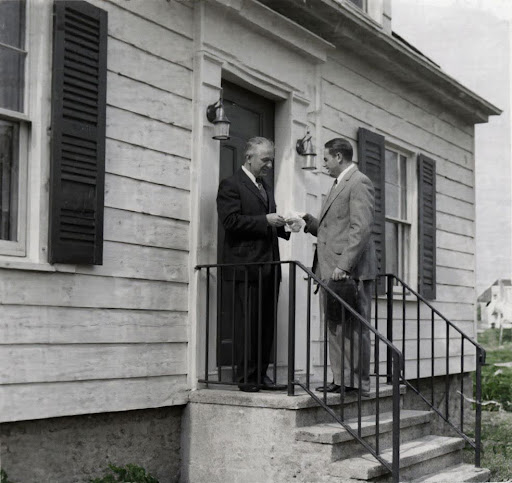
    Webster Bank founder Harold Webster Smith (right) makes the bank’s first loan to Joe Baltrush in December 1935 on the steps of his Waterbury home at 114 Chambers Street. Source: Webster Bank

    The organization was later renamed Webster Bank when it went public in 2002 and converted to a national commercial bank in 2004, enabling broader service offerings while largely preserving its regional identity. 

    Today, Stamford, Connecticut, serves as its headquarters, but its branches extend from suburban New York to Rhode Island and Massachusetts, giving it a solid regional footprint.

    Webster Bank (NYSE: WBS) remains true to its ethos: serving communities across the Northeast while moving billions of dollars of healthcare payments and powering fintech platforms behind the scenes. 

    Webster Bank’s evolution from a local thrift to a publicly traded commercial institution reflects a long-term focus. The bank serves clients across three key areas: commercial banking, consumer banking, and healthcare financial services.

    In today’s 10Q edition: What’s Left in the Shadows, we shine a light on the less-talked-about publicly traded names in the industry that do their own thing but remain integral to the banking ecosystem.


    subscription wall for TS Pro

    0 comments on “What’s Left in the Shadows: How 90-year-old Webster Bank punches above its weight by combining purpose with profitability”

    10-Q, Member Exclusive

    Green Dot and the case to make financial experiences feel calmer

    • Green Dot is shifting to prioritize "Cortisol UX", a philosophy that aims to absorb user stress by embedding signals into its architecture that increase predictability of interactions.
    • The product team is focusing on slowing down paths such as transaction confirmations to reduce cognitive load and uncertainty.
    Sara Khairi | May 11, 2026
    Banking, Lending, Member Exclusive

    LendingClub rebrands to Happen Bank as its identity catches up to its model

    • LendingClub (soon Happen Bank) did what few scaled fintechs manage cleanly: it let the business lead, and the brand follow.
    • The company remains lending-centric, but is building out a broader post-loan experience.
    Sara Khairi | May 07, 2026
    10-Q, Member Exclusive

    Coinbase is building on a dual-engine structure, but trading still sets the tone

    • Coinbase is working to expand beyond its crypto identity into a broader financial services platform, but the shift is still too early to call a clean transition story.
    • A dual-engine model best captures Coinbase at present: trading is the volatility engine, subscriptions and infrastructure the baseline.
    Sara Khairi | May 04, 2026
    Artificial Intelligence, Member Exclusive, Payments

    How agentic commerce is making execution, intent, and credit actionable inside payments

    • Agentic commerce is narrowing the gap between execution, intent, and credit within payments.
    • Across the payments stack, companies like Stripe, American Express, and Affirm are applying agentic AI to smooth the path from intent to execution.
    Sara Khairi | April 30, 2026
    10-Q, Member Exclusive

    Can Robinhood build sustainable revenue streams that are not tied to how often people trade?

    • In 2026, Robinhood’s strategy has been about expanding what surrounds its core trading engine.
    • The actual question is: Can episodic trading behavior be converted into persistent reliance on Robinhood?
    Sara Khairi | April 27, 2026
    More Articles