Can fintech’s brightest stars shine on Wall Street?
Klarna and Chime are finally ready to test the public markets, likely this year. The Swedish buy now, pay later (BNPL) firm and the US neobank have reportedly confidentially filed in late 2024 for IPOs, marking two of the most anticipated fintech public debuts in recent years.
But with shifting market conditions, a new administration in the White House, and a mix of investor excitement and skepticism, these IPOs could either be fintech’s grand return to Wall Street — or another cautionary tale.
The possibility of an IPO for Revolut and Stripe has also been brewing since 2023, but neither company is ready to seal the deal just yet.
The case for going public
For Klarna and Chime, the timing makes sense — at least on paper. Markets have started 2025 with a bullish streak, fueled by cooling inflation, a rebounding IPO pipeline, and a government that appears friendlier to fintech innovation. However, alongside that enthusiasm come fiercer competition and sharper investor scrutiny.
After a turbulent couple of years, Klarna has been eyeing a public listing. Its valuation plummeted from a $46 billion peak in 2021 to around $6.7 billion in 2022 before rebounding to an estimated $15 billion. Going public could help Klarna raise fresh capital, expand further into the US, and compete more strongly with rivals like Affirm and Apple’s Pay Later service.
As for Chime, with over 20 million customers, it is one of the biggest digital banking players in the US. However, it hasn’t raised funds since 2021, when it was valued at around $25 billion. A public listing could provide it with capital to fuel growth and potentially diversify beyond its core product offerings, which include a fee-free digital banking experience.
The aspirations and tactical execution
The post-pandemic era has turned IPOs into a proving ground rather than a victory lap. Companies can no longer bank on hype alone — they need solid profitability, sustainable growth, and a narrative that withstands intense scrutiny. The Federal Reserve’s tighter monetary policies, global market volatility, and the shift from a liquidity-driven to a fundamentals-driven investment climate are creating higher entry barriers.
Both Klarna and Chime will be entering a relatively less forgiving market and heightened investor concern than in 2021, a year that saw 61 fintech IPOs — far more than the 16 that have launched in the past three years combined.
Last week, I teased a mystery topic, letting you stew in curiosity about what was coming. Well, the wait is over! Given that Valentine’s Day was just last Friday, I’m leaning toward a theme that fits the season: unions & collaborations.
We often dive into stories of partnerships that start with fireworks and flawless roadmaps — only to crash and burn for one reason or another. But today, let’s moonwalk through this. Let’s talk about rivals who went from side-eyeing each other to shaking hands (at least in the business world).
Take banks and fintechs, for example. Their early days were more ‘battle for dominance’ than ‘let’s work together’ — fintechs painted themselves as challengers, while banks saw them as pesky invaders. But time and market realities have a way of reshaping narratives.
Now, banks and fintechs are increasingly recognizing their strengths. It’s a classic ‘you complete me’ scenario — if corporate romance were a thing.
Graphic credits: Tearsheet
But let’s hit rewind for a moment. How did these once-feuding forces go from wary opponents to strategic allies? And where do these kinds of relationships stand now?
Let’s dig in.
Block vs. J.P. Morgan Chase: From competition to cooperation
J.P. Morgan Chase initially saw Square (now Block) as a major small-business payment competitor. In 2014, CEO Jamie Dimon famously warned that Silicon Valley was “coming to eat our lunch.” Square’s success with small business payments and its Cash App product placed it in direct competition with Chase’s merchant services.
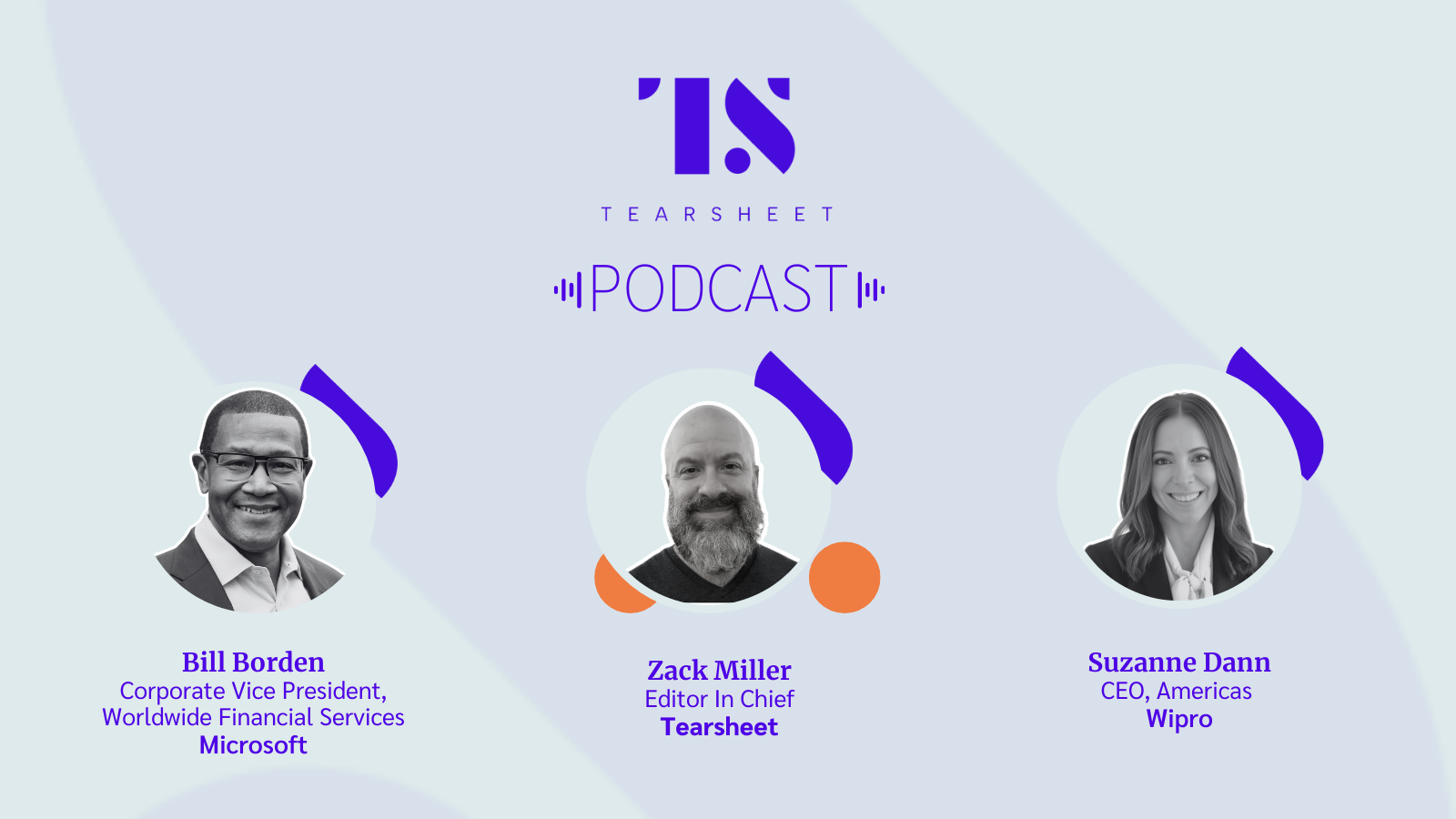
Today, we’re joined by Bill Borden, Corporate Vice President, Worldwide Financial Services, at Microsoft, and Suzanne Dann, CEO for the Americas at Wipro. Together, they discuss their collaboration on leveraging Azure OpenAI to enhance generative AI in finance. This partnership focuses on improving customer experiences, streamlining processes, and ensuring responsible AI practices in the financial industry.
As Suzanne puts it, “My role is to help clients digitally transform by bringing together the right industry expertise, technology, and integration experience.” Bill adds, “Our goal at Microsoft is to build products and services that truly meet the unique needs of financial institutions.”
We’ll explore how cognitive assistants, powered by generative AI, are reshaping customer interactions, loan origination, and even the broker experience, all while maintaining a focus on security, reliability, and expanding AI access across the sector.
Powered Cognitive Assistants for GenAI in Finance
Cognitive assistants are intelligent systems designed to enhance the capabilities of financial professionals. They do this by providing real-time insights and personalized customer interactions. Unlike traditional chatbots, these assistants leverage generative AI and natural language processing. This aims to offer deeper, context-aware support.
“It’s not like a chatbot that is not intelligent. It has all the intelligence built in, and that’s the real differentiator,” explains Suzanne.
Enhancing Customer Interactions
Cognitive assistants can transform how banks and financial institutions interact with their clients. These AI tools offer personalized advice by understanding a customer’s history and preferences. It makes interactions more meaningful and efficient.
“It’s almost like you’re talking to a human who has all the knowledge,” Suzanne notes. She highlights the human-like intelligence of these assistants.
Loan Origination and Investor Onboarding
The partnership between Microsoft and Wipro is focusing on two critical areas. First, loan origination and second, investor onboarding. These processes are often time-consuming and data-intensive. This makes them ideal candidates for AI-driven optimization. “Half the time is spent on loan processing and manual data entry. That can all be removed,” Suzanne points out, emphasizing the efficiency gains from AI.
Improving Broker Experience
Large insurance companies may use Azure OpenAI to improve the broker experience. Cognitive assistants improve productivity. They focus on customer satisfaction by organizing data and giving quick, relevant responses.
“Now they can use this cognitive assistant either through the contact center agent. Or directly to answer their questions,” Suzanne explains.
Responsible AI and Governance: Accuracy and Reliability
The rapid adoption of generative AI brings with it challenges related to accuracy and reliability. Microsoft and Wipro are dedicated to creating safe, secure, and compliant AI systems. “We’re building all types of tools and capabilities into our approach that allows for safety and security,” Bill elaborates.
Democratizing Gen AI in Finance
One of the significant achievements of this partnership is the democratization of AI. It makes advanced tools and platforms accessible to a broader audience. This democratization ensures that AI benefits are widespread and inclusive. “It has democratized AI and made it available to anyone,” Suzanne states.
Data Modernization for GenAI in Finance
Combining Wipro’s consulting experience with Microsoft’s technology creates seamless AI solutions. Generative AI gets better at giving accurate and personalized responses as it learns over time. “Generative AI… is constantly learning. And it is about what data you can provide it to learn from,” Suzanne says. “The power of large language models at a scale that we now can access anybody can access… is the unlock”, Bill explains.
The Big Ideas
Generative AI in financial services is evolving by offering personalized and efficient solutions.“What generative AI offers us and these cognitive assistants is the power to learn and iterate,” says Suzanne. She sheds light on the future of AI in banking.
Microsoft and Wipro’s Partnership combines technology with industry expertise. By doing so, it helps to build AI solutions that address real-world problems. “Our opportunity and excitement at Microsoft is extending our cloud capabilities to specific financial services,” Bill explains.
Cognitive assistants in banking are the next frontier. They are not just advanced chatbots, they are intelligent systems that enhance human capabilities. “It’s almost like having the smartest person next to you who knows everything about what you do,” Suzanne notes.
Responsible AI Practices are crucial to building such AI systems. It includes ensuring that AI systems are accurate, reliable, and compliant is crucial. “We’re building responsible AI that’s safe and secure, but also usable by all,” Bill emphasizes.
The real-world impact focuses on several aspects of generative AI. Improving broker experiences and automating loan origination show AI’s real benefits. “We’re seeing so many of these POCs moving to production,” Suzanne highlights.