


How Lendflow is helping embedded lenders reduce system fragmentation and gain an edge in AI
- Lenders juggle multiple data vendors, wrestle with disconnected point solutions, and these tools lack the ability to paint a full picture of the SMB customer and their needs.
- Listen to this podcast to learn how Lendflow is helping lenders break out of the fragmentation quagmire and access a full agentic AI toolbox that helps re-engage borrowers, as well as improve efficiencies for internal processes.
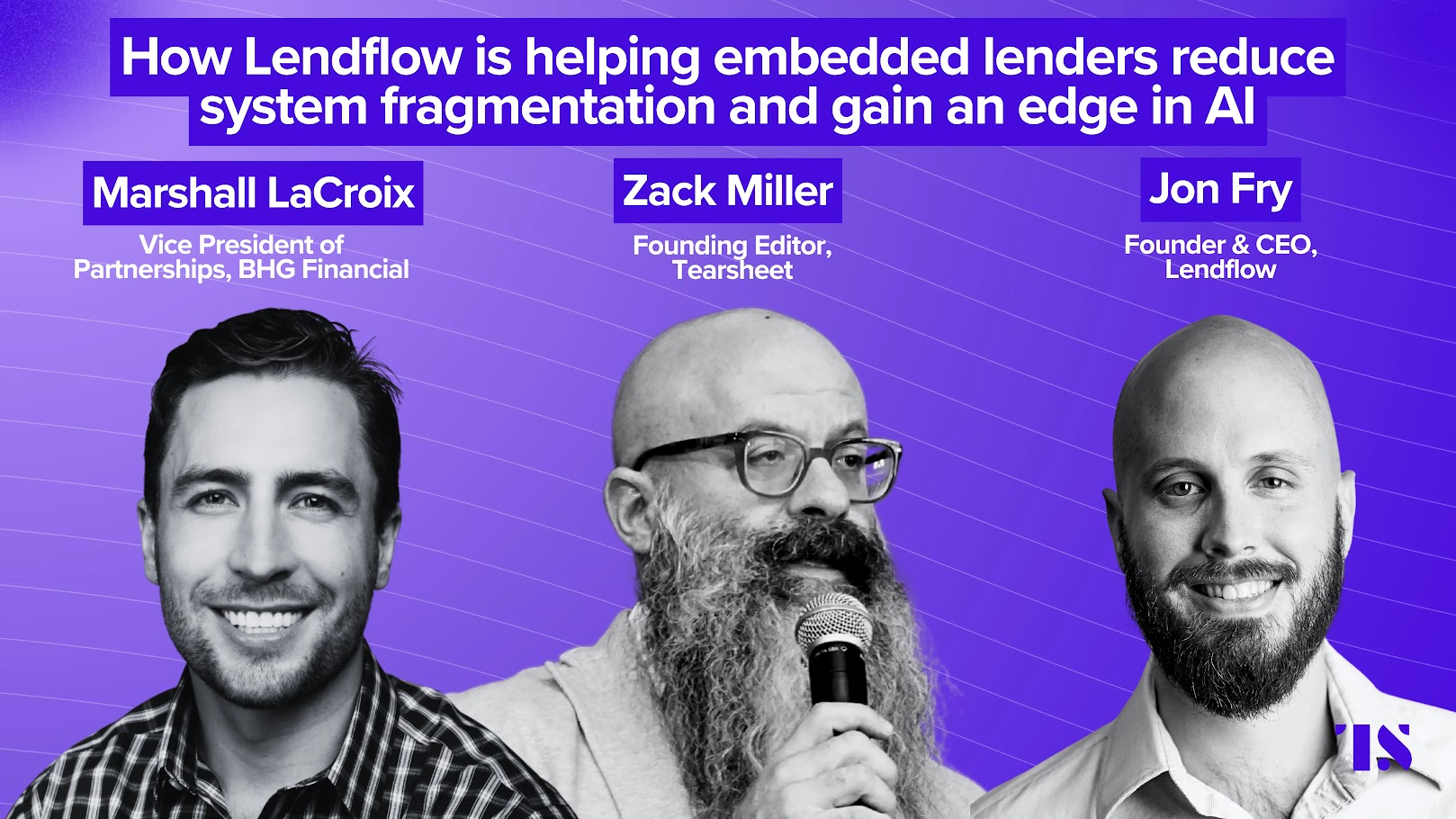
SMBs don’t have access to the same level of sophisticated lending options as consumers. There is one fundamental problem that prevents this class of product from pushing forward: lenders juggle multiple data vendors, wrestle with disconnected point solutions, and these tools lack the ability to paint a full picture of the SMB customer and their needs.
The result is an ecosystem where a majority of time is spent on solving operational blockades rather than building solutions that cater to the whole lending lifecycle of a SMB customer.
“We need something that covers everything. There can’t just be a bunch of point solutions,” says Jon Fry, founder and CEO of Lendflow.
Lendflow has tackled this challenge by building a unified embedded lending infrastructure that works with over 200 companies to streamline three critical pillars in the lending lifecycle: distribution, decisioning, and workflow automation.
The firm is not a lender today, nor are they interested in becoming an embedded lender in the future; instead it has positioned itself as the technology backbone that enables existing lenders to become embedded lenders themselves.
Lendflow’s approach is paying off for clients like BHG Financial, which uses the firm’s entire platform suite and has seen dramatic improvements in operational efficiency and approval rates through the partnership.
Listen to this podcast to learn how Lendflow is helping lenders break out of the fragmentation quagmire and access a full agentic AI toolbox that helps re-engage borrowers, as well as improve efficiencies for internal processes.
Watch the full episode
Listen to the full episode
The build-buy-partner decision
When BHG Financial, a diversified financial services firm which offers financial solutions for professionals, small businesses, and institutions decided to scale its commercial partnerships three years ago, the company faced a critical choice. The market was moving toward digitization, as consumers now want instant offers rather than lengthy traditional processes.
“We had a variety of ways we could solve that,” said Marshall LaCroix, Vice President of Partnerships at BHG Financial. “First, we could build it internally. Second, we could buy some technology that already had it done, or third, we could partner with a company.”
After six months of due diligence, BHG Financial chose Lendflow. The platform’s API-first approach allowed for easy integration, while its modular architecture meant BHG Financial could assemble components that made sense for their business.
“Once we actually popped the hood on it, we were really impressed with what we saw,” LaCroix says. “They had a module flow that allows you to pick and choose… and then architect your flow according to what made sense for your business.”
The modularity of Lendflow’s platform also helps lenders get out of the approval and prioritization quagmire.
“For a company like BHG Financial, or any lender, to do 10 integrations, that would take an enormous amount of work,” he notes. “You’d have to get it prioritized, put it into sprints, compete against other initiatives you have going on, and it’s a big commitment of time and resources.”
The impact on approval rates has been even more dramatic since launching with Lendflow. Before implementing Lendflow’s intelligence layer, BHG Financial’s underwriting approval rates were around 20%. After building their credit and underwriting models into the platform, approval rates jumped to nearly 70%, according to LaCroix.
Breaking free from the point solution box
Lendflow’s approach stems from Fry’s previous experiences building lending platforms and working with various point solutions. Individual solutions would work well for specific use cases but created friction when lenders needed to adapt or scale, always a recurring issue.
“The other problem was you would lose context and data between all of those solutions,” Fry explains. “They weren’t greater than the sum of all of their parts. They actually created drag and caused you to lose a lot of things.”
The insight became central to Lendflow’s architecture: the firm created a unified platform where different modules work together while remaining flexible enough for standalone use.
“We want these to be point solutions that are great and can be used on a standalone basis, but they also have to be part of a bigger platform, a bigger machine, and they all have to work together seamlessly,” Fry says.
How Lendflow is building an AI toolkit for lenders
Mature lenders that have already solved for fragmentation compete on efficiency and customer experience. Lendflow Automate offers over 50 of industry-specific and context-trained agentic tools that help lenders gain an edge on their competitors.
Lendflow’s Application Walkthrough Assistant, for example, autonomously reconnects with users who abandon applications, guiding them through completion and document uploads. Meanwhile, the Industry Map Agent instantly classifies businesses with NAICS and SIC codes, delivering up to 100% accuracy and eliminating manual classification bottlenecks.
Firms like BHG Financial are already seeing powerful improvements in workflows: The company had been frustrated with data providers that weren’t returning industry codes for applications, mandating manual work to classify businesses by industry type.
“When there’s no industry code returned, we actually had to assign a manual intervention where a human came in and took several steps to sort through, and then put that manually into the system,” LaCroix says.
The AI solution now provides nearly 100% coverage for industry codes while improving accuracy, eliminating work that was both time-consuming and error-prone.
“This is where AI can really come in,” Fry explains. “We can take all of this disparate data, and that’s what AI is really great at—being able to understand how we can bring it all together and map it to things like industry codes.”
The second-look marketplace advantage
Beyond improving primary lending operations, Lendflow has created new revenue opportunities for its clients through its second-look marketplace for declined applications. Traditionally, declined applicants simply represented dead ends for lenders.
“Historically, if you go and apply for a loan with a lender and you’re not approved, you’re just kind of done there,” Fry says. “The goal of the second look marketplace is to optimize for the lender and provide their customers a better experience.”
The marketplace automatically routes declined applicants to other lenders based on predefined rules, creating a better customer experience while allowing the original lender to monetize leads they paid to acquire.
For BHG Financial, this creates what LaCroix describes as “air traffic control” capabilities. “If I get that customer inside of Lendflow’s ecosystem, we can then come up with intelligent logic to figure out where this customer best fits,” he explains.
Building toward an agentic future
Looking ahead, Fry sees the unified platform approach as essential for the next phase of lending automation. As AI agents become more sophisticated, they’ll need comprehensive context about customer interactions and loan histories to provide truly intelligent service.
“If you don’t have all the context from all the prior applications, all the prior protocols, all the prior loan offers, then you can’t really build the agents to be as intelligent as you want,’ said Fry.
The company’s infrastructure-first approach, combined with comprehensive data integration, positions it to enable increasingly sophisticated automated workflows. Rather than forcing lenders to choose between point solutions or becoming technology companies themselves, Lendflow provides the foundation for lenders to focus on their core competency while leveraging modern automation capabilities, giving SMB borrowers better experiences that mirror the advancement made in consumer lending.
“SMB has been so far behind consumer, but now we’re going to be able to level the playing field,” Fry says. “Maybe SMB will even take the lead.”
Learn more about how Lendflow is helping lenders with its suite of solutions here.