


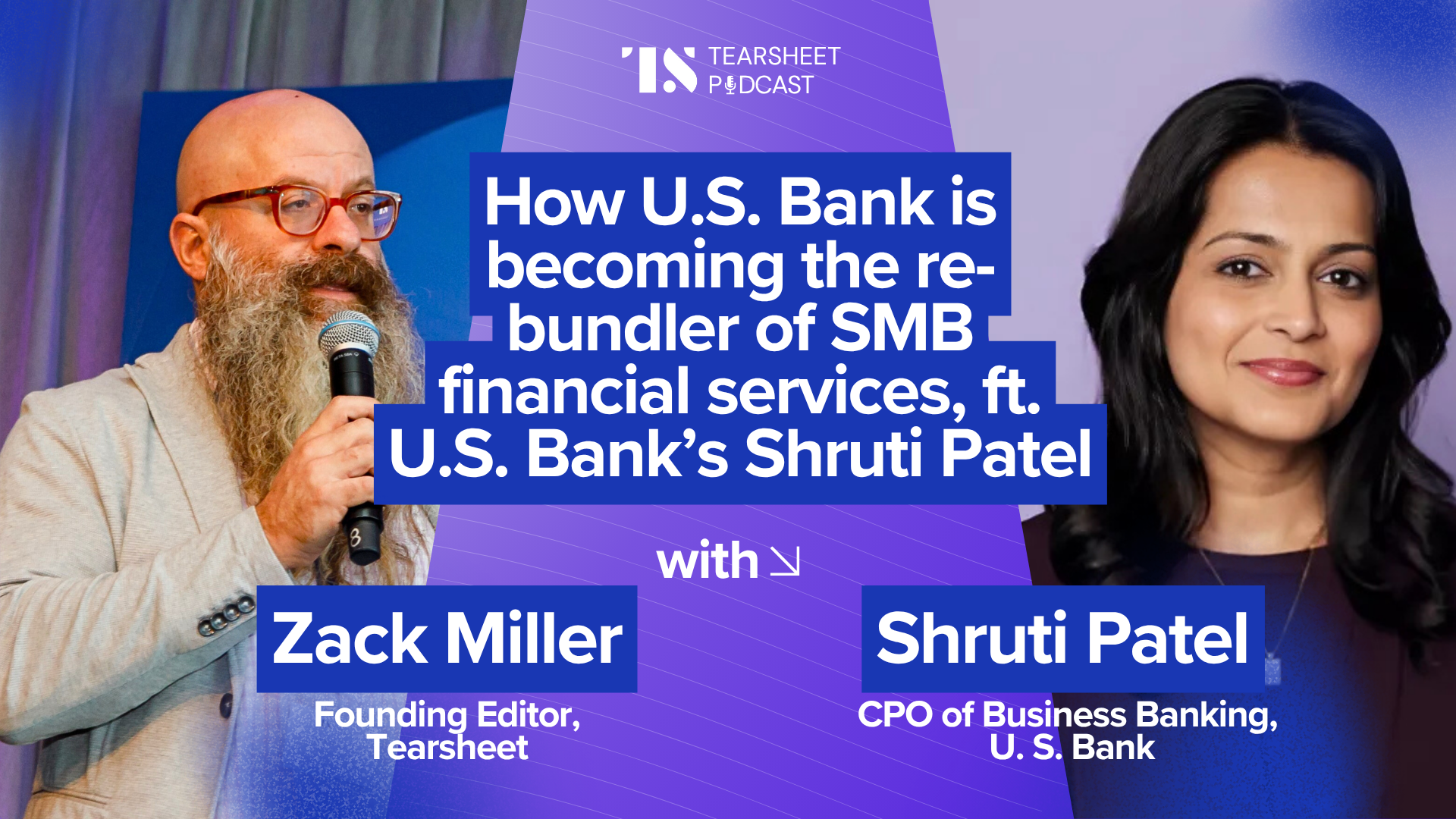
How U.S. Bank is becoming the re-bundler of SMB financial services, ft. U.S. Bank’s Shruti Patel
- SMBs are drowning in a sea of disconnected financial tools, juggling separate platforms for banking, payments, accounting, and lending. Banks can leverage their central and trusted role to help SMB owners run their businesses more efficiently.
- Listen to this podcast to learn about U.S. Bank’s Shruti Patel is helping U.S. Bank position itself as the primary re-bundlers of financial services in the post-pandemic era.
This podcast is sponsored by Gusto Embedded.
Payroll has emerged with one of the highest adoption rates across embedded finance categories, according to Tidemark Capital’s Benchmark Report. The right embedded payroll partner can help your institution be more competitive with SMBs, meet strategic goals, and reduce customer churn.
Gusto’s guide will help you assess if adding payroll is right for you, and evaluate product fit, implementation strategies, and revenue models to offer your SMB customers a sticky and profitable payroll product.
Download now
SMBs are drowning in a sea of disconnected financial tools, juggling separate platforms for banking, payments, accounting, and lending. Many business owners find themselves logging into five or six different systems just to manage their daily operations, creating inefficiency and driving up costs at a time when economic pressures are mounting.
U.S. Bank’s latest 2025 Small Business Survey shows that SMBs are looking to their FIs to collapse these various digital solutions into one integrated experience. “They are overwhelmed by the number of standalone software solutions which exist in the marketplace,” explains Shruti Patel, Chief Product Officer for the Business Banking segment at U.S. Bank.
“They would like to consolidate these so that they’re not constantly juggling with multiple tools or playing mental gymnastics, all while streamlining costs.”
The survey data, drawn from approximately 1,000 SMB owners across the country with revenues up to $25 million, shows a clear trend toward viewing banks as comprehensive financial hubs rather than simple repositories for funds. SMBs are seeking integrated solutions that combine banking, payments, and software capabilities under one roof.
Listen to this podcast to learn about U.S. Bank’s Shruti Patel is helping U.S. Bank position itself as the primary re-bundlers of financial services in the post-pandemic era.
Watch the full episode
Listen to the episode
Apple Podcasts I SoundCloud I Spotify I Google Podcasts
Economic pressures drive digital transformation
The survey identified several macroeconomic stressors affecting small businesses, including uncertainty from tariff announcements, ongoing inflation, supply chain disruptions, and expected slowdowns in consumer spending. Despite these challenges, SMB owners remain optimistic about their future prospects and are actively seeking ways to future-proof their operations.
Digital tool adoption has increased by 15% year-over-year, with businesses particularly focused on cash flow automation and workflow streamlining, according to U.S. Bank’s data. The top priorities include merchant acceptance solutions, accounts payable and receivable management, payroll integration, and digital wallet capabilities.
This digitization trend is driven by necessity. Small businesses are using technology to maintain margins and operational efficiency in an increasingly challenging economic environment. The cost pressures they face make bundled solutions from trusted financial institutions particularly attractive.
Gen AI adoption is accelerating in SMBs
The survey demonstrates a striking shift in how small businesses approach technology adoption. Generative AI has moved from an emerging trend to a standard business practice in just one year. “Almost 60% of our respondents have already started deploying Gen AI tools or plan to over the next 12 months,” Patel notes.
SMBs are deploying AI across multiple functions, including marketing and sales strategies, email automation, content creation, social media posts, back-office management, and data analysis. What’s particularly notable is the cost-conscious approach these businesses are taking. Nearly half of the SMBs using Gen AI are spending less than $50 or using free subscriptions, illustrating that the technology is both widely available and easily adaptable, according to Patel.
Banks as financial hubs and re-bundlers in SMB finance
The survey data shows a shift in how SMBs view their banking relationships. Rather than seeing banks as simple custodians of money, SMBs increasingly expect their financial institutions to serve as comprehensive operational hubs. “They see banking as their financial hub,” Patel explains. “Where they store their money, but they’re also relying on money movement capabilities for inflows, outflows, and conducting all of the important transactions.”
This evolution represents a reversal of the unbundling trend that dominated fintech innovation over the past decade. While numerous specialized solutions emerged to address specific pain points, small businesses are now seeking consolidation. The complexity and cost of managing multiple vendor relationships has become a burden that outweighs the benefits of best-in-class point solutions.
To address this demand, U.S. Bank launched Business Essentials in April, a bundled solution that combines a premium checking account with merchant acquiring capabilities through the bank’s Elavon platform. The package includes a free card reader, unlimited digital transactions, and fraud detection tools, all without annual fees. This approach simplifies the onboarding process while reducing operational costs for small businesses.
Partnerships are helping banks offer more
Rather than building everything internally, U.S. Bank has pursued a strategic approach to partnerships and acquisitions. The bank acquired Talech, a point-of-sale solution, to complement their merchant acquiring capabilities, and purchased Bento for spend management features.
“At U.S. Bank, we are very much focused on partnering with technology firms or fintechs who are doing it best,” Patel explains. The bank recently launched spend management capabilities tied to their Small Business Card, giving customers either free basic features or paid premium packages for enhanced expense tracking and employee card controls.
Banks have to prepare for a generational shift
The survey data reveals a significant demographic trend that will likely reshape the SMB landscape. Nearly 50% of SMB owners are 55 and above, indicating an impending generational transition as millennial and Gen Z entrepreneurs take over family-owned businesses.
“We’re going to experience a massive generational shift in the coming years,” Patel notes. This transition will require banks to prepare succession planning strategies while adapting to serve digitally native business owners who expect more sophisticated technology integration.
The convergence of economic pressures, technological advancement, and generational change is creating a unique moment for traditional banks to reassert their central role in SMB operations.
“That’s where the source of funds is. These are the same institutions where they trust these institutions as custodians of their money,” Patel notes, explaining why SMBs are turning to banks as comprehensive service providers.
Success will depend on the firm’s ability to bundle services effectively while maintaining the trust and reliability that small businesses value most.