




4 charts, Member Exclusive, Who owns the customer

Four charts: Why consumers rely on banks rather than retailers for post-purchase issues

  • Most customers like to go through their banks rather than knock on the retailer’s door, with 87.6% customers claiming they prefer their banks to cancel their subscriptions.
  • Due to the role bank's play in customers lives, an unspoken relationship transfer takes place post-purchase, where its the bank that starts to own the customer rather than the retailer.

close

Email a Friend

Four charts: Why consumers rely on banks rather than retailers for post-purchase issues

Even though customers go to retailers (or platforms) when they need to purchase a service or a product, when it comes to demanding a refund for a disappointing purchase or canceling a subscription, most customers like to go through their banks rather than knock on the retailer’s door. 87.6% customers claiming they prefer their banks to cancel their subscriptions, according to recent data.  

Refunds vs. Disputes

Retailers would prefer to own the customer even after the purchase is made, but if a customer is unable to receive a refund, they may dispute the charge as an alternative. 72% of customers report thinking that disputes are a valid alternative to requesting a refund from a merchant. This automatically shifts the customer relationship away from the retailer and brings it closer to the bank. From the customer’s perspective, calling the bank with which she already has a relationship with is easier than calling a retailer whose customer service may not be as accessible. 
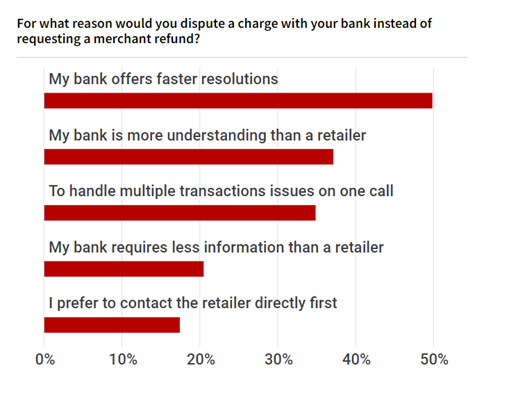
Bar chart showing why consumers dispute a charge with their bank rather than requesting a merchant refund. 
Banks offering faster resolutions, being more understanding as well as the ability to handle multiple transactions on a the same call emerge as the most popular reasons.
Source: Chargebacks911

Customers’ preference to work with banks on chargebacks is also exhibited by the fact that 70% people are at least ‘satisfied’ with the disputing process, indicating that the way banks have structured their customers’ journeys is resonating with their clients.

Here, Capital One emerges as a clear winner in customer satisfaction when it comes to disputes.


subscription wall for TS Pro

0 comments on “Four charts: Why consumers rely on banks rather than retailers for post-purchase issues”

Banking, Who owns the customer

Open Banking and its odd three-body problem

  • Both banks and fintechs are trying to shift the tide of the Open Banking 1033 regulation in their favor, with banks like Wells Fargo and PNC insisting that fintechs go through bank-backed providers like Akoya for data sharing requests. On the other hand crypto fintechs are requesting the White House to rule in the favor of a fee-free 1033 regulation.
  • Reports are coming out showing that the CFPB may be axed entirely, in this article we break down how the moves made by the government, banks, and fintechs have collectively destabilized progress on 1033.
Rabab Ahsan | November 18, 2025
Who owns the customer

What’s going on in Open Banking?

  • The Open Banking rulemaking has gone through some major rehauls, with the new administration gutting the CFPB as well as proposing changes that would require fintechs to pay for data access.
  • In this article we track how the rulemaking has evolved, what moves by major industry players are likely to play a major role in how banks and fintechs structure their relationships, and what impacts big and small players alike are likely to experience because of these changes.
Rabab Ahsan | September 30, 2025
Finance Everywhere, Who owns the customer

Apple faces regulatory troubles and payments are at the heart of it

  • Digital wallets are central to the recent lawsuit filed against Apple.
  • Although this lawsuit by the US Justice Department is new in the US, it builds upon precedent set by the EU.
Rabab Ahsan | March 26, 2024
Who owns the customer

Open Banking? More like Open Opposition: 1033 pushes fintechs, banks to take sides

  • CFPB's Director Chopra expects the new proposal on open banking to increase competition, but a survey of industry participants shows that not all players are on the same page.
  • As the end of the comment period on the proposed rules approaches, both banks and fintechs are claiming to safeguard consumer interest better than the other. 
Rabab Ahsan | December 08, 2023