


If you’re interested in investing in and learning about emerging fintech startups, join our community of current and former banking and fintech executives. You’ll be part of an exclusive group of out-of-the-box builders and investors building a community to invest in the next wave of fintech startups around the globe.
Sign up to hear about the latest developments in fintech globally, and access exclusive investor materials and opportunities.
While attention often focuses on developed markets, the most exciting fintech innovations are emerging where mobile technology, young digital-native populations, and gaps in traditional banking converge. These regions aren’t just adopting Western models – they’re creating entirely new paradigms that may eventually reshape global finance.
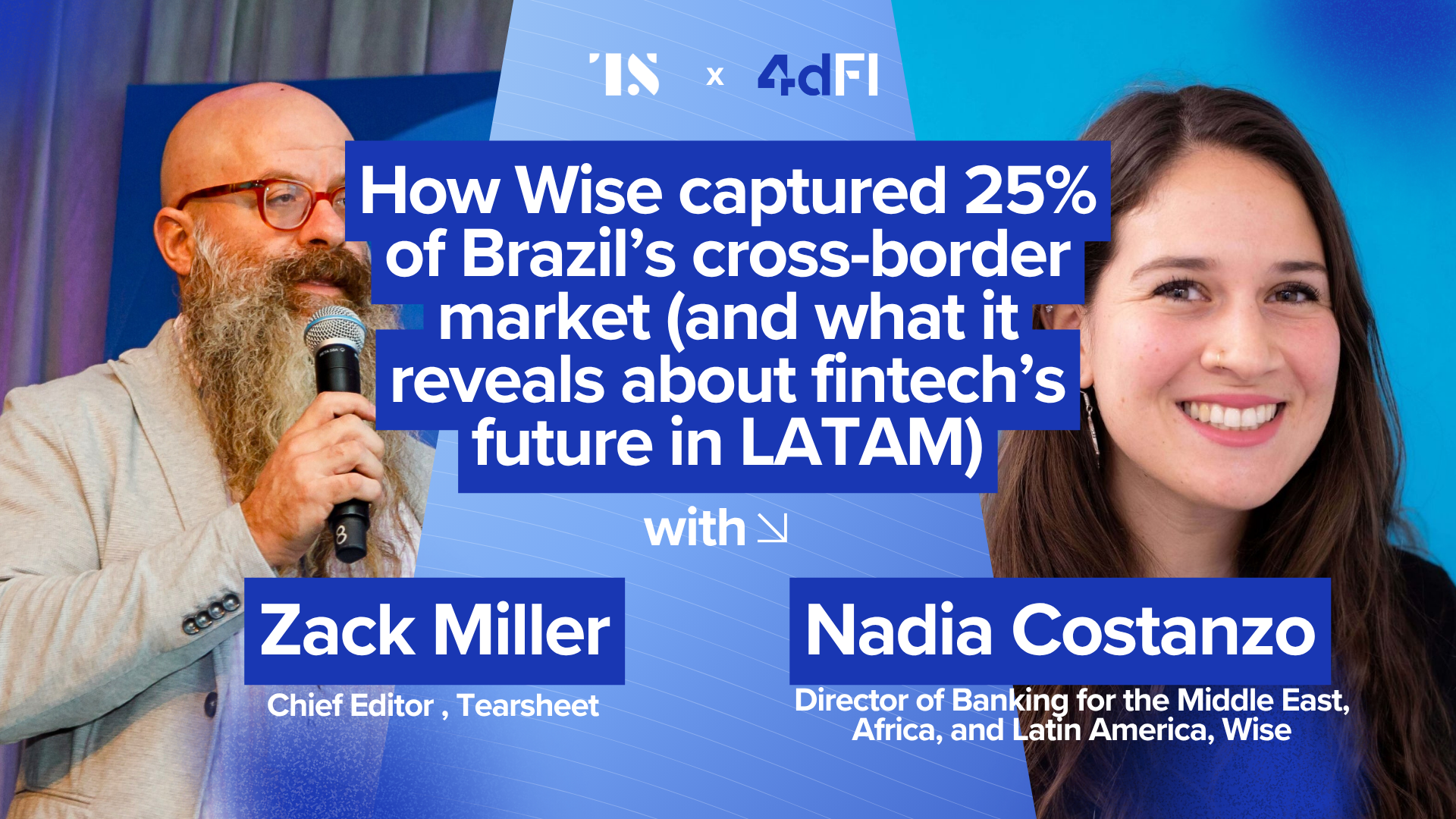
Today I’m joined by Nadia Costanzo, Director of Banking for the Middle East, Africa, and Latin America at Wise. Nadia drives Wise’s expansion across these regions by building banking relationships, securing licenses, and navigating complex regulatory frameworks.
Her background is uniquely valuable – before Wise, she worked with Kiva in Nairobi facilitating microfinance across Africa, contributed to the World Bank’s Universal Financial Access agenda, and worked directly with microfinance institutions in Paraguay.
Today, we’ll explore how fintech evolves differently across emerging markets, examine key challenges, and discuss surprising innovations where traditional banking is limited. We’ll also consider what these developments mean for established financial institutions looking to engage with these dynamic markets.
Listen to the full episode
Subscribe: Apple Podcasts I SoundCloud I Spotify
Watch the epsiode
Focused expansion in LATAM’s diverse markets
Latin America is often viewed as a unified market, but Nadia breaks this perception. Each country presents unique opportunities and regulatory conditions. Wise currently operates in Brazil, Mexico, Chile, Colombia, and Costa Rica. It prioritizes depth over breadth. “Whenever we choose a market, we want to be able to ensure that we offer our whole product offering to the customers over there,” she shares.
A key driver for Wise’s regional strategy is customer demand for cross-border services. In Brazil, Wise holds approximately 25% of the market share in cross-border transactions. “That’s because we’re offering a more convenient product. It is more transparent and less costly than traditional financial services,” Nadia explains.
Regulation and Collaboration: Navigating the fintech landscape
The regulatory landscape in Latin America is actively evolving, and Wise is growing with it. Countries like Brazil and Mexico are building open regulatory frameworks. These support the growth of fintech partnerships. They also enable new entrants to offer services independently. “You see how they’re modelling their regulatory developments on each other rather than looking only to the Global North,” says Nadia.
Wise recently secured its second payment institution license in Brazil. This granted access to PIX, the country’s instant payment system. Nadia points out that this has dramatically changed consumer expectations. “Brazilians wouldn’t understand why you wouldn’t offer PIX. It’s that embedded in everyday use now.”
Fintech and Banks: From competition to cooperation
Instead of direct competition, Nadia observes increasing collaboration between banks and fintechs. Wise depends on local financial institutions for payment execution in some markets. Those institutions rely on Wise’s international infrastructure in return. “Partnership has always been part of our model,” she says. “We offer something to them, and they offer something to us.”
This approach echoes the banking-as-a-service model. It is particularly useful for SMEs and micro merchants seeking digital tools for cash flow management. Banks are also responding by creating their fintech branches or collaborating with firms like Wise. They are doing this to reach digitally native customers more effectively.
Financial inclusion and digital accessibility
While Wise currently serves mostly banked users, the broader vision involves expanding access. “Hopefully that will change,” Nadia adds. She talks about reaching unbanked populations in LATAM. This goal is becoming more achievable as smartphone access and digital literacy grow.
The trend toward small business digitization is also contributing to greater financial inclusion. “People want extreme speed—instant payments, seamless transfers. That’s driving adoption,” she says. Wise’s presence is helping local economies, especially SMEs. It helps them to gain access to transparent cross-border tools. It bypasses traditionally complex and costly banking methods.
Building local teams, strengthening local economies
Wise’s model is deeply rooted in local presence. In Brazil alone, the company has over 200 employees. “There’s no one who knows the ins and outs of how to operate in these places like local people,” Nadia emphasizes. Local hiring ensures that Wise can navigate regulatory uncertainty. It allows them to better serve communities in line with cultural expectations.
She also highlights a growing fintech ecosystem in LATAM. It is supported by fintech associations. These allow players to share challenges and regulatory concerns collectively. This collaboration is essential to ensuring long-term growth. It ensures safety and cybersecurity within the region’s digital banking systems.
There’s more work to be done (and opportunities to grab)
LATAM’s fintech ecosystem is becoming more connected and user-focused. In response, Wise is expanding its services. They’re building strong infrastructure for cross-border payments. They are focusing on digital banking as well as support for small businesses. Wise has obtained new licenses and is forming stronger partnerships. This helps them expand their services across Latin America. They can now offer both global reach and local understanding to their customers.
As Nadia notes, the work is far from over. “I’m excited to bring our global products to customers in the region,” she says. And with 2 million cards issued in Brazil alone, the appetite for better financial solutions is clear—and still growing.
The Big Ideas
- Each LATAM market is a unique opportunity. “We tend to go deep in the markets that we operate in.” Wise targets specific countries rather than treating LATAM as a homogenous region.
- Regulation is opening doors. “You see how they’re modelling their regulatory developments on each other.” Governments are enabling fintechs through open payment systems and licensing.
- Fintechs and banks need each other. “We need partners, but increasingly, they also need Wise.” Mutual dependencies are shaping a new model of embedded finance.
- Financial inclusion starts with accessibility. “You need to have access to the banking system and a smartphone.” Current users are mostly banked, but Wise is positioning itself for broader reach.
- Local teams build better products. “No one knows the ins and outs like local people.” Hiring regional talent helps navigate unwritten rules and strengthens market fit.
Read the transcript
Wise’s Latin America strategy and market share
Latin America for us is one of the most promising markets that we see, right? We have, we have a few countries specifically where we’re already operating in quite actively. Those are Brazil, Mexico, and then we have smaller operations to Chile, Colombia, Costa Rica, Uruguay. So we’ve been, we’ve been in the region for over a decade now, I would say, or around a decade. And the evolution that we’ve seen in that market is quite remarkable, mostly because of how those markets themselves have evolved, we’ve obviously seen a huge uptake of our product in the market. So in a place like Brazil, we have approximately 25% of the market share on all cross border transactions, which is amazing. But what we’ve also seen kind of throughout that journey is the resurgence of lots of local fintechs who have been really changing the game for banks and incumbent financial institutions, and with that, also regulatory changes, which has allowed companies like wise to really, you know, change things and enter those markets and offer, like, more importantly, really impactful services to customers in those markets.
Partnership strategy vs competition
So in a place like Brazil, I would say that we were kind of one of the first ones on the ground offering a product that’s really cross border in nature. We that has changed a lot since we joined, since we went there, right? So that was probably around 2016 that’s changed a lot. What we see now is actually huge potential for partnerships, right? We see local fintechs who are hugely focused on the domestic offering, but they also want to offer international products to a population who is also changing, right? You see incomes increasing in these markets, people who are traveling a lot more, and so they’re looking to also go cross border as well. So while they’re focused maybe on the domestic products that they can offer, wise comes in to offer this more international product. So what happens is that we have these partnerships now. Partnerships has always been a part of our model. So and it exists, you know, still today, in Mexico and Brazil and Chile, all these markets that I’m referring to, we need partners, right? We need to partner with the financial institutions to execute the payments, especially where we don’t have local connections to payment systems, which is something we can hopefully talk about later, but, but that’s somewhere where we need the banks. But more and more we see the banks or new fintechs needing wise right? And so it’s a really cool two way kind of partnership, where we offer something to they offer something to us. And then on our side, we have what we call the wise platform product, where we essentially offer our rails internationally to allow for residents and customers in these countries to be able to, you know, have multi currency accounts offshore, right? Have be able to do cross border payments at a much cheaper cost and much more transparent and and that’s all through partnerships. And we’re really excited to see the likes of new bank Itau in Brazil, right? These are some of the biggest financial institutions in the region, partnering with us to use our payment rails. So it’s pretty cool.
Market entry strategy and regional differences
Absolutely, we. We tend to look at the markets by opportunity size, obviously. So what we would look at is, okay, where, what does this market offer, in terms of, Okay, is there an actual need and demand for this product? We’re very customer focused as a business, right? So we’re only gonna go and offer products that are needed by customers in a particular place. So where we see that there’s huge cross border flows, we know that there’s definitely a need for wise, right? Because the benefits that wise is offering by coming is offering a much more convenient product, right? If you’re a FinTech, and we can talk more about what that actually means in practice, but you’re offering a product that is much easier to use than traditional financial services in these markets, which are very paper heavy, right? Paperwork, bureaucracy, et cetera, very costly, lots of hidden fees in the transactions and and just, just generally difficult to use. So again, so we’re looking at markets where there’s a demand. Now we would also look at markets and in terms of, well, so before we look at the demand, then we see, okay, once we launched the market there, how much is actually used, right? So is that demand actually equal to the reality, and then we would continue to invest further. If we see that there’s huge uptake, we would also pair that with kind of our understanding of the local market, right? So in places where there’s a relatively open regulatory framework, for example, that’s that’s a country that we would probably want to go after as well, because we know that there’s the demand paired with the openness from the regulator, so that makes it relatively ripe for opportunity, right where we can go in there and operate. So I would say those are two of the main components that we would look into. We tend to go really deep in the markets that we operate in. That’s why you heard me talk about a few countries, and we’re not in every single country in Latin America directly. But that’s because whenever we choose a market, we really want to be able to ensure that we offer our whole product offering to the customers over there. And we will try our best to find a way to do that, usually it will have regulatory implications, right? So we need to understand, what are the licenses available, what are the what are the regulations that would allow us to offer all of the different products. And it doesn’t mean we would not pursue new opportunities just because we haven’t launched everything in one market, but we really tend to be pretty focused on delivering as much as possible in that market.
Regulatory evolution and cross-regional learning
So the region has, I mean, generally speaking, and you look at a lot of these markets, and they’re also looking at each other’s own developments, right to learning each other, which is really cool, right? Because you you see how they’re modeling their regulatory developments on each other more so than always looking to, you know, the global north, right? And so that’s pretty cool as a development, and they’re actually ahead of the curve in many ways, right? So I think with our two biggest markets, Mexico and Brazil, but you see this in also other markets, like Colombia has a FinTech license available, and Chile is developing a FinTech license. And then, yeah, of course, Brazil and Mexico already have these FinTech licenses. And these were both licenses that were launched in the last six, seven years, whatever it is, right, paired with the development of a local instant payment system that is open and accessible to these fintechs. So just by opening it up, you can just see the appetite that these regulators have for bringing in fintechs and fostering kind of the development of local fintechs, not just international ones, but also learning from them and and you you essentially see them wanting to understand the experiences that fintechs are having, openness in consultations on regulatory developments and, yeah, just a general openness to having a thriving FinTech environment.
Brazil’s payment system revolution: the PIX story
More specifically. I mean, I think one of the coolest things on my journey at wise, for example, has been watching how Brazil has developed, right? So, you know, 678, years ago in Brazil, you essentially had two main payment methods, and one was very much like, like, kind of like checks that we have in the US, right? Which, to me, is mind boggling that we’re still using checks. But we had that, and then we had kind of a, you know, form of, you know, just like a local payment transfers, right? So, so was I going to say? So, yeah. So over the last few years, they developed this system called pix, right? And that’s an instant payment system. And what’s incredible about that, it was launched in around 2019 and now, like, I think more than 70% of all domestic payments are operated through pix like Brazilians. They they wouldn’t understand why you wouldn’t offer pix. If you’re a financial institution locally, they will be very confused if you can’t offer pix, right and and just just the development of that you know, the usage of QR codes as well, the fact that you can self determine your account identifier on your pix on your account, right? So I can get paid. It’s almost like a Venmo, right? So you’re using a banking system that becomes almost like Venmo, but that’s in the banking system. And you can, like, example, in Brazil, you can, you can, um, you can choose up to, I think it’s up to five different pix keys, is what they call them. I think it’s five. So you can choose Email address, you can choose your phone number to be identified by. You can choose random, random keys, etc. So you can use all of this and then just get paid instantly, right? And and this is through the like a banking system, right? It’s not through some separate ecosystem, like we have with Venmo or whatever, right? So that’s just something that’s been developing over the last less than decade, right? And that’s happening in Mexico too. You see the development of spei, right? Most payments are instant through spei, which is a local instant payment system, and it’s happening more and more. It’s almost like a domino effect that we’re seeing across the region and, and, yeah, I’m super excited to see what’s going to happen next, right? Because you’re also seeing these countries develop really strong open banking, open finance frameworks and, and I just think that you’re going to see these markets becoming ahead of the curve very soon.
Incumbent banks vs fintech: collaboration over competition
I would say it’s pretty similar. And look maybe in 10 years, it’ll look very different, but in what we see now is kind of what I was saying earlier, right? We still rely FinTech, still rely on banks for the most part. Right now, of course, when there’s a more developed system where you can have access to the local payment system, you know that, which is that’s very different from the US. Right in the US, you actually need to be a bank to directly connect to the payment system, whereas in in some of these markets, Mexico, Brazil, etc, you can actually, as a FinTech connect directly, so you can essentially cut out the banks eventually. I don’t think we’re quite there yet where, you know, all fintechs can completely cut them out. You know, there’s still a component where we still need them. I also think banks are learning with the fintechs, right? And so, you know, again, they will start seeing partnerships being more valuable, similar to the partnership that we have with with those partners in Brazil, where they’re using our international rails, but even even for other purposes, right, there will be products that local fintechs will be offering that banks can’t and and banks are changing right? There’s they’re understanding more and more that fintechs aren’t just like some pesky little like startups on the side, no, they’re actually a real threat if you don’t keep up with the times. So they’re trying to develop stronger systems to kind of keep up with this, stronger APIs that you know, maybe fintechs can connect with, or that other type of clients can connect with. But they’re also developing, for example, their own fintechs, right? So you see this in Colombia is happening quite a bit, where some of the major banks ban Colombia David, they each have their own FinTech arm, essentially, where it’s completely separate from how the bank is actually operating, right? So it’s two separate entities, but they belong to the same bank, right? And so you’re seeing that banks are understanding, okay, actually, clients want a more fun way to interact with financial services, but still secure and trustworthy, right? And I think that’s where the banks, in many ways, still have an upper hand, right? Is that they’re very established institutions. Ins, they bring that trust. They’ve been there for, you know, in some cases, hundreds of years, and so customers continue to trust them. And maybe, you know, you might not see all individuals wanting to, let’s say, move all of their savings over to a FinTech, because they don’t quite trust them enough, right? So, so it might, you know, look different at some point in the future, but I would say that banks are starting to change, and this is happening at a faster and faster pace, and they’re starting to think more creatively as well, because they understand that it’s an opportunity for them.
Banking as a service and embedded finance
Yeah, it’s definitely happening more and more. There are, in some cases kind of regulations that allow it, and in some cases regulations that don’t allow it. So So I think it’s going to be something that’s going to increase, and we’ll see more of this kind of over time and again. I think it’s very similar to our wise platform product, where we’re just using each other for different types of services. And, yeah, you you’re seeing this happening a lot in these markets.
Building a fintech startup ecosystem
So I think it’s, it’s fine, right? Like, I think you, what you’re seeing is, for example, FinTech associations that are present in most of these markets, and that are developing more and more and that are gaining a lot more membership from the FinTech community. And those those associations, are essentially creating a community of fintechs who can learn from each other, you know, I think the worst thing that any FinTech could do is work completely in isolation, you know. So we do have to collaborate with these fintechs to have some form of influence on how the market is developing. So if a regulation is being issued, that makes zero sense for how a FinTech operates. There’s more power in unifying and doing it together, right? So approaching regulators together, obviously, you know, we each have our priorities and where, you know, we’re all maybe competitors to a certain extent. So, so, you know, there’s limitations, but I do think there’s, there’s a lot of value in working together on that. And then beyond that, there’s, there’s a lot of talent in these markets, right? So you it’s actually like, you know, when you go out there and you start hiring, you see not just the talent, but just this hunger for working on these kind of different, more innovative products, and people are super knowledgeable, and that ranges from anything from lawyers to engineers, right? And so I think the importance there is really building a strong local team and building a team who really understands the market. And this is more specifically speaking, from an outside perspective. You know, I think when you’re building something inside, obviously that’s, that’s kind of, yeah, it’s kind of obvious, right? Like, yeah, we’re gonna hire people who understand the market. But I think if you’re an international FinTech who’s trying to enter these markets, I mean, there’s no one who knows the ins and outs of how to operate in these places, like local people also, because there’s a lot of unwritten rules. And I think it’s maybe like that everywhere, but, but you see this a lot of them domestic in your domestic market, yeah, yeah, yeah, exactly. So there’s, like, a very clear regulatory framework, but then there’s also the murky nuances and and that is natural when you have a regulatory framework that’s developing is that there’s always going to be lack of clarity over something within that regulation. And so hiring a really strong local team, I think, is kind of what helps you really break kind of the barriers and then really be able to figure it out. And I’m proud to say that we’ve built a really, really strong local presence, at least in Brazil, we have, we have over 200 people in that office right now, and it’s consistently growing. We’re going to be hiring lots in the coming years. So so yeah, and it’s just really fun to see, wow, like all these people who are so passionate about improving the the financial services industry in their market.
Regulatory risk and adaptation
There’s definitely risk, but I think it’s, you know, it’s, it’s risk that also the regulators are aware of if I’m understanding your your your question correctly, because things can change at any moment, right? Usually there’s enough notice in advance. And once you are a licensed entity, it’s a lot easier to kind of get in the know of, or get get, you know the preliminary announcements, if we want to call them that of you know, how things might be evolving, how things might change. So I would say the regulators tend to be quite open in that now maybe the some of the risk could be more associated to, okay, you’re, you’re enabling lots of new players to come in. You know, what are other kind of risks that might arise? You know, like cyber security risks, privacy risks, et cetera. And I think globally, we’re seeing a lot more focus on that in the last few years, developments of privacy laws, et cetera. And that’s something that’s ever changing. And yeah, just something that as institutions, you need to keep, keep in mind, OK, how are you going to develop a system that’s going to be able to withstand cybersecurity threats, or that’s going to protect the privacy of your individuals. So those risks are going to continue coming up. But I would say that the the central banks and regulators have actually done a really good job about, you know, putting really stringent security protocols in place for their own payment system, right? So to ensure that whoever’s coming onto the system is very robust, and so, of course, that makes it very difficult to do, you know, the integrations that are necessary and to comply. But I think it’s a good thing, right? I think it protects consumers, which is ultimately what we want.
Customer demographics: banked vs unbanked
For us, I would say we’re targeting mostly a banked community. Hopefully that’ll change. I’ll explain why in a second. But typically, you know, to use our services, you need to have access to the banking system and and while I do think that that’s becoming easier in the region. Obviously, there’s still barriers to financial inclusion, but, but you still, you know right now, you still need to be part of the banking ecosystem. You need to have a smartphone, right, or a computer, right, because you need to be able to onboard and that is all done remotely, right? And so you need to be able to do the checks remotely. And so in that sense, you need to be kind of tech savvy to a certain extent. Like, you know, we have customers of all ages, of all ranges, right, all types and and, you know, we really focus on developing our product and doing user research to make sure that we’re developing such that everyone there’s, there’s high accessibility of it. But you know, again, I would say that most of our consumers are people who already have access to financial services. And the reason why I say like, hopefully that will change, is because, you know, I think with the kind of increase in fintechs in these markets, you’re also seeing the ability to to onboard or for customers to understand how to operate within a like more traditional or more formal, let’s say financial system, rather than a cash based system, is going to be increasing. So, you know, I think globally, there’s a trend, especially post COVID Probably. But even just in general, where cash is becoming less of King. And you know, as I was saying earlier, you’re seeing more people wanting to have that extreme speed right like instant payments right away. They want to get access to their money. They want to be able to make a payment and not think about it again. And that’s happening more and more. You’re seeing cash reducing, and typically the people who are using cash are people who are kind of the unbanked, so So yeah, hopefully that will change in the future, as, you know, as kind of people shift away from the cash based mindset. But you know, it’s still, it’s still pretty present.
Emerging opportunities: super apps and credit innovation
Yeah, it’s an interesting one. I think what you’re seeing a lot more, but this is super hard to develop, is this focus on, like, super apps. So you see that a lot in Asia, right? And I think more and more you’re seeing specific ones pop up in each domestic market, right? So an app that will allow you to offer all types of services all in one place, I would say there’s that the I would say the region tends to be very credit oriented, and that’s been kind of the success of Nubank, right? Like, you know, they’ve sold credit, and they basically have democratized credit, credit for all of Brazilians, right? That’s why you see the vast majority of Brazilians actually have an account with Nubank, and why you’re seeing success in other markets as well. It’s very impressive, right? So you Yeah, you’ll definitely see credit being a space where, you know, there’s, there’s probably a lot of innovation that can continue to take place, and that, you know there’s, there’s clearly appetite and need for that, for local consumers.
2025 goals and product expansion
I’m really excited, you know. So we got a license in Brazil last year, our second license in Brazil last year, to the payments institution license. And so for me now, I’m really excited that now we’ve done most of the work to, you know, be fully compliant and to access the local payment system. It’s like, okay, what other doors did this? Does this open for us over there? But more generally speaking, I’m just excited for us to really bring our global products to to customers in the region, right? You know, I mean, like, we’ve seen such big appetite in in a place like Brazil for our account product in in in Brazil. So globally, we have around 11 million cards issued, and I think 2 million are in Brazil, right? And we, we launched cards in Brazil, like, four years ago or something. So, so you just see, like, wow, there’s such appetite for this. And I’m really excited to bring that to the rest of the region, you know, probably starting with Mexico as one of the bigger markets. But you know, how can we bring that, then to to the other markets? So I know that there’s the demand and and more broadly, right? You know, we have, we have an assets product as well. So that’s basically where we’re allowing customers to to put money aside and in a money market fund, right, and make a bit of a return. How do we allow that for for local customers, right? Because that’s a huge, huge opportunity as well. So it’s really like, going back to what I was saying earlier, is, how do we bring our entire product offering and really build something that’s very localized and very strong for the customer base in the region? I think that’s just, you know, something that keeps me excited every day.