


The evolving role of Chief Data Officers and Generative AI in financial services with Jay Como and Glenn Kurban
- Jay Como and Glenn Kurban discuss the evolving role of Chief Data Officers and the impact of generative AI on financial services.
- Explore how AI is transforming data governance and data migration in financial services.
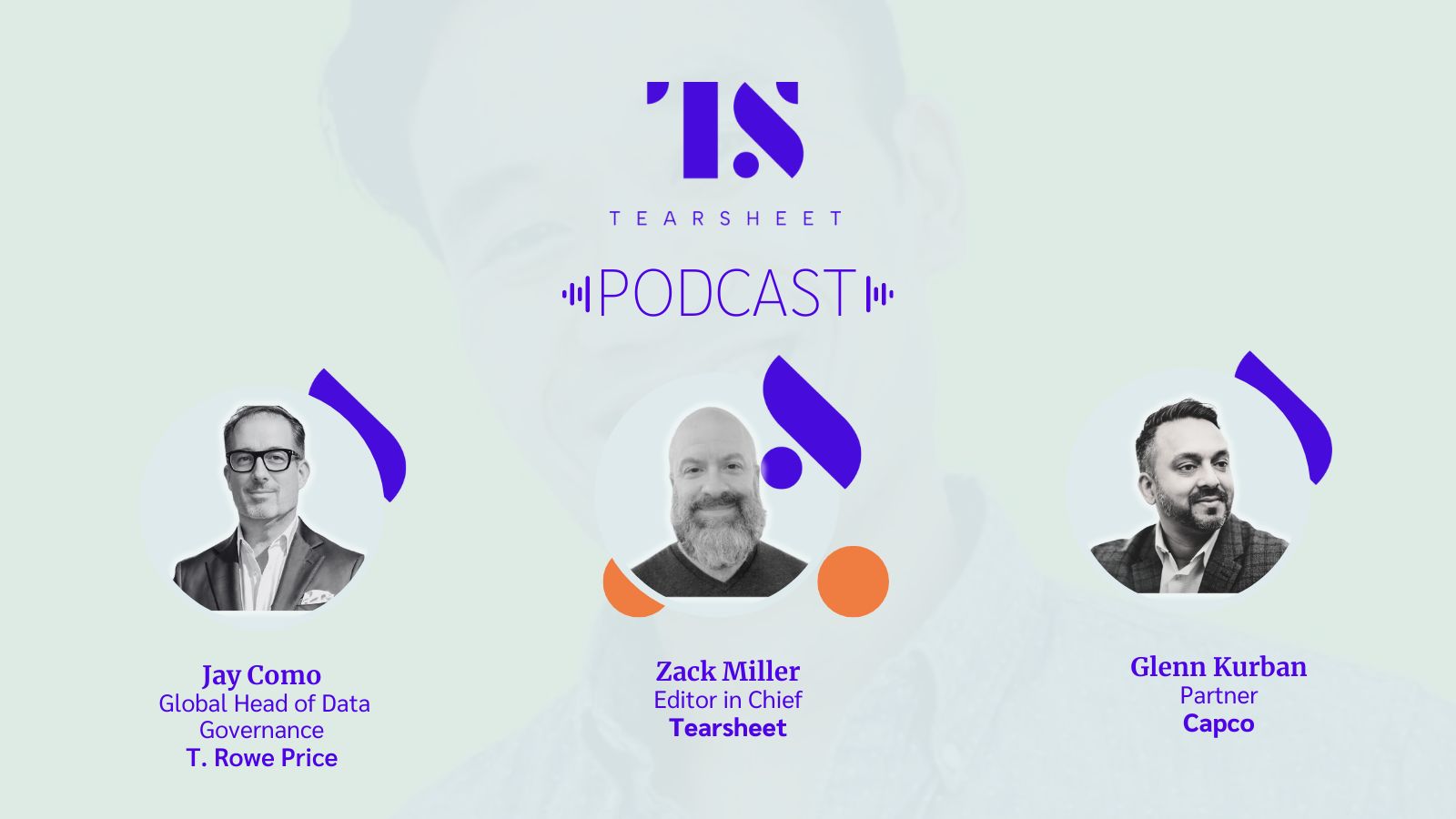
In today’s episode, we explore what it takes to build world-class data governance in financial services. Our guests are Jay Como, the global head of data governance at T. Rowe Price, and Glenn Kurban, a partner at Capco.
We talk about how generative AI and new data strategies are transforming finance, sharing insights on the transformation of the Chief Data Officer role.
The discussion also focuses on the challenges of large-scale data migrations. Jay Como reflects on the convergence of data and digital roles. He states, “What we’ve seen is there used to be kind of two shapes of CDOs. There was a chief data officer and there was a chief digital officer. And what I think in the last five years is what we’ve seen is those roles have really come together.”
Glenn Kurban adds depth to this perspective, emphasizing the shift towards more proactive data strategies. Glenn says, “You’re seeing much more being asked of CDOs in terms of, how are we moving now to an offensive posture around data? That is, how am I going to monetize this data? How can I use it to drive better decisions, reduce costs, and actually outpace our competitors?”
As our discussion unfolds, it becomes clear that the financial services industry is at a pivotal moment. AI tools and cloud technologies are reshaping traditional approaches to data governance and migration. The insights shared by Como and Kurban offer a glimpse into the future of data management in finance. AI-driven solutions and strategic data governance converge to create new opportunities and challenges.
Evolving Role of Chief Data Officer
The conversation begins with a deep dive into how the role of Chief Data Officer has transformed over the years. Jay Como explains that the position has expanded beyond its initial focus on analytics and regulatory compliance. “There’s still those separate titles, but you can’t be an effective chief data officer if you’re not fantastic at digitization and vice versa,” Como highlights the merging of data and digital roles.
Glenn Kurban says that CDOs are now expected to be more proactive. “You’re seeing much more being asked of CDOs in terms of, you know, how are we moving now to an offensive posture around data,” he says. This shift includes strategies for data monetization and improved decision-making processes.
The Impact of Generative AI on Data Governance
Generative AI is transforming data governance practices in financial services. Jay Como states: “A year ago, June, I was in a data conference and the individual speaking said, who has gen AI in their data governance programs and literally no hands with and eventually inspired me to write a white paper on it because I thought it was a great opportunity. A year later, same conference. That’s all we talked about.”
The discussion reveals how AI tools are being leveraged for various aspects of data governance, including:
- Identifying and redacting Personal Identifying Information (PII).
- Generating systematic data quality rules.
- Creating robust data lineage for compliance and copyright infringement prevention.
Data Migration Challenges and AI Solutions
The podcast delves into the challenges of large-scale data migrations. These may be particularly from legacy systems to the cloud. Glenn Kurban highlights the creative use of AI in this context. He says, “We’ve got programs with clients right now that are woefully behind because you can’t find, you know, the legacy engineers to actually tell you what the old code was doing. And so we’re having AI do it for us.”
This application of AI to reverse engineer and translate legacy code demonstrates the potential for AI tools to streamline complex migration processes. It helps to overcome historical challenges in data management.
Future of Data Management in Financial Services
Looking ahead, both experts share insights on emerging trends that will shape data management in the financial sector:
Jay Como expresses excitement about the improving capabilities of cloud providers. Glenn Kurban predicts the rise of AI-powered data catalogs and marketplaces. This makes it easier for users to find and access relevant data within organizations. Kurban also envisions a future where AI reduces the manual effort in data migrations. He states, “I think we’re moving into an era now where if we think about, you know, when we got a new phone or a new laptop 20 years ago, you’re You’re, you know, slogging data from one hard drive to the next and moving with car, you know, memory cards and so on and so forth. And now it’s very much a push-button operation.”
The Big Ideas:
- Jay Como focuses on the convergence of data and digital roles. He observes, “There used to be kind of two shapes of CDOs. There was a chief data officer and there was a chief digital officer. And what I think in the last five years is what we’ve seen is those roles have really come together.” This convergence reflects the increasing importance of data in driving digital transformation initiatives.
- Shift to offensive data strategies emphasizes the growing focus on data monetization and strategic use of data assets to drive business value. Glenn Kurban notes, “You’re seeing much more being asked of CDOs in the terms of, you know, how are we moving now to an offensive posture around data?”
- The rapid adoption of generative AI in data governance underscores the transformative potential of AI in data management. Jay Como highlights the speed of change: “A year ago, June, I was in a data conference and the individual speaking said, who has gen AI in their data governance programs and literally no hands with… A year later, same conference. That’s all we talked about.”
- The use of AI to interpret and migrate legacy systems represents a significant advancement in data migration strategies. Glenn Kurban shares an innovative application of AI: “We’ve got programs with clients right now that are woefully behind because you can’t find, you know, the legacy engineers to actually tell you what the old code was doing. And so we’re having AI do it for us.”
- The evolution of cloud services for data management has improved the capabilities of cloud providers in supporting sophisticated data management needs. Jay Como expresses optimism about cloud technologies: “I’m really, really excited now. And I’ve been a skeptic for years and now I’m, I’m kind of drinking the Kool Aid and I think it’s going to taste really good in the future.”
Listen to the full episode
Read the transcript (for TS Pro subscribers)