
Member Exclusive, Podcasts

Trust, stablecoins, and the AI margin squeeze: What McKinsey and QED’s fintech report means for banks

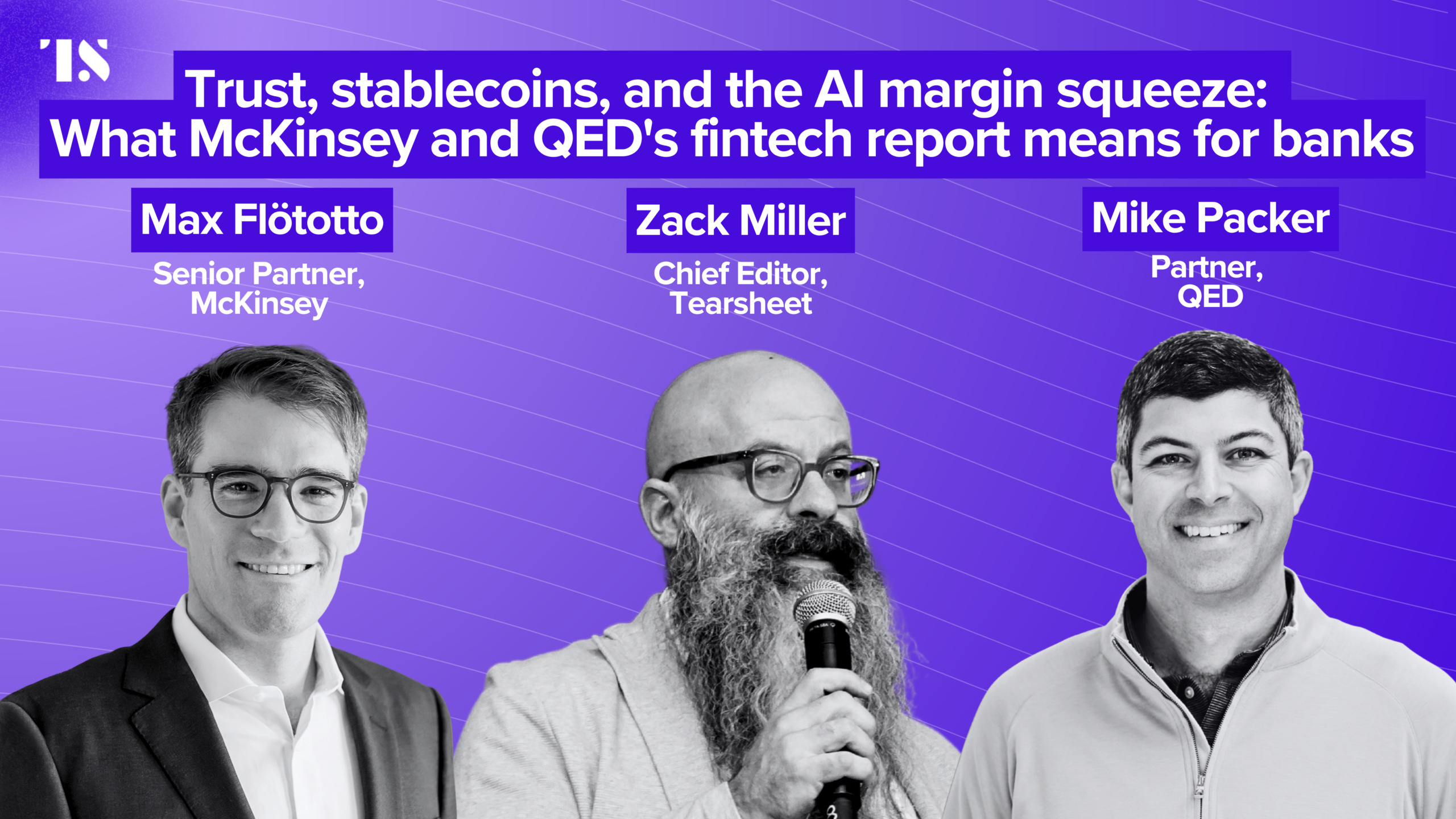
  • Max Flötotto, who leads McKinsey’s global retail banking practice, and Mike Packer, a partner at QED Investors, just co-authored a report mapping where fintech goes next — and they agree on almost everything in it.
  • We dig into why “a feature is no longer a fintech,” why only 1% of stablecoin volume is actual end-user payments, and why the simplest version of banking — deposits and loans — may be the part most at risk from AI agents.
close

Email a Friend

Trust, stablecoins, and the AI margin squeeze: What McKinsey and QED’s fintech report means for banks

Fintech just lived through four distinct ages — pioneers, growth-at-all-costs, the 2021-22 hype cycle, and the brutal reset that followed. Now we’re in a fifth: bigger, more profitable, and more disciplined than any version that came before it. Stripe’s reportedly eyeing a six-figure IPO. Fintech listings tripled investor appetite this year. And yet talk to anyone who lived through 2021, and they’ll tell you this doesn’t feel anything like that boom.

To make sense of that contradiction, I sat down with the authors of a new joint report from McKinsey and QED Investors — two firms that sit on opposite sides of the table from the fintechs they study. Max Flötotto is a senior partner at McKinsey, where he leads the firm’s global retail banking practice and coordinates its fintech work across Europe. Mike Packer is a partner at QED, leading growth-stage investing globally for a firm that’s been backing fintech since its earliest days, nearly two decades now.

We dig into the report’s biggest findings: why the simplest version of banking — collecting deposits, making loans — is structurally at risk if customers start letting their own AI agents shop for the best rate; why fintechs have, for the first time, actually overtaken incumbents on trust in Europe, even as banks ha ve closed much of the product gap; and the massive spread in how seriously banks are actually taking AI, from “talking about thinking about it” to rebuilding their entire operating model around it.

We close with each of them picking the one trend out of six in the report that they think matters most for the next decade.

Max, Mike, welcome to the show.

Watch the episode


Listen to the full podcast

Subscribe: Apple Podcasts I SoundCloud I Spotify


Top-line Takeaway: AI, stablecoins, and fintech are often discussed as separate trends. This conversation argues they’re becoming one story. McKinsey and QED Investors contend that banking’s next competitive advantage will come from rebuilding operating models around AI, earning trust that rivals incumbents, and preparing for a world where money increasingly moves in real time. The bigger risk may be AI reducing banking itself to a commodity, forcing incumbents to compete on efficiency, distribution, and customer relationships rather than products alone.


Read the whole transcript (for TS Pro subscribers)

Where the report’s authors actually agreed and disagreed

…



0 comments on “Trust, stablecoins, and the AI margin squeeze: What McKinsey and QED’s fintech report means for banks”

Blockchain and Crypto, Partner, Podcasts

At Stellar’s Meridian conference, Anthony Scaramucci tells banks to “kill the iPod in your business”

  • Anthony Scaramucci wants the 10 largest U.S. stocks on chain first, because equities will draw the attention that pulls the rest of the market along.
  • The SkyBridge founder expects SEC guidance to matter more than legislation and urges bank product leaders to retire their own best-selling products.
Rabab Ahsan | November 10, 2026
Partner Content, Podcasts

What Bluevine learned from $2 billion in mobile check deposits and a growing partner stack

  • Bluevine’s SVP and GM of checking and payments explains how the digital bank decides which jobs to take on for small business owners, and what it takes to make a partner's product feel like its own.
  • Cooper also discusses what Bluevine learned from processing more than $2 billion in mobile check deposits without branches, and why he expects most owners to choose the provider they trust over the best tool for every task.
Zack Miller | November 05, 2026
Opinion, Podcasts

If you disappeared tomorrow, would your customers care?

  • In Episode 3 of TER, Sara and Zack discuss what makes a fintech indispensable and which companies could disappear without customers noticing much of a difference.
  • Zack picks PayPal for its role in opening up online commerce. Sara names Wise and Stripe, where value comes from solving recurring problems and becoming embedded in business operations.
Sara Khairi | November 04, 2026
Partner Content, Podcasts

Banks look to close the expectation gap with data, real-time infrastructure, and human judgment

  • Executives from Regions Bank and Temenos explain how a bank’s data, real-time infrastructure, and AI controls, combined with human judgment, can close the gap between what customers expect and what banks deliver, from personalized advice to payments.
  • They discuss how Regions is applying generative AI with people in the loop, why security and convenience anchor its payments strategy, and what it takes to earn a larger share of a customer’s financial life.
Zack Miller | November 03, 2026
Partner, Podcasts

Why small businesses hesitate on AI in finance, and how BILL is addressing it

  • Small and midsize businesses want the time and cost savings AI can offer, but hesitate to hand over their financial operations, so BILL built its new AI suite around three pillars: accuracy, control, and security.
  • According to BILL’s Tara Wellington, the company’s own risk platform saw about $1.5 BILLion in potentially risky or mistaken payments last year. For her, that kind of data is what lets the risk agent flag issues at the moment they matter, helping keep operations moving smoothly.
Rabab Ahsan | October 22, 2026
More Articles